This à la carte learning provider uses woodwork to instill deeper lessons
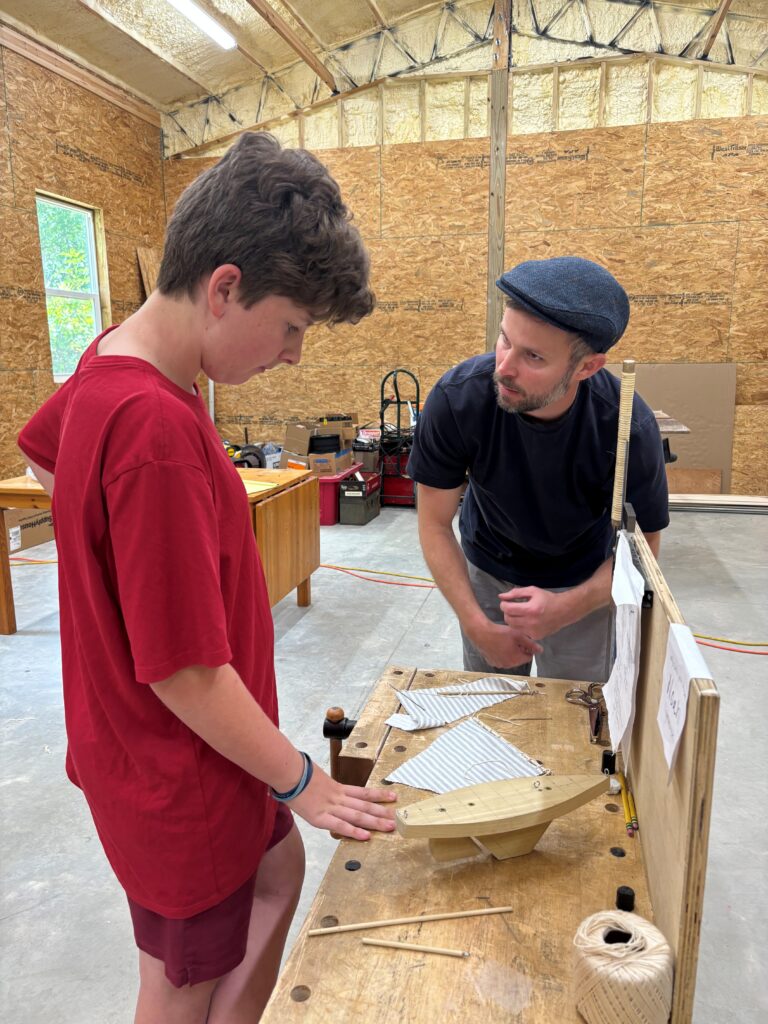
JACKSONVILLE, Fla. — Alex Knott began to gravitate toward woodworking in 2021, first as he was remodeling he and his wife’s fixer-upper, then as he was teaching his friend’s kids how to build birdhouses. His interest led him to the classic PBS show, “The Woodwright’s Shop.” He watched, rapt, when the series re-aired a segment about “sloyd,” an approach to education through woodworking that originated in Scandinavia in the late 1800s.
A year later, The Sloyd School was up and running.
Alex’s wife, Lindsey, tapped their homeschool connections for an initial cohort of 21 students. That turned out to be more than enough for Alex, then a gainfully employed mechanical engineer, to realize he wanted to do this full time.
“The kids didn’t use a lot of words, but you could see it in the smiles on their faces. They’d say, ‘This is so cool’ and ‘This is so satisfying,’ “Alex said. “And their parents would say, ‘It’s nice that they’re using their hands to make things, and they’re off the screens.’ “
Demand, too, signaled the Knotts were on to something. Today they serve 91 students across 13, 90-minute classes. The students range from 8 to 20 years old.
Alex’s full-time job now is being their instructor.
They’re “not doing it because they’re necessarily going to be a woodworker someday,” Alex said. “They’re doing it because they want to learn, and they want to make stuff, and they just love planing and sawing and the way they’re bodies move.”
“If they take satisfaction and pride in their work,” he continued, “that’s going to carry forward.”
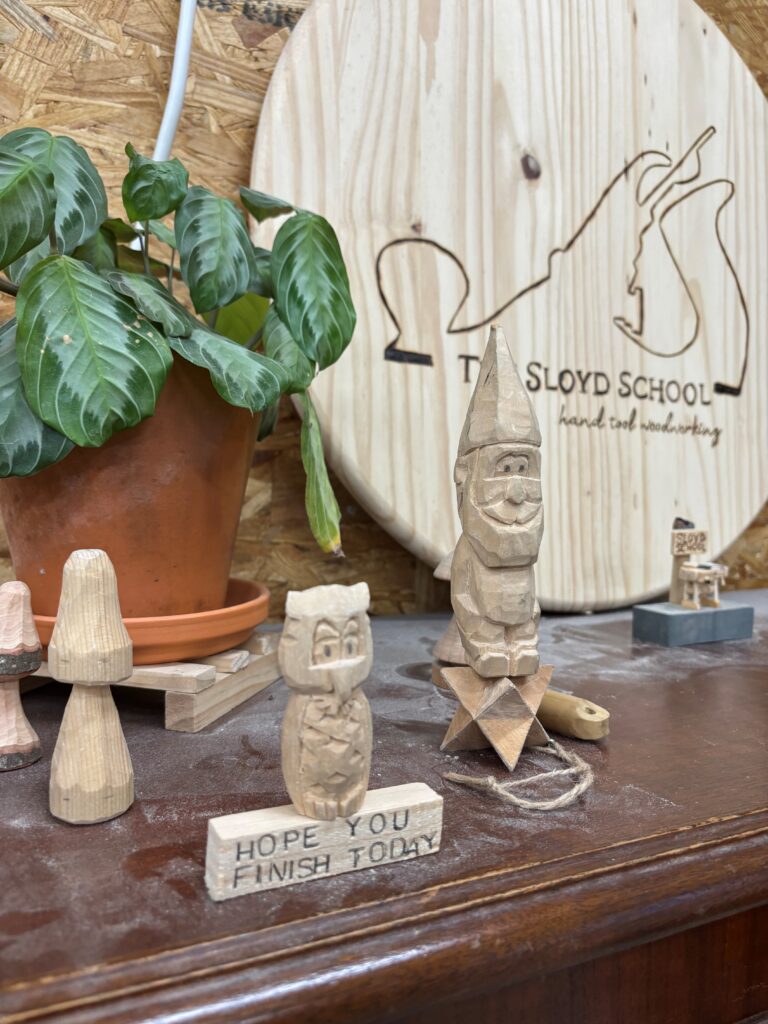
The Sloyd School is another bloom on the most diverse and dynamic education landscape in America.
In Florida, where school choice and education choice are the new normal, it’s easy to find former public school teachers behind new schools and à la carte providers. But it’s also not hard to find other talented people creating compelling options, like this marine biologist … this neuroscientist … this building contractor …
Alex worked as a design and process engineer. Lindsey taught literature in a hybrid homeschool. Now their fledgling operation is one of roughly 8,000 à la carte providers that, in just a few short years, are already part of Florida’s choice-driven education system. With 150,000+ à la carte learners and more than $1 billion in à la carte spending this year, Florida is setting the pace nationally when it comes to unbundling education.
Classes at the Sloyd School are aimed at cultivating “skilled hands and wise hearts.”
The magic happens in a spacious workshop next to the Knotts’ home. It’s sweet with the smell of sawdust and alive with the bang and scrape of wood being transformed.
Most of the students use either the Personalized Education Program scholarship or the Family Empowerment Scholarship for Students with Unique Abilities. Both are education savings accounts that can be used for parent-directed learning.
The students fashion their projects at individual work benches, arranged in two rows against a backdrop of walls made from oriented strand board and wood scraps stacked neatly on shelves. With planes and files and a variety of other hand tools, they make everything from yo-yos and hat racks to toy sailboats and crossbows.
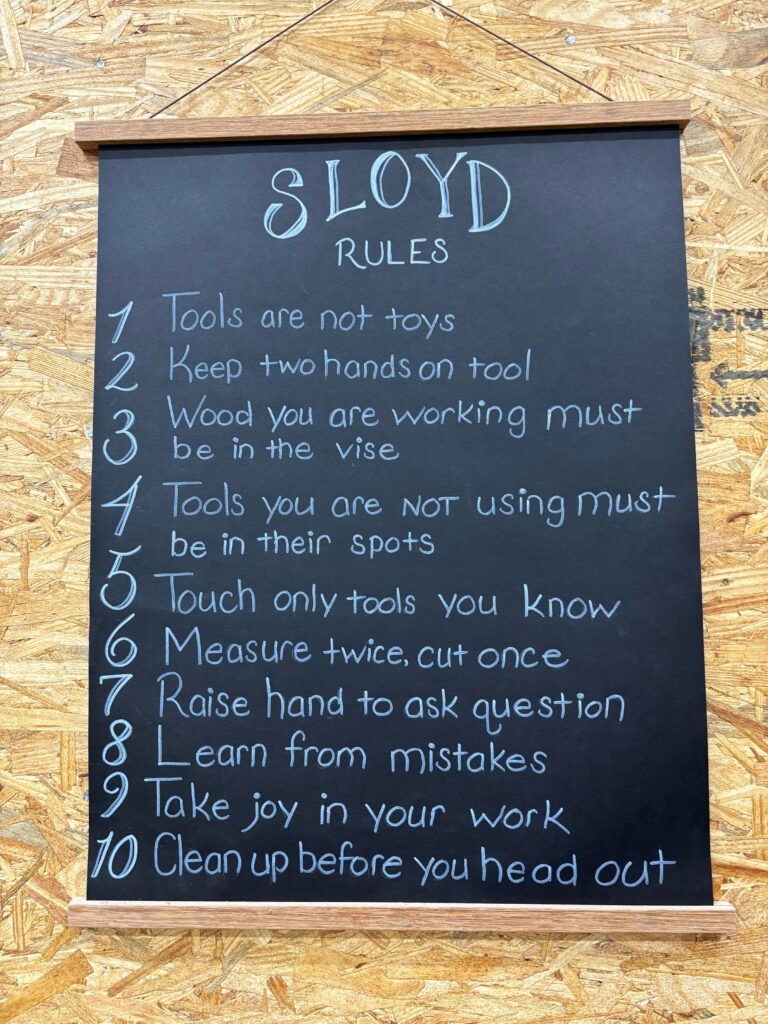
Power tools are not in the mix. The school website explains why, in terms that should be savored:
“Because hand tools function as an extension of the hand, rather than reducing the hand to a manipulator of buttons or mechanical arm, they immerse us in the full benefits of handwork; they bring the world close enough to experience its spectacular range of textures and scents and hues, to feel the difference between working with rather than against its grains and currents and patterns, to move from knowing about the world as a fact to knowing it as a friend.”
Alex scaffolds his lessons, starting with the simplest exercises, then adding new skills class by class. The students follow written instructions for their projects. But Alex offers guidance as he makes the rounds with a newsboy cap on his head and a pencil perched on his ear.
“This side looks really, really tight,” he told a student making a stool, referring to where a leg fit into the socket on the underside of the seat. “But this side’s got a little gap.”
Another student was making a helicopter-on-a-stick toy that’s propelled by spinning the stick between the palms and abruptly stopping. “I’ve found that if you make these a little thinner,” Alex said of the blades, “it’ll fly better.”
Both students listened and nodded, then got back to work.
Sloyd is about way more than the practical skill of making things with wood.
The lessons are deeper: Pride in work. Problem solving. Persistence …
Laura Flaherty enrolled her oldest son Matthew after hearing about the class in 2023. Her father, a civil engineer whose hobby was woodworking, unexpectedly died five years ago just as he had begun to teach Matthew the basics.
“We were all happy to have someone with as much skill and knowledge as Alex teach our boys,” said Laura, a former veterinarian who’s now a stay-at-home mom of four. “He’s a calming presence too. He’s so good with how he explains things.”
Matthew, now 12, likes the challenge. His favorite projects are the toughest ones, like the windmill he finally finished after breaking several blades.
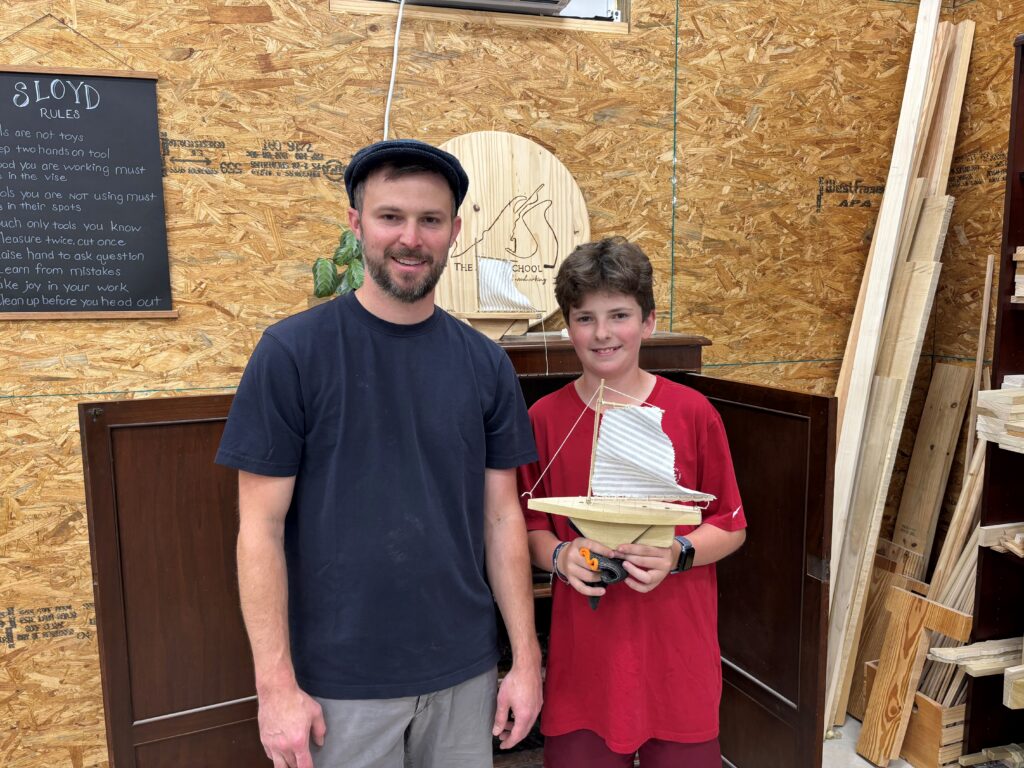
“There were several projects he told me were frustrating, but he kept at it,” Laura said. “If you make mistakes, you keep moving and eventually you’ll get it.”
The Sloyd School feels like a bridge, not only between past and present, but between different educational camps. It evokes other threads in alternative education, like the “common arts” idea that surfaces in some classical education circles, and the “handwork” from Waldorf education.
The school website nails the deeper connections.
“To shove a plane across a pine board is to work in the pattern of countless others across time and place, and to join hands with them in sustaining and shaping a facet of human culture,” it says. A few sentences later it adds, “Yet over above all this, we delight to work with wood because it is a living material, individual, intriguing, and lovely.”
Piece by piece, The Sloyd School and other à la carte providers are re-shaping public education into something more individual, intriguing, and lovely, too.
Students at the University of Austin are getting an overview of the nation’s rapidly expanding education choice movement, including its storied history in Florida.
The survey course includes guest lectures delivered by top national researchers and thought leaders, including Ron Matus, director of research and special projects at Step Up For Students. The nonprofit organization is Florida’s and the nation’s largest education choice scholarship funding organization. Matus, who spent 25 years as a journalist and eight years as the state education reporter at the Tampa Bay Times, has authored many white papers on education innovation in Florida for Step Up.
The topic of Matus’s lecture was “Freedom, Pluralism and School Choice: Competing Rationales and Contemporary Practice” and included a special emphasis on education innovation in the Sunshine State.
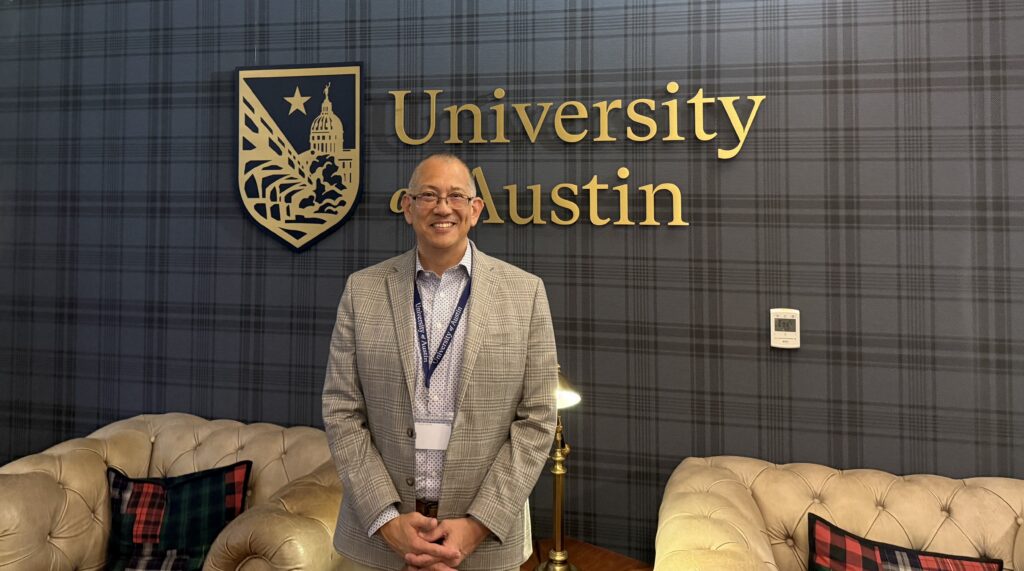
Matus shared the evolution of public education in Florida from its first model of neighborhood zoned district schools to the rise of charter schools, homeschooling, private school scholarships, educational savings accounts, a la carte learning, and even public schools now offering individual courses paid for with education savings accounts. He also described the many learning options now available, from traditional private schools to farm and forest schools to microschools and programs customized by families.
Matus also recommended reading that exposed students to various arguments in favor of education choice, including economist Milton Friedman’s 1955 groundbreaking essay “The Role of Government in Education,” which emphasized free markets and competition, and John E. Coons, a professor emeritus at the University of California, Berkeley, School of Law, who focused on dignity and fairness to all families regardless of income.
Erin Davis Valdez, executive director of the university’s Center for Education and Public Service, developed the course, which followed two K-12 practicums with rotations that began in the fall of 2025 at participating private and charter schools.
She describes the program as being in “the incubator phase,” and hopes to expand it into an academic minor.
“What we’re trying to do every term is offer a course for students interested in education policy as a career or in teaching as a career or something adjacent to it, like entrepreneurship,” she said. “But for now, students can take these as elective classes, and it builds their interest in the field.”
Valdez, who was homeschooled as a young child in Lakeland, Florida, a year before it became legal, said she chose the guest lecturers by looking for the best researchers and thought leaders in the movement. In addition to Matus, the list includes Eric Wearne, an associate professor in the Education Economics Center at Kennesaw State University and director of the Hybrid Schools Project. Wearne, who once described most traditional teacher prep programs as “thinly veiled arms of the HR department of the school district,” spoke on “Design Policy for New School Models.”
Others included Patrick Wolf, Distinguished Professor and 21st Century Chair in School Choice at the University of Arkansas, who spoke about the history of school choice policy, Jay P. Greene, senior fellow at the Defense of Freedom Institute, who spoke on the national responsibility of American universities; Katherine Bathgate, CEO and founder of SchoolForward, who spoke about economic foundations and emerging policy issues I education freedom; Mary K Wells, managing partner at Bellwether, who spoke on the last 30 years of education reform efforts; and Anita Scott, director of public policy for the Texas Home School Coalition, who spoke on connecting policy and practice in the homeschooling community.
Matthew Ladner, a senior adviser for education policy implementation at The Heritage Foundation’s Center for Education Policy and former executive editor of the NextSteps blog, is scheduled to lecture on June 1 about new directions in education choice and the question of accountability. The class will conclude June 8 with a lecture by Robert Pondiscio, a senior fellow at the American Enterprise Institute, whose topic is “The Last Days of Public School.”
TALLAHASSEE, Fla. — Parents, students, and education leaders who gathered at the Florida Capitol on Thursday had a message for the Florida Education Association, the teachers union that filed a lawsuit to end K-12 education choice scholarship programs used by nearly 540,000 children, as well as all charter schools.
Just drop it.
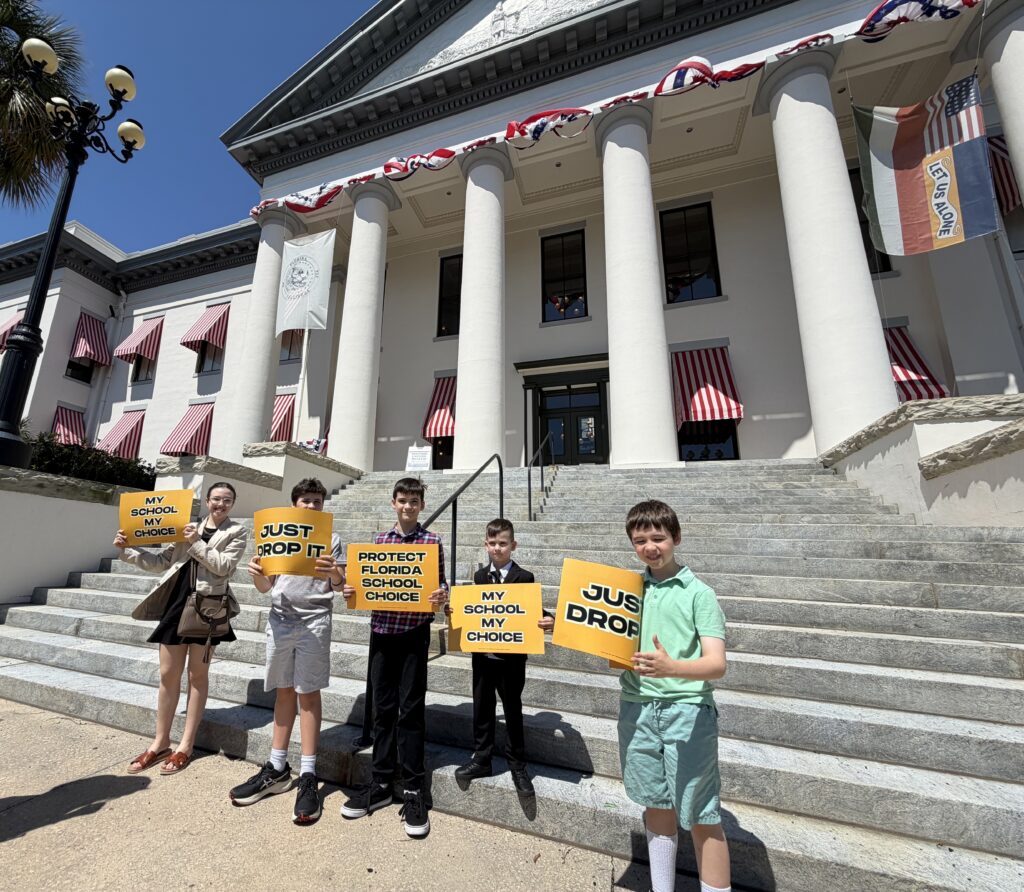
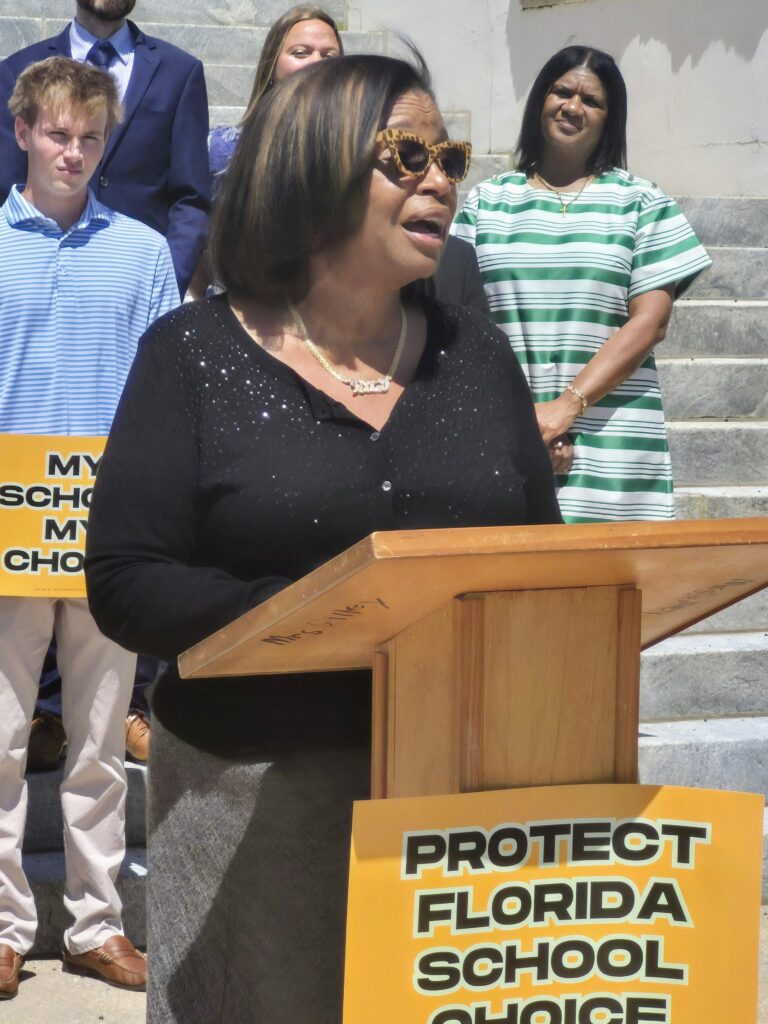
That was just one of the messages on the signs that supporters held up as they stood on the steps of the Old State Capitol building, as advocates proclaimed how education choice scholarships changed lives for the better. “My School My Choice” and “Protect Florida School Choice” could also be seen on the bright yellow signs. Former Gov. Jeb Bush’s Foundation for Florida’s Future organized the news conference. Bush launched the private school choice movement in 1999, right after he became governor.
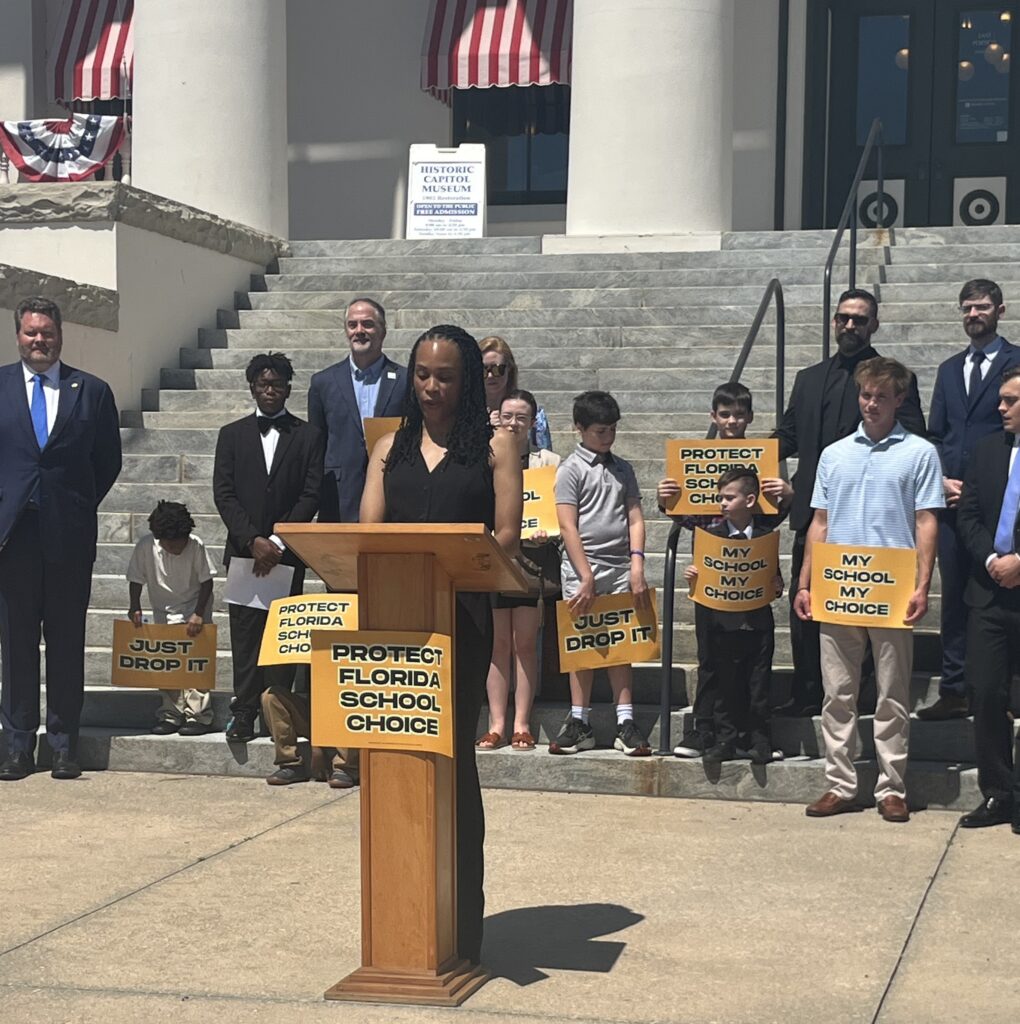
“The scholarships are VERY important to me,” said Kiteka Walker, whose son, Rashad, is in seventh grade at Dixon School for Arts & Sciences in Pensacola. After attending previous schools and homeschooling Rashad, he asked to return to school. She sent him to Dixon because it was the right fit, offering Rashad opportunities to participate in student government, the robotics team, and other enriching activities. The Florida Family Empowerment Scholarship he received made it affordable for him to attend the private school while his two younger brothers attended a private elementary school. If the lawsuit succeeds in eliminating the scholarships, Walker said she would have to homeschool him again because she could not afford private school for three children.
“Parents choose where we send our children to daycare, we choose where to go to college. Why can’t we do the same with K-12 schools?”
Rashad Walker, who traveled to the event with his family, shared how he is thriving at the school his mother chose for him.
“Dixon has been the perfect fit for me. It has a lot of culture and provides a bunch of opportunities in band, art, singing, technology, and media,” he said.
Rashad, who also participates in robotics and serves on the student council, said the school encourages him to try new things, like playing a piano that had been gathering dust at home for years.
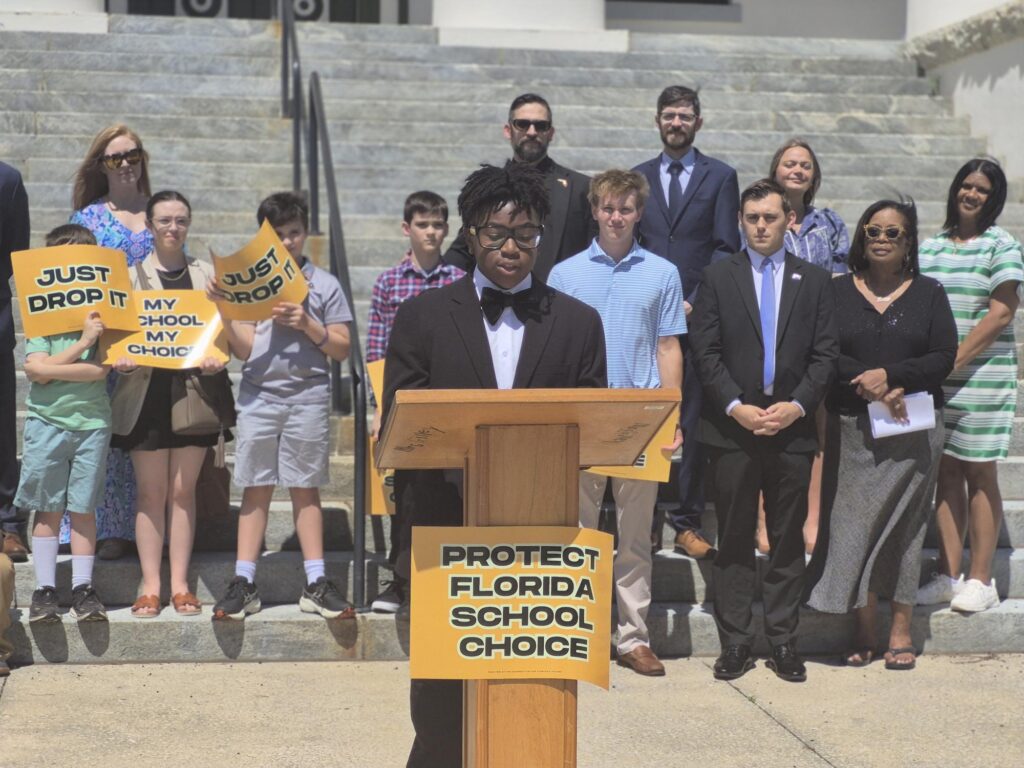
“Dixon inspired me to teach myself to play the piano. I practice every day on that piano at home. No more dust,” he said.
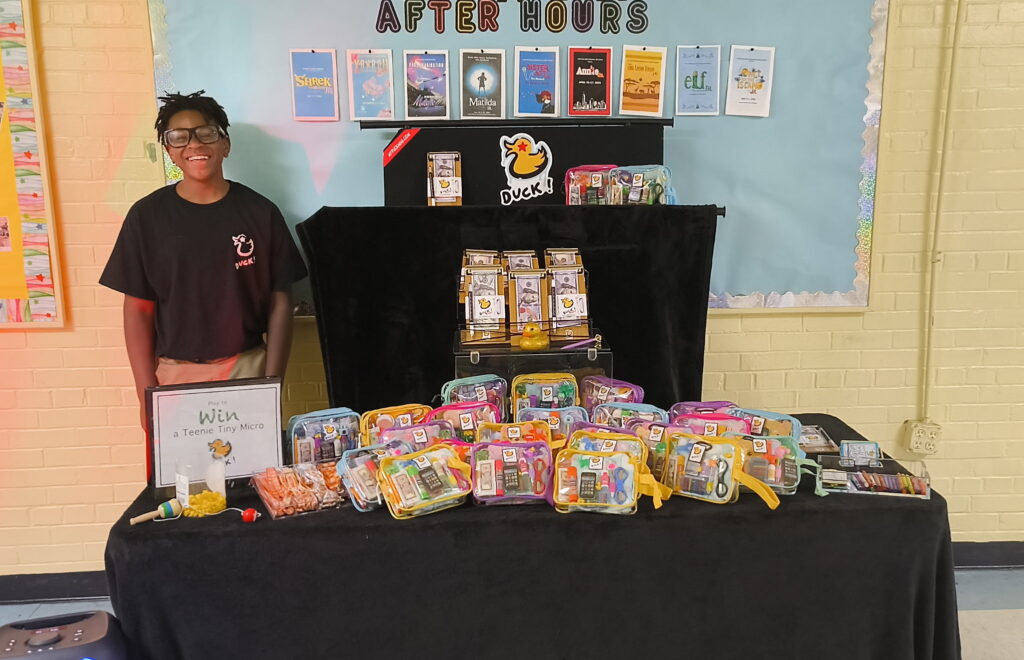
Last fall, when he was hospitalized for three weeks following knee surgery, Rashad created craft kits called DUCK bags that help kids combat boredom. He sold the kits at business fairs and is making some to donate to children’s hospitals.
None of that would have happened if it weren’t for Dixon, he said. And Dixon wouldn’t have happened if it weren’t for the scholarship.

“That’s why I don’t understand this lawsuit,” Rashad said. “Why get rid of something that is life-changing for other people? That helps them achieve better things in life?”
Rita Brown can see proof that education choice changes lives every day at Brownsville Preparatory Institute in Tallahassee, a private school she founded more than 20 years ago.
The school began as a pre-kindergarten and now serves 95 students through third grade. Brownsville is in a low-income community. Most parents can’t afford private education after their 4-year-olds complete the state-subsidized pre-kindergarten program.
The scholarships, Brown said, changed that.
It allowed her to add grades. Today, Brownsville students typically learn to read at age 3 and are adding, subtracting, writing, and learning cursive.
“We are the best school in our neighborhood,” she said. “Florida’s education choice scholarships have been a vital part of that.”
If the teachers union wins in court, Brown said, the school would lose most of its school-age children.
“That K-3 program would probably die. It would be devastating for our parents. We have all these students doing amazing things, but they would be forced to go to schools that don’t meet their needs. “
She called the lawsuit “frivolous” and “an attempt to turn back the clock.” But Florida is too embedded in education choice to return to a bygone era.
“At the end of the day, we need to be collaborative in educating all students,” Brown said.
The event inspired a lawmaker to attend to voice his opposition to the lawsuit.
State Sen. Jonathan Martin, R-Fort Myers, said empowering parents to choose the best options for their children does not take away resources from other students and makes America “the light on the hill that Ronald Reagan talked about.”
Florida’s robust scholarship programs have led the way and “will continue to make sure our light stays the brightest, not just in this country but around the world.”
You may have read or seen a story this week about the Florida Education Association, the state's largest teachers union, filing a lawsuit challenging the state’s scholarship programs and its charter schools.
Basically, the union is claiming that because private and charter schools don’t have to follow the same rules as district schools, the funding of these programs violates the Florida state constitution. The state constitution has a provision that Florida must provide a "uniform, efficient, safe, secure, and high-quality system of free public schools".
The union wants the courts to interpret this provision to mean the state can fund nothing but district-run schools, or at least make all schools that receive state funding be “uniform.”
Of course, the whole purpose of education choice is to create alternatives to traditional district schools to meet the needs of Florida’s incredibly diverse students.
Today, over 50% of taxpayer-funded K-12 students in Florida do not attend their zoned district school. In Miami Dade, our largest district, that figure is over 70%. The largest category of choice is district-run choices: magnets, open enrollment, career academies. Districts have admirably responded to competition.
In a ruling from 20 years ago, the state Supreme Court cited this uniformity provision when ruling that a small scholarship program was unconstitutional. The Harvard Law Review called the ruling an “adventurous reading and strained application” of Florida’s constitution. In contrast, a legal challenge to the tax credit scholarship was defeated in 2017.
The justices on the state Supreme Court — and their legal philosophy — is very different than even a decade ago. It would be very difficult to imagine that this court would interpret the uniformity provision in the same way as 20 years ago.
However, it will be very important to demonstrate to everyone how important education choice is.
Step Up led the coalition that defeated the lawsuit the union brought in 2014. This effort was a wonderful opportunity to show the country what choice meant to Florida families. The culmination of this effort: over 10,000 people came to Tallahassee to show their support for choice:
There will be an even stronger coalition this time around.
Rashad Walker’s big idea was born last September in room 429 of the children’s ward of Ascension Sacred Heart Pensacola hospital.
Rashad, confined to a bed for three weeks after surgery to repair his knock knees, was bored.
“Insanely bored,” said his mom, Kiteka “Tiki” Walker.
There are only so many books you can read, TV shows you can watch, and video games you can play. His mom and dad, Sean, visited daily, and so did his two younger brothers, but eventually, they ran out of things to talk about.
If only there was a way to occupy your hands and your mind, to unlock the imagination. Get the creative juices flowing.
Rashad, 13, had an idea. It would require construction paper, glue, and scissors.
And imagination.
The result is DUCK, an acronym that stands for Different Unlimited Craft Kits.
“It’s kind of like an emergency kit, but it’s crafty,” he said.
Rashad is a seventh-grader at the Dixon School of Arts and Sciences in his hometown of Pensacola. He attends the K-8 private school with the help of a Florida educational choice scholarship, managed by Step Up For Students.
DUCK debuted in October at Dixon’s business fair. From there, Rashad was invited to sell his kits at the Pensacola Children’s Fair. The kits are priced at $25. Between the two fairs, Rashad made $600.
And he’s just getting started.
“I see myself as an entrepreneur, helping others, helping my generation, or the next generation,” he said. “I want to create more solutions for boredom.”
This is Rashad’s first year at Dixon, a school his mom and grandmother attended when it was still part of the Escambia County School District. Tiki was intrigued by the changes after it became a private school. She liked the arts and science components. The robotic and coding classes. The student-maintained garden.
“They seem to be well in tune to get more out of the students,” Tiki said. “Rashad wasn’t doing any of that yet, and I wanted him to.
“I felt like it was the school for him, and it’s been a wonderful experience. He just blossomed.”
Despite missing three weeks in the fall because of his hospital stay, Rashad quickly made an impact. He was elected to the student government and participates in the school’s music and dance programs.
“He looks for opportunities, which is really neat,” Dixon Principal Dr. Kevin Kovacs said. “He looks at the things we offer and just goes for it.
“It’s a pleasure to see his smile and warmth and drive to get involved. It’s hard to be a new student. It’s hard to be a middle school student. But Rashad fit in, and he fit in right away.”
Rashad had to deliver a speech to the middle school when he ran for the student government. He told of how he wanted to help them and how they could help bring out the leader in him.
He had never been a member of the student government at any of his previous schools.
“I really want to help others,” he said. “I want to try new things.”
Those desires worked in tandem to bring about DUCK.
But first, understand this: Rashad has experience as an entrepreneur.
When he was 3, he received a kit that allowed him to engrave names and words into crayons. His parents set up a table for him at a flea market. Tiki said he made $50.
Two years ago, he took some of his mom’s excess supply of Easter-themed art supplies, made baskets, and sold them from the trunk of Tiki’s car, first on the road in front of his grandmother’s house, then on a busier road.
He made $200.
Rashad entered the hospital in early October for guided growth surgery, a procedure where a plate and screws were inserted into each knee. There were complications that required a longer-than-expected stay.
“And boy, he found out what true boredom is,” Tiki said. “I even found out that there was a different level of boredom than you can even imagine.”
Tiki has a container at home of what she called “junk.” It’s filled with feathers, beads, fake snow, old socks, and shirts.
“You name it, we've got it,” Tiki said. “We cut them up and turn them into something.”
What if the junk container were a small box, and the box was filled with items that could keep someone’s hands and mind busy?
Well, you’d have DUCK.
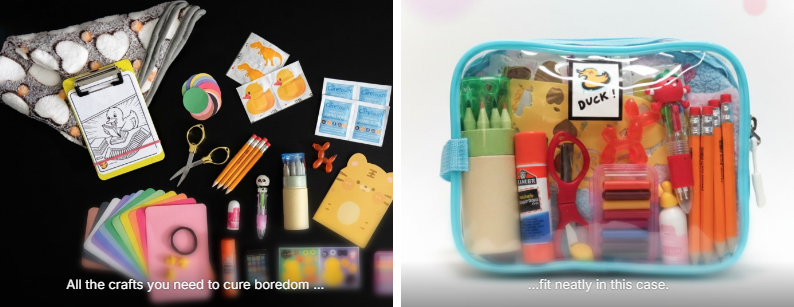
Each kit comes with construction paper that is 4 inches by 6 inches, a small pair of scissors that fold up, a miniature clipboard to hold miniature worksheets and coloring sheets, small crayons, colored pencils that come in a case, and glue.
There are Band-Aids, hand wipes, a hairclip, and lip balm.
The kit also contains a small blanket that can be used as a drop-cloth of sorts, so the items don’t roll away if the user is in a hospital bed or on a plane.
Rashad Walker’s big idea was born last September in room 429 of the children’s ward of Ascension Sacred Heart Pensacola hospital.
Rashad, confined to a bed for three weeks after surgery to repair his knock knees, was bored.
“Insanely bored,” said his mom, Kiteka “Tiki” Walker.
There are only so many books you can read, TV shows you can watch, and video games you can play. His mom and dad, Sean, visited daily, and so did his two younger brothers, but eventually, they ran out of things to talk about.
If only there was a way to occupy your hands and your mind, to unlock the imagination. Get the creative juices flowing.
Rashad, 13, had an idea. It would require construction paper, glue, and scissors.
And imagination.
The result is DUCK, an acronym that stands for Different Unlimited Craft Kits.
“It’s kind of like an emergency kit, but it’s crafty,” he said.
Rashad is a seventh-grader at the Dixon School of Arts and Sciences in his hometown of Pensacola. He attends the K-8 private school with the help of a Florida educational choice scholarship, managed by Step Up For Students.
DUCK debuted in October at Dixon’s business fair. From there, Rashad was invited to sell his kits at the Pensacola Children’s Fair. The kits are priced at $25. Between the two fairs, Rashad made $600.
And he’s just getting started.
“I see myself as an entrepreneur, helping others, helping my generation, or the next generation,” he said. “I want to create more solutions for boredom.”
This is Rashad’s first year at Dixon, a school his mom and grandmother attended when it was still part of the Escambia County School District. Tiki was intrigued by the changes after it became a private school. She liked the arts and science components. The robotic and coding classes. The student-maintained garden.
“They seem to be well in tune to get more out of the students,” Tiki said. “Rashad wasn’t doing any of that yet, and I wanted him to.
“I felt like it was the school for him, and it’s been a wonderful experience. He just blossomed.”
Despite missing three weeks in the fall because of his hospital stay, Rashad quickly made an impact. He was elected to the student government and participates in the school’s music and dance programs.
“He looks for opportunities, which is really neat,” Dixon Principal Dr. Kevin Kovacs said. “He looks at the things we offer and just goes for it.
“It’s a pleasure to see his smile and warmth and drive to get involved. It’s hard to be a new student. It’s hard to be a middle school student. But Rashad fit in, and he fit in right away.”
Rashad had to deliver a speech to the middle school when he ran for the student government. He told of how he wanted to help them and how they could help bring out the leader in him.
He had never been a member of the student government at any of his previous schools.
“I really want to help others,” he said. “I want to try new things.”
Those desires worked in tandem to bring about DUCK.
But first, understand this: Rashad has experience as an entrepreneur.
When he was 3, he received a kit that allowed him to engrave names and words into crayons. His parents set up a table for him at a flea market. Tiki said he made $50.
Two years ago, he took some of his mom’s excess supply of Easter-themed art supplies, made baskets, and sold them from the trunk of Tiki’s car, first on the road in front of his grandmother’s house, then on a busier road.
He made $200.
Rashad entered the hospital in early October for guided growth surgery, a procedure where a plate and screws were inserted into each knee. There were complications that required a longer-than-expected stay.
“And boy, he found out what true boredom is,” Tiki said. “I even found out that there was a different level of boredom than you can even imagine.”
Tiki has a container at home of what she called “junk.” It’s filled with feathers, beads, fake snow, old socks, and shirts.
“You name it, we've got it,” Tiki said. “We cut them up and turn them into something.”
What if the junk container were a small box, and the box was filled with items that could keep someone’s hands and mind busy?
Well, you’d have DUCK.
Each kit comes with construction paper that is 4 inches by 6 inches, a small pair of scissors that fold up, a miniature clipboard to hold miniature worksheets and coloring sheets, small crayons, colored pencils that come in a case, and glue.
There are Band-Aids, hand wipes, a hairclip, and lip balm.
The kit also contains a small blanket that can be used as a drop-cloth of sorts, so the items don’t roll away if the user is in a hospital bed or on a plane.
All of the items are purchased on Amazon and modified by Rashad and his mom.
The idea behind the smaller-sized contents is that everything can fit on an overbed table used in hospitals, a snack tray on a plane, or the backseat of a car.
“Trust me,” Rashad said, “you can have a lot of fun with this.”
Rashad wants to grow the product by adding crossword puzzles and word games. He’d like to make an instructional video for kids who aren’t used to arts and crafts. He would like to someday present DUCK to the investors of the TV show Shark Tank in the hopes of receiving financial backing.
Some of Rashad’s customers at the Pensacola Children’s Fair didn’t buy the kits for themselves. Rashad said they asked if they could donate them to the patients in the children’s ward at the hospital.
He thought that was a great idea.
“Because,” Rashad said, “I want to solve that problem where other kids won't have to feel that boredom while they're in the hospital.”
Editor's note: This post is shared by our sister organization, Step Up, Step Further Scholarship Fund, a new federal scholarship program launching in 2027 to support students in public and private schools.
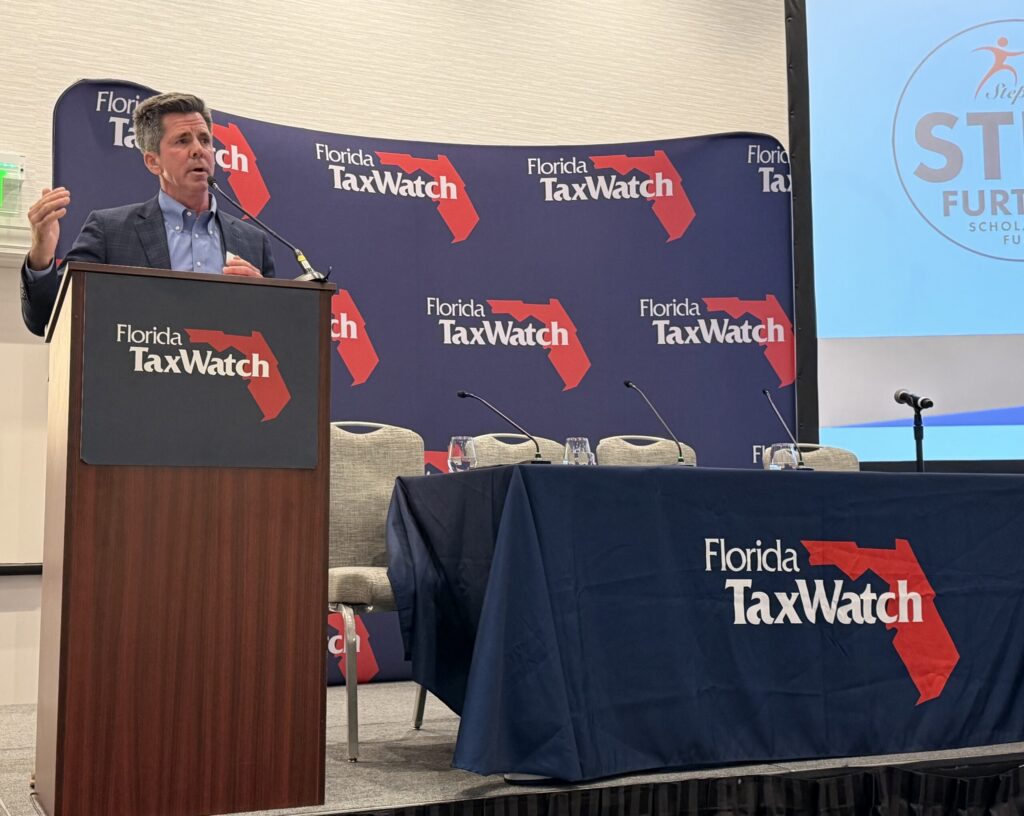
At Florida TaxWatch’s policy forum, Step Up For Students Founder and Chairman John Kirtley shared how the new federal Education Freedom Tax Credit will help expand opportunity for K-12 low income district school students. “The income levels that the federal law allows are, in my opinion, pretty generous,” Kirtley said. “They’re 300% of the area’s median income, which in Florida will be anywhere up to probably $250,000. However, a scholarship organization can set its own income limits.”
The new tax credit will continue to allow Step Up, Step Further, sister organization of Step Up For Students, to focus on serving the lowest-income students in Florida.
Kirtley went on to illustrate how Florida school districts have seen a dramatic increase in graduation rates since 1981, when the graduation rate hovered under 50%. He noted that a statewide push for greater accountability in schools and grading them has resulted in a graduation rate of over 90%.
“That’s an incredible improvement, and we should all be very proud of that. A great example of how the districts have responded is very close to home for me. My high school, Fort Lauderdale High School, when schools were first graded back in 1999, my high school was an ‘F.’ And it was an ‘F’ for several years,” Kirtley said.
Read the full article at Florida Politics > https://floridapolitics.com/archives/791109-john-kirtley-makes-case-for-choice-encouraging-use-of-education-savings-accounts/
Less than two months after the application season began, record-breaking interest continues with more than 500,000 students applying for Florida’s K-12 education choice scholarships.
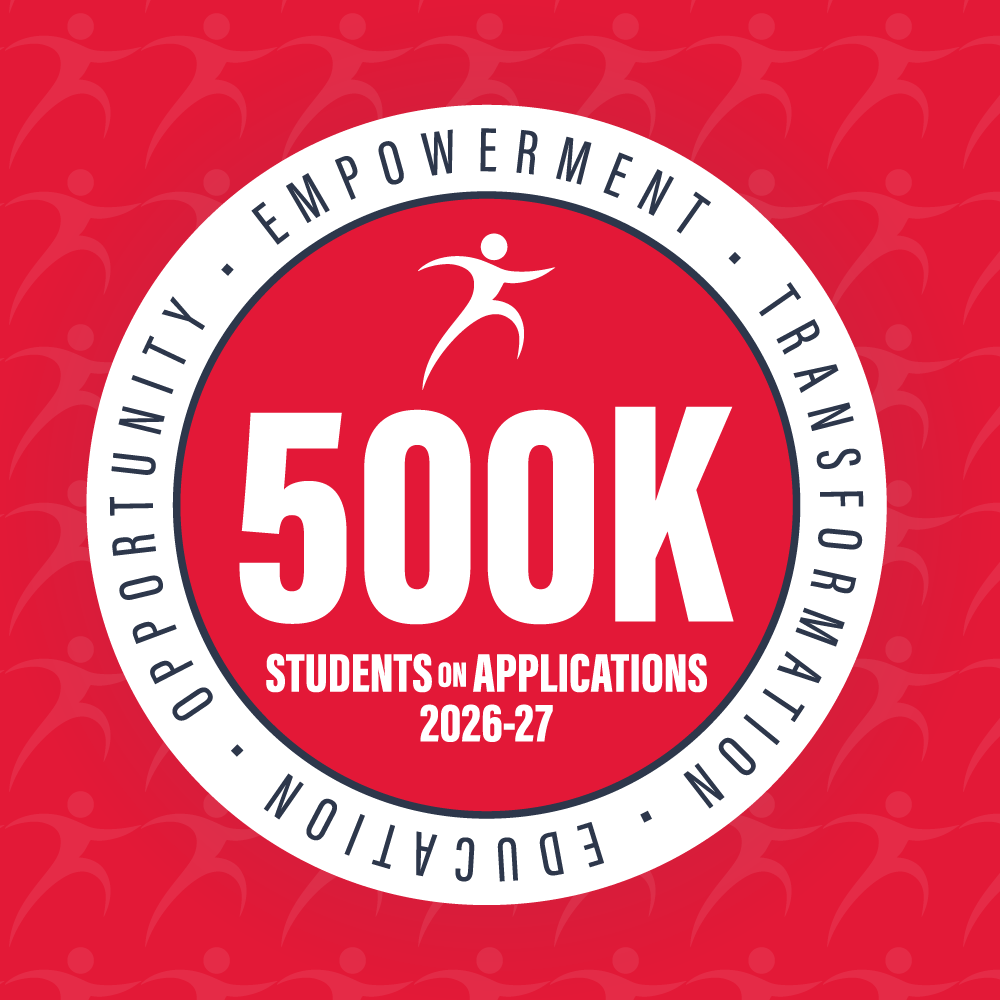
Step Up For Students, the nonprofit organization that administers 98% of the state’s scholarships, opened applications for the 2026-27 school year on Feb. 1. A record 200,000 applied during the first three days.
By midday Feb. 10, a total of 300,106 students had applied for scholarships, which represents an 11.7% increase over the same 10-day period last year. By Friday morning, Feb. 27, a total of 401,507 students had applied.
Applications reached the 500,000 mark on March 30, which was 22 days earlier than in 2025.
Step Up For Students CEO Gretchen Schoenhaar said last week that the organization’s team and systems were ready for the surge of interest. Step Up’s technology systems processed 15% more applications on the first day this year than at the same time last year. Of the families who called for assistance, more than 90% reported being “satisfied” or “very satisfied” with the support they received.
“Florida continues to set the pace for the nation in education choice,” Schoenhaar said. “Families have become accustomed to seeking options in their children’s education and Step Up For Students is proud to support them every step of the way.”
Since its inception in 2002, Step Up has administered more than 3 million scholarships.
During the 25-26 school year, more than 525,000 students have been funded on Florida’s K-12 scholarship programs to access learning options of their choice. If these students were counted as a single school district, it would be the largest in the state and the third largest in the country. That makes Florida the national leader in education options.
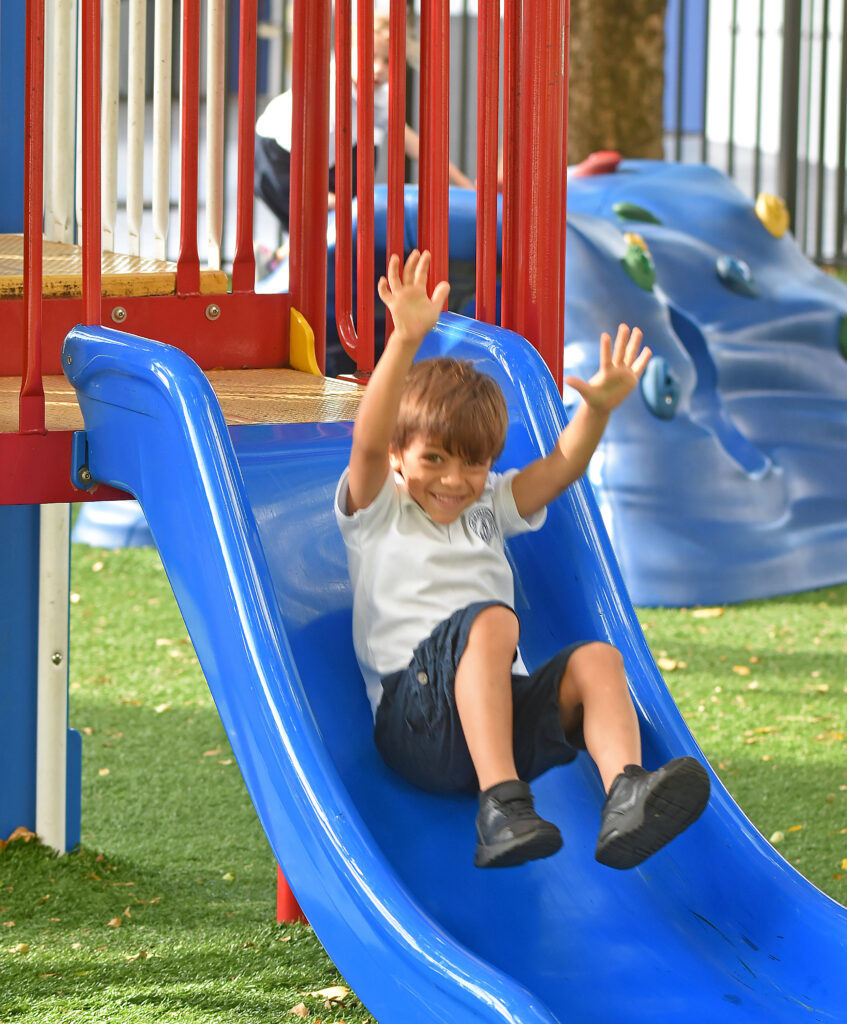
However, not all families end up using their scholarships. Top reasons include: Their preferred private school lacked capacity; they were on a waitlist for a charter school and were accepted; they chose to attend a district school, etc.
Step Up is on track this school year to have 2.75 million transactions on MyScholarShop, its online marketplace, for over $425 million. Step Up is on track to process over 4.5 million reimbursement requests this year, worth over $595 million, four times what it had just two years ago.
Current scholarship families have until April 30 to renew their scholarships for the next school year. All families who want a PEP scholarship must also apply by April 30.
Applications and more details are available here.
We will continue to update the numbers in this post until applications close.
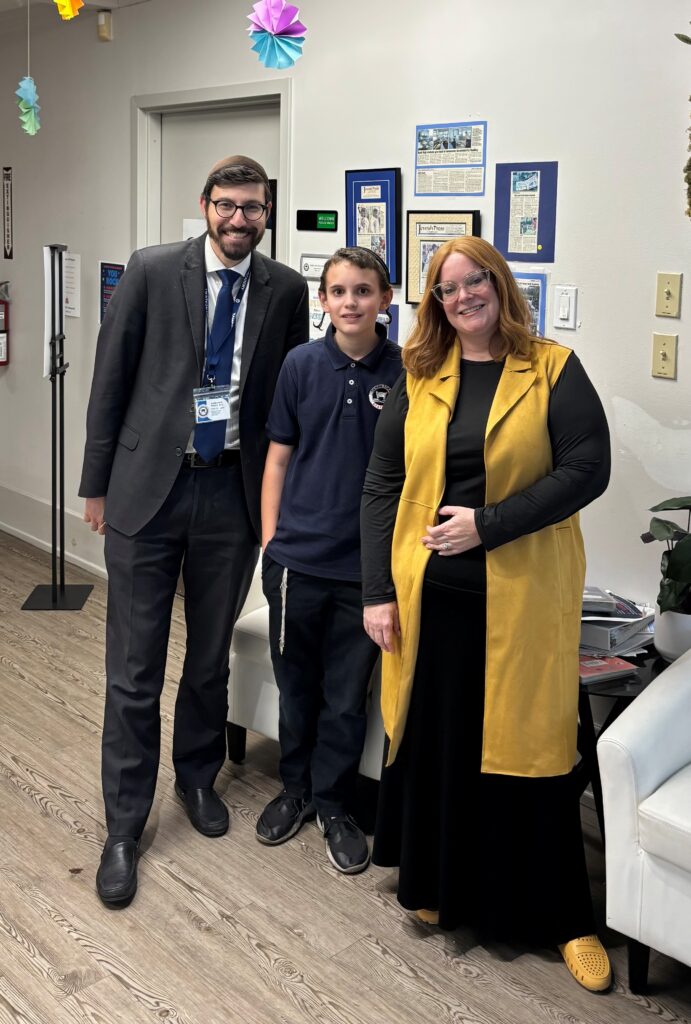
TAMPA, Fla. – Shuli Goldenberg didn’t need to see Tampa Torah Academy to know it would be just right for her now 12-year-old son, Yanky. After talking on the phone with a rabbi who co-founded the school, she was sure it was “perfection.”
Still, she had persuaded her husband, Yisroel Aron, to move 1,200 miles from the Catskills in upstate New York; to leave family behind; to start life anew in the Sunshine State – all for a school they’d never seen.
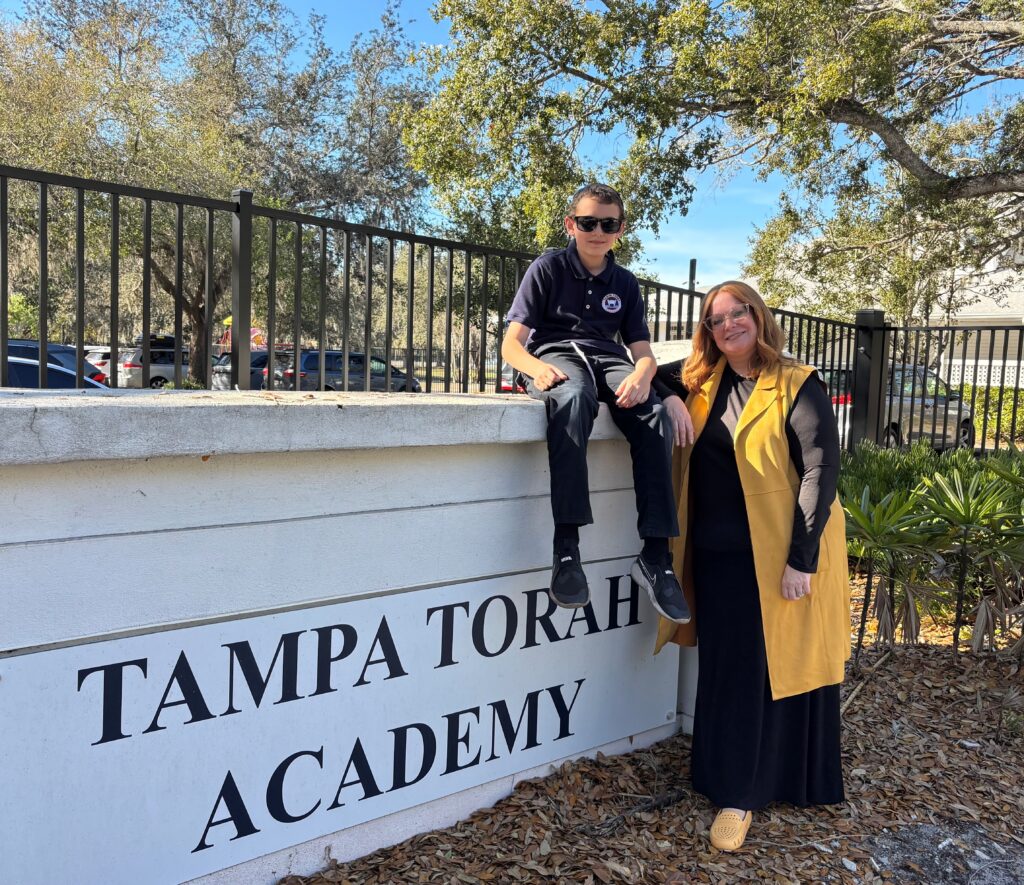
So, when she finally got to see it in person, a few days after the family moved down …
“I stood there with tears in my eyes thinking, ‘I’m home,’ ” Mrs. Goldenberg said. “It was like magic. It was exactly the school I wanted and exactly the school I knew my son would thrive in.”
The Goldenbergs are yet another example of a family drawn to Florida by educational opportunity (see others here, here, and here).
In their case, they represent what is likely the biggest group of “school choice transplants.” Hundreds if not thousands of Jewish families have moved to Florida in recent years, motivated at least in part by booming Jewish schools and the universal availability of state school choice scholarships.
The result: Between 2007-08 and 2022-23, the number of students in Florida’s Jewish schools grew 58%, to 13,379, and the number of Jewish day schools and yeshivas nearly doubled, from 40 to 74.
The Destination Florida pipeline is especially strong from New York to South Florida. But there are growing pockets of Jewish schools emerging in other parts of Florida too, like Tampa.
The why is obvious, said Rabbi Ariel Wohlfarth, co-founder of Tampa Torah Academy.
“School vouchers, no income tax, nice weather; why would you be any place else?” he said.
Tampa Torah Academy occupies a former preschool in a polished suburb. The school and its dormer windows and wraparound porch are framed by stately oaks and towering palms, next to a pond with a fountain whose streams arc outward in a circle, like the petals of a giant aquatic flower. An aerial view is the first thing people see when they visit the school website, along with the words, “Experience the Warmth of a Jewish Connection.”
Tampa Torah Academy opened in 2022 with 10 families, eight of whom relocated from New York. In the three years since, it’s tripled in size, from 33 students in grades K-7 to nearly 100 in K-12.
Every student uses a choice scholarship, which averages $8,000 or $10,000 a year, depending on the scholarship type. As of 2023, they’re available to every student in the state.
In New York, Yanky attended Jewish schools before Mrs. Goldenberg pulled him after a bullying incident.
She tried to homeschool him, but it wasn’t easy. She worried he wasn’t proficient enough in some subjects, like math, because of her own academic shortcomings, and that he wasn’t hanging out enough with other kids.
There were a few other Jewish schools in the area. But they were too expensive, too far away, or too big. Yanky, she said, “would have been lost and miserable.”
Thankfully, in the summer of 2022, Mrs. Goldenberg said, a miracle happened.
As word spread about a wave of Orthodox Jewish people leaving New York for schools in Florida, Mrs. Goldenberg got a fundraising pitch for Tampa Torah Academy. She donated, then called, then had a long conversation with one of the co-founders, Rabbi Yirmiyahu Rubenstein.
She was amazed by what she heard. The school promised solid instruction in both secular and religious studies; small class sizes; and teachers who would know each student’s strengths and weaknesses and adjust accordingly.
Everything “was like perfection,” Mrs. Goldenberg said. “I hung up the phone, I went across the house to my husband, and I said, ‘We’re moving to Tampa.’ “
Mr. Goldenberg is a retired businessman who worked in real estate. Mrs. Goldenberg is a former English teacher. Both had familiarity with Florida, having lived near Miami before things, for them, got too congested and hectic.
Neither knew the Tampa Bay area. But seven months after the call with Rabbi Rubenstein, they settled in Wimauma, a suburb 30 miles south of Tampa where a Jewish community is growing and former pastures are sprouting subdivisions.
“I thought Florida had flamingos, but we have cows next door,” Mrs. Goldenberg said.
Odds are high that more out-of-state families will be joining the Goldenbergs soon.
Tampa Torah Academy has room for 170 students – and it’s actively informing families in other states about what’s available in sunny Florida. Families in New York, New Jersey, and California, all states without private school choice programs, are among them.
As one indicator of the interest level, Rabbi Wohlfarth pointed to a recent, online “community fair” that connected Jewish communities nationwide to Jewish families interested in moving. Nearly 150 families visited the Tampa booth; more than 30 indicated serious interest.
The choice scholarships, Rabbi Wohlfarth said, are a powerful draw.
Jewish families are generally familiar with private school choice programs, “but they don’t know the amounts,” Rabbi Wohlfarth continued. When they hear what Florida provides, their ears perk up, he said. “They’re like, ‘I didn’t realize it was that much.’ “
Even without the scholarships, tuition at Tampa Torah Academy was more reasonable than similar schools up North, Mrs. Goldenberg said. The scholarship made it better still.
Without it, she said, paying for the school “would have been an enormous amount of stress.”
Tampa Torah Academy provides Yanky everything he needs to be successful, she said. It’s strong in both general academic subjects, what Orthodox families call “English,” and Jewish religious studies, often called “Judaics.”
“I wanted him to have both. That’s very important,” Mrs. Goldenberg said. “At Tampa Torah Academy, they also have a high school division now, so they can prepare to send the kids to the best colleges.”
Yanky said he’s happy with his new school and state. For top Florida amenities, he listed 1) “It’s not cold,” 2) theme parks, 3) Top Golf.
Mrs. Goldenberg said the only downside is the family’s two older children – a son and a daughter and their four grandchildren – are still in New York.
Otherwise? The people of Tampa Bay are “lovely,” she said, and the pace of life just right: “not as rush-y” as South Florida but more energizing than the Catskills. “There’s always something to do,” she said.
The cherry on top is the school, and the tight-knit community that revolves around it.
“Oh my God I love it. I feel like all of us are thriving,” she said. Meanwhile, friends up North are “buried under 27 inches of snow.”
TALLAHASSEE, Fla.– Amanda Thompson said she will be the president of the United States.
Not wants to be or hopes to be but will be.Amanda Thompson said she will be the president of the United States.
Not wants to be or hopes to be but will be.
Just like she will be the attorney general of Florida, the governor of Florida, and the United States attorney general before reaching the Oval Office.
“That’s the plan,” she said. “I’m going to get there.”
Of course, there is some prep work to be done before she begins a career of service to her state and country.
First, Amanda, 17, is set to graduate this May from St. John Paul II Catholic High School (JPII), where she will be class valedictorian. She attends the parochial school in Tallahassee with the help of a Florida education choice scholarship managed by Step Up For Students.
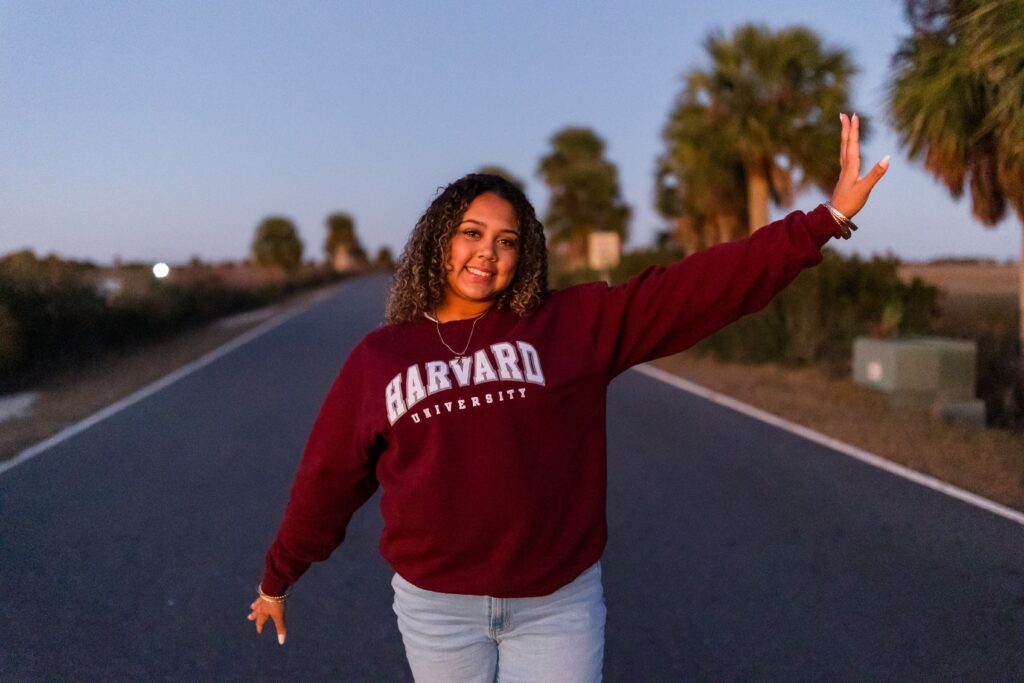
Then it’s off to Harvard University, where she plans to double-major in government and history and earn a degree from its prestigious law school. Along the way, Amanda will pitch for the Crimson softball team with designs on leading the program to its first appearance in the Women’s College World Series.
As that unfolds, Amanda is determined to play softball in the Olympics. She has attended tryouts for Team USA and is a member of the United States Virgin Islands national team.
Taken separately, any one of her goals is ambitious.
But combined?
“She has very, very high expectations,” said JPII Principal Luisa Zalzman. “She’s a go-getter, a high achiever. She has a drive that is very mature for her age.”
“She's done everything she's ever put her mind to,” said Amanda’s mother, Ashley Williard. “She said she wanted to be valedictorian, and I said, ‘OK, go be valedictorian.’ And she did it.”
Amanda is a bundle of energy and confidence. On the softball field, she has a running dialogue with everyone – teammates, opponents, coaches, umpires. In the classroom, she’s involved in every class discussion.
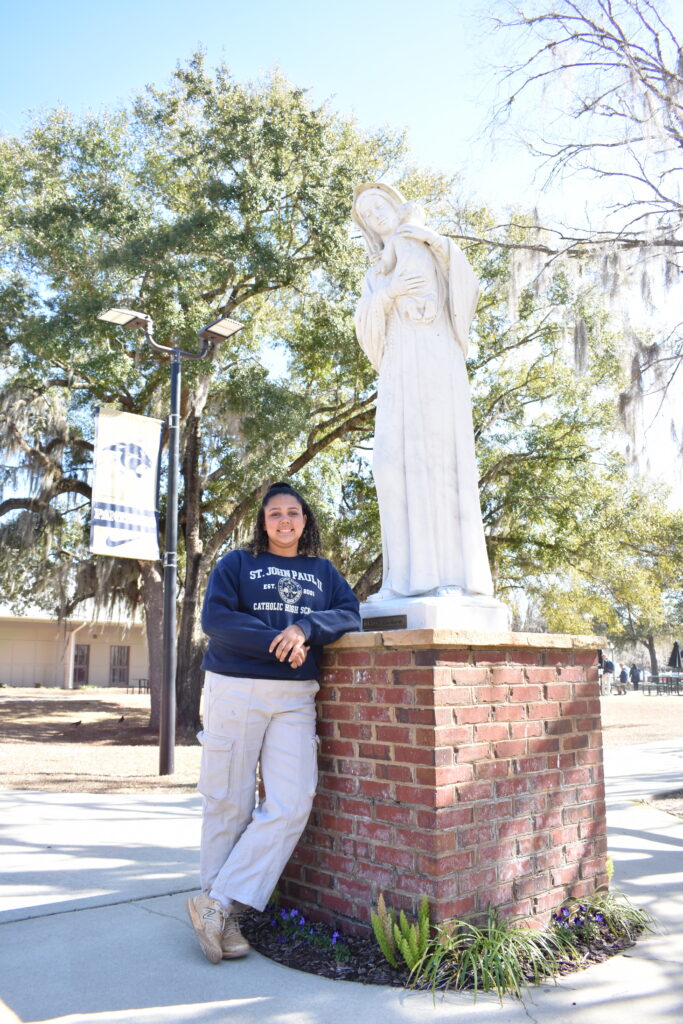
If you had approached her in August 2022 as she took the initial steps of her high school journey and told her she would graduate first in her class and be a member of Harvard Class of 2030, she would have been stunned.
“I would have said, ‘You got the wrong person.’ The difference between me then and me now is astronomical, and I think it’s because I attended this school,” she said. “It has to be.”
Amanda was a star as she rose through the ranks of the Tallahassee youth softball programs. Her parents, Ashley and James Thompson, envisioned their daughter earning an athletic scholarship to college. They were thinking of a high-end academic university like Duke or Notre Dame. That’s how Amanda, who attended her district schools until eighth grade, landed at JPII.
“We wanted a high school that was college-focused,” Ashley said. “Education is what we were looking for, and we could not have done it without Step Up For Students. No way could we afford to put her in that situation.”
There were “little things,” Amanda said, that shaped her academic future.
Her freshman English teacher encouraged her to write outside the margins during tests and essays.
“He said, ‘You don’t have to stay within this box. If you know more, write more on the paper.’ That stuck with me,” Amanda said.
Her freshman world history teacher announced to the class that Amanda scored the highest on the first test of the year.
“He congratulated me,” she said. “I thought that was insane.”
Midway through that semester, Amanda realized she had A’s in all her classes. That’s when she began to believe in herself as a student. Future valedictorian?
“Why not?” she said.
Amanda took AP World History as a sophomore and aced the AP test.
“That’s the class where I learned to learn,” she said.
Also, her love of history and government was born in that class, Amanda said. She can name all the countries of the world, tell you where they are located, and identify the flags.
“I’m working on my capitols,” she said. “It’s my hobby.”
Amanda took Spanish I and II in middle school and passed each, but not with grades that would stand out on a high school transcript. Sara Bayliss, JPII’s college advisor, suggested that Amanda retake those courses.
“She said the grades weren't good enough, that I could do better,” Amanda said.
Amanda retook both classes. She asked Principal Zalzman, a native of Venezuela, for tutoring help. The result was a pair of grades that fit proudly on the transcript Amanda sent to Duke. Duke was her dream school for education and softball.
And then Harvard called.
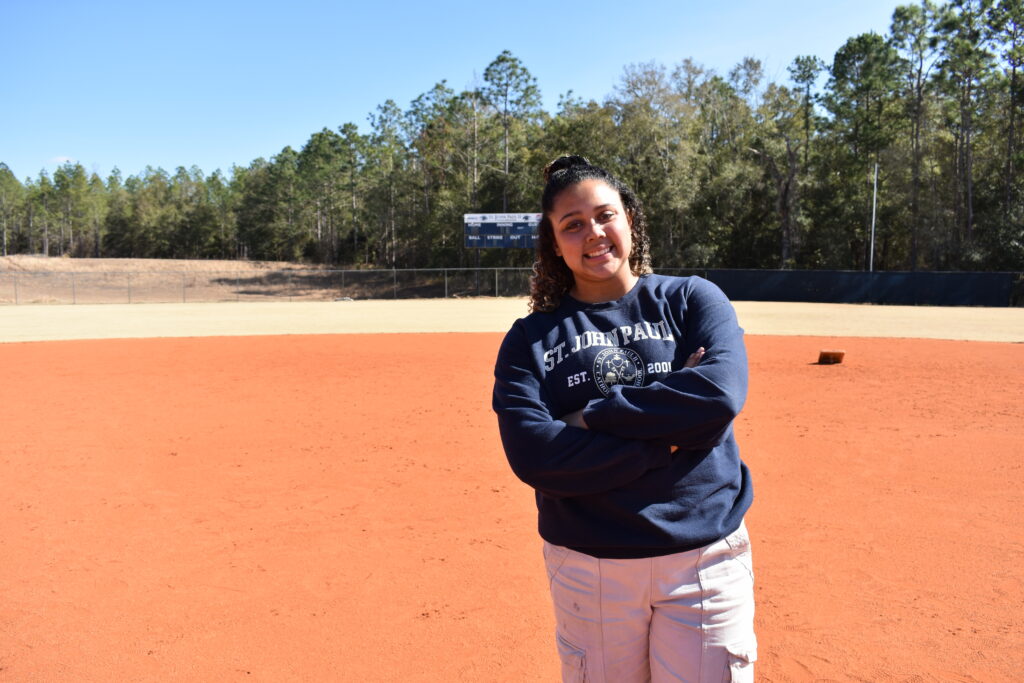
At midnight on Sept. 1 of her junior year – the first day college coaches can contact 11th graders – Amanda received a phone call from the Harvard softball coach.
“I didn’t even know they had a softball program,” Amanda said.
Intrigued, Amanda accepted a recruiting visit to the university located just outside of Boston. That trip marked the end of her Duke dreams.
“I want to make a difference in this world, and I think Harvard is the perfect school for me,” she said.
Terrence Brown, JPII’s softball coach, has watched Amanda emerge as an Ivy League student and a Division I softball player good enough to attend Team USA tryouts and earn a spot on the national team of a small territory with Olympic ambitions.
“She’s goal-oriented, and she doesn’t let anything get in the way of achieving those goals,” he said. “She’s worked very hard to get to where she’s going.”
Ashley and James are proud parents, but Ashley said they won’t take too much credit for Amanda’s success.
“We have nothing but pride,” Ashley said. “She is self-driven, self-motivated. We try to provide motivation. She’s missed proms and dances because of softball travel and schoolwork, and that was all her decision.
“There are a lot of sacrifices made to go along with this. She’s not afraid of hard work. She says she’s going to do something, and she goes out and does it.”
PALATKA, Fla. — All Risa Byrd wanted to do was start a little preschool. That’s it. But then the former public school teacher got swept up in one of the most epic education stories in American history. Now her fast-growing school is the latest example of what’s possible when school choice is the new normal.
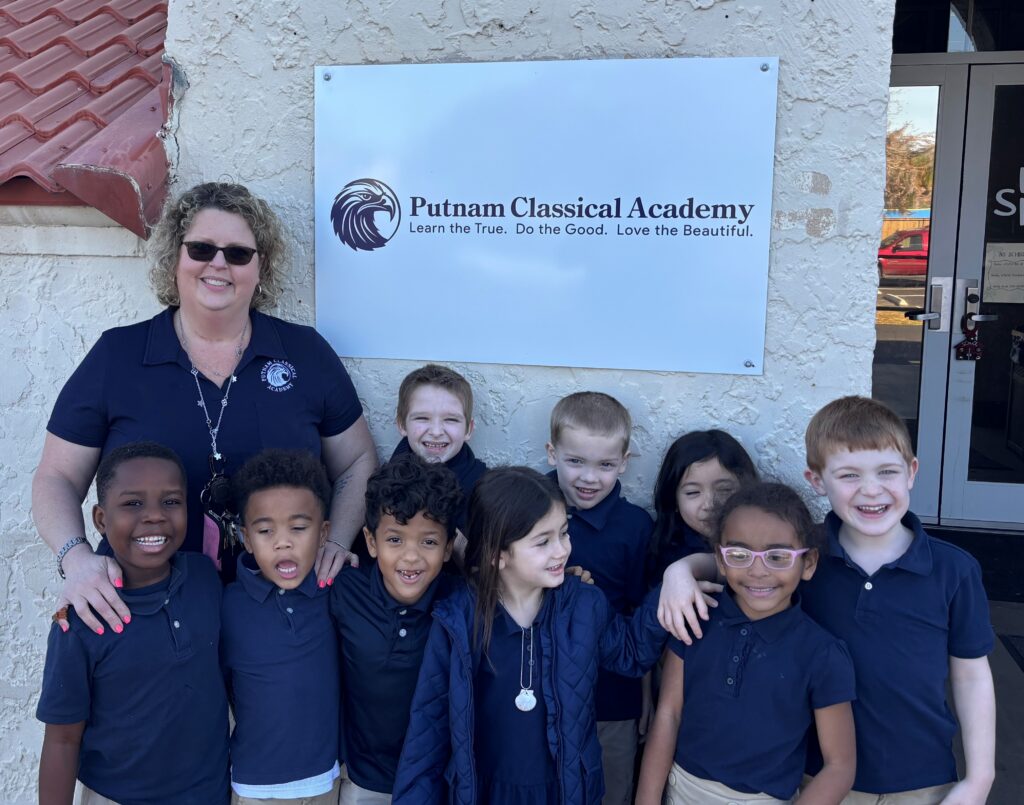
In 2022, Byrd retired from a 26-year teaching career to start Little Sprouts Learning Center. The goal was modest: Get her granddaughter’s academic journey off on the right foot.
A few months later, though, Florida lawmakers passed, and Gov. Ron DeSantis signed, one of the most sweeping school choice bills of any state, ever. Suddenly, every student in Florida was eligible for a state-supported choice scholarship.
Byrd didn’t realize it at first. But her school had caught a wave.
In the fall of 2023, Byrd added kindergarten and first grade, starting with eight students in those grades. She called the school for the higher grades Putnam Classical Academy.
By the fall of 2024, Putnam Classical had 50 students in grades K-5.
By the fall of 2025, it had 234 students in grades K-6, in addition to 60 in preschool.
Now Byrd’s looking for a whole other building to house a separate middle school. When she announced plans via Facebook, 111 students signed up in three days.
“Parents are desperate for their kids to be well educated,” Byrd said, particularly those from underserved communities. “They’ve been written off.”
Byrd is one of hundreds of former public school teachers who have leveraged Florida’s choice scholarships to create their own learning options. They can be found in every corner of the state, even in rural and semi-rural counties like Putnam, where a paper mill is the biggest private employer, the biggest town has 10,000 people, and the best-known landmark may be a blast-from-the-past diner.
The parents driving demand aren’t looking for anything exotic, Byrd said. They just want safe schools with top-quality academics, high expectations, and no drama.
“Parents got the word that we don’t play. That’s the biggest draw,” Byrd said. “They’re fed up. They know kids can’t learn, and teachers can’t teach, if there’s sheer chaos in the classroom.”
Byrd’s story may be a particularly dramatic example of what’s happening in Florida, and particularly symbolic.
More than half of Florida’s 3.4 million students are now enrolled in something other than their zoned neighborhood schools, and more than 1 million are enrolled outside of district schools entirely. Perhaps it’s fitting, then, that Putnam Classical leases a century-old building that once served as the local school district’s headquarters.
Despite the name, Putnam Classical isn’t truly classical yet. Byrd said she and her staff, which includes 20 teachers, will transition to a more recognizable “great books” curriculum within two years.
The first order of business is to establish a higher rate of basic literacy.
A self-described “data nerd,” Byrd is a “science of reading” adherent and a huge fan of Natalie Wexler, author of “The Knowledge Gap” and a leading proponent of using a content-rich curriculum to boost vocabulary and comprehension.
For the early grades, Putnam Classical uses an explicit, evidence-based phonics curriculum developed by the University of Florida. For the higher grades, it uses the highly regarded Core Knowledge curriculum for language arts, science, and social studies.
“If you teach these kids to read, you will change the trajectory of their lives,” Byrd said. “Then they can be an astronaut, a chef, anything they want to be.”
Byrd said as a public school teacher, she earned a reputation for working well with struggling readers, so more and more were sent her way. It became obvious, she said, that many students acted out because they couldn’t read well.
One time, she said, she stopped a 10th grader from disrupting her classroom, then took her out to the hallway to talk. The girl broke down and told her, in between sobs, “I’d rather everyone in that room think I’m a b---- than think I’m stupid.”
In three years, Byrd said she’s expelled two students. The school isn’t orderly because it’s draconian about discipline, she said. It’s orderly because kids are achieving academically and are proud of themselves. “When you learn to read,” Byrd said, “school becomes a lot more fun.”
About half of the students at Putnam Classical are Black or Hispanic; about 75% would be eligible for free- or reduced-price lunch in public school. The school does not charge tuition beyond the amount of the choice scholarship, which averages about $8,000 statewide and is far less than what districts spend.
Most of the students who switched to Putnam Classical were not reading at grade level when they arrived, Byrd said. Some incoming second graders didn’t know their letter sounds.
But now?
Now more than 60% are showing average or better growth compared to their peers nationwide, according to the STAR reading assessment Putnam Classical uses. In other words, students who were previously losing ground in their prior schools are now catching up and starting to get ahead.
Dalton Crews chose Putnam Classical for his 5-year-old, Delilah. He said he attended a private elementary school before moving on to public school and thought it built a good foundation for academics and character. He wanted the same for his daughter, and thankfully, he said, choice made it possible.
“I love the teachers. They communicate really well. They always tell me what’s going on,” said Crews, who installs fire sprinklers for a living. “They tear up when the kids leave. That’s love. They’re good people.”
Shentae Roberts said her 10-year-old granddaughter, Ja’Zyiah, was receiving good grades in her prior school, even though it was obvious to her family that she was struggling with basic material.
Her daughter tried contacting the school to get more information, she said, but never got a response. That’s why, in 2024, her daughter switched Ja’Zyiah and younger brother, Hakiem, to Putnam Classical.
“Best thing she did,” Roberts said.
Roberts said her granddaughter initially struggled at Putnam Classical, too. But the teachers gave her the attention and instruction she needed, she said.
The result: Ja’Zyiah “came back 10 times stronger,” Roberts said. “All the staff get to know the children, and they’re responding to them. They’re pulling the children to the next level.”
Byrd said more good things are ahead, not just for her school.
Even though Florida has been a national leader in private school choice for a quarter century, Byrd said she didn’t know much about it until HB 1, the landmark legislation Gov. DeSantis signed in 2023. Now, though, she realizes the game-changing potential not just for families but for teachers.
“Every public school teacher says, ‘If I were the boss, I would do it this way,’ “ Byrd said.
Well, now’s their chance.

