 This is the fourth in a series of brief observations on the ideal technical design of state systems using “vouchers” as the means to empower parents to choose their child’s school. Vouchers are to be distinguished from tax credits; the latter fund parents indirectly through private contributions to charitable organizations, thus reducing the donor’s tax liability; the whole or part of the contribution can be credited against the contributor’s taxes. The charity then awards scholarships either to schools or to families whom it selects from among its applications.
By contrast, the voucher is simply an award of government money directly to the parents to be used for the child’s tuition at their chosen school. Vouchers will be our subject.
Why are rules important here? Why not just let the two parties - parent and school - bargain? If either says no, Suzie goes elsewhere. Such a system is imaginable, but in this society, improbable and possibly unjust. Rules of admissions are perhaps the most controversial element in the design of systems of choice - certainly of vouchers. Consider the following cases:
Susie’s mother wants her in Mozart High which emphasizes music as the medium of learning. Susie is tone deaf and hates music. Should she, by law, displace Jim, the gifted student next behind her in the lottery run by the school? And why must the school be using a lottery in the first place? And why shouldn’t the more gifted child simply have precedence?
Or, try this one. Arthur, who is black, also drew the short stick in the lottery. The school - otherwise all white - wants to admit him. Of course, to do so, someone else must get bumped.
Or, again, a disabled child wants entry to St. Cecilia, a small Catholic school with no facilities to accommodate her and no resources to redesign the school. What’s the point of forcing her admission?
Schools differ greatly in virtually every respect except in their (presumed) capacity to teach “the basics” as these are defined by law in the particular state. Furthermore, with respect to the basics, schools are free to employ a very wide range of methods. Often it is important that the pupil population come prepared to do it the school’s distinctive way. Still it is also crucial that kids who are less attractive to the school have the benefit of their parents’ choice.
Of course, long before the problem of admission even arises, a school may advertise, both positively and negatively, in order to maximize those applications it desires. It may also try directly to dissuade the unwelcome parent. In addition (as noted earlier in Essay #2) the school may, with fair warning and due process, expel a student who, after a fair trial, simply doesn’t make it. Still, the process of choice by the school itself can be confounded, for example, by an unexpected bubble of applications from children who “just don’t fit.” St. Cecilia, a Catholic school, may wish the best for Muslim applicants, but their sheer number may present a serious pedagogical problem. Like our current leaders on the Potomac, schools and parents need both a spirit of - and a mechanism for - compromise. (more…)
Many of our more public minds oppose aid to families who want, but can’t afford, a non-government school. For working families and the poor, the guru’s motto appears to be “public school only.” He endorses our ancien regime of schooling, which eliminates the parent from any role in the process; as such minds see it, the State rescues half of America’s children from their parents’ mistakes by conscripting them each morning to government custody. I will call these pundits “shepherds”; they applaud as the lambs of the hoi polloi get herded into that safer fold of the State.
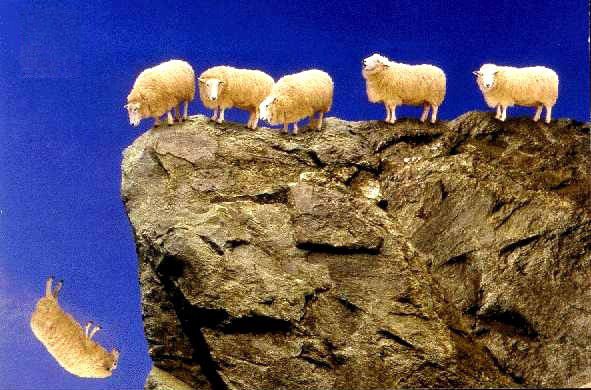
It takes guts not common to the Shepherd to argue plainly that the well-off parent is up to the job, but not the rest of you. Better just to stand by as the State properly does for worker and the poor what better-fed families do for their own children - i.e., choose.
Oddly enough these same Good Shepherds - so often wordy - seldom comment on the wisdom and justice of family choice when exercised by those other parents who can afford it. Of course, such comfortable folk can actually assert a constitutional authority over the child; and it would be a steep climb - legally and politically - to disentitle every parent, as Oregon attempted nearly a century ago. Still, one might expect our contemporary civic sentinels to notice and regret the damage to children and society wrought daily by these imperfect parents making choices. The honest dogmatists of Oregon were candid and public about their fear of feckless parents both rich and poor; today’s enemies of choice remain oddly reserved and ambiguous regarding the sovereignty of our more prosperous mamas and papas.
Such restraint suggests profound ambivalence. Often we watch the very prototype of the Shepherd - the public school teacher and union leader - execute their own child’s exodus to a more favored district residence or even to a private school. Such thoroughbred parents on occasion even manage a different postal address for the child, one where in fact he is seldom to be found. (Less popular school districts now pay bounties to detectives to assure that resident parents do not divert illegally the per-pupil state subsidy for their child. Parents caught cheating get prosecuted.)
Is this silence of the the Shepherds a shroud for their own embrace of choice by the well-off? As these gurus run with the hare and hunt with hounds, they remind us of that familiar foreign critic of America’s sins - the one who turns handsprings to secure his own visa.
Is the Shepherd simply a hypocrite? Often yes; but often no. In this short piece it would be hazardous to critique the possible excuses of the Shepherd - coherent and otherwise - for his apparent approval of society’s systematic bullying of the poor parent while indulging the tastes of the rich. In my experience - apart from union intimidation - the most common explanation is the simple blindness of the middle class and the academy to the reality of the coercion. (more…)

