The big story: After delivering a one-two punch to Blaine Amendments, the nation’s highest court decided not to take aim at Michigan’s version.
Zoom in: This week, the U.S. Supreme Court declined a request to hear an appeal of a 2021 lawsuit brought by kindergarten mom Jill Hile and four other families in the Wolverine State who sued after they were prohibited from using funds saved through the Michigan Education Savings Program, a tax-exempt 529 plan, to help offset the cost of K-12 private school tuition. The court offered no comment when it announced the decision, taken up during a Sept. 30 private conference preceding its 2024-25 term. The refusal to hear the case lets stand a Sixth Circuit Court of Appeals decision affirming a lower court’s ruling that upheld the constitutional ban on private school support.
The issue: A string of recent U.S. Supreme Court rulings has struck down provisions in other state constitutions that bar direct state  funding of private and religious schools. Michigan takes things to another level by prohibiting state funds from supporting any non-public educational institution. This, according to the Sixth Circuit, includes indirect aid like tax-exempt funds saved through 529 plans. This makes Michigan’s Blaine Amendment, enacted in 1970, among the most restrictive in the nation.
Other states, including Kentucky, have restrictive versions of the Blaine amendment. The Bluegrass State provision has shot down laws establishing private school scholarship programs as well as charter schools. Kentucky voters are set to go to the polls next month to decide whether they want to rewrite part of the state constitution to let the state legislature allocate taxpayer dollars to these educational opportunities.
Yes, but: The Supreme Court’s refusal to hear this case could open the door for other states to use Michigan’s overly broad Blaine Amendment as a blueprint to hinder school choice. However, some legal experts doubt that will happen.
“Politically, that would be an uphill battle in most states with parental choice programs,” said Nicole Stelle Garnett, a law professor and director of the Notre Dame Education Law Project. “It won't stop opponents from trying, of course.”
What they’re saying: “Michigan families are desperate to have more options,” said Molly Macek, director of education policy at the Mackinac Center for Public Policy, which teamed up with a Michigan law firm to represent the families in the case. “A child’s educational success shouldn’t be determined by the family’s financial means or ZIP code. We will continue to keep fighting until every family has the ability to choose the best education for their children.”
Next steps: Burdensome rules make repealing Michigan’s Blaine amendment highly unlikely. A two-thirds majority of the state’s lawmakers would have to vote to remove it legislatively. Or supporters could try a ballot signature amendment that would require 446,197 signatures from registered voters to get the issue on the ballot. Another solution would be for Congress to pass a national education choice bill that would make Blaine amendments obsolete – or at least give families a way to bypass them.
Not a cure-all: Legal experts warned that landmark U.S. Supreme Court decisions that struck down bans on religious schools from participating in choice programs wouldn’t be a panacea. “Despite the Supreme Court's decisions in Espinoza and Carson, barriers to educational choice remain in a small handful of states with "’public/private’" Blaine Amendments,” said Michael Bindas, a senior attorney of the Institute for Justice who argued the Carson case before the high court. “Although it is unfortunate that the Supreme Court did not use Hile v. Michigan as an opportunity to address the federal unconstitutionality of such provisions, we are confident that the Court will eventually do so.”
Growing pains: Blaine amendments were primarily rooted in bigotry aimed at the increasing numbers of Catholic immigrants entering the United States during the 1800s. Other laws required all students to attend district schools, which at the time promoted Protestantism. A 100-year-old landmark Supreme Court ruling in Pierce v. Society of Sisters abolished forced public school enrollment and declared that parents had the right to direct the education of their children. Education choice opponents’ court challenges to education choice programs, and supporters’ challenges to Blaine amendments will no doubt continue as the nation’s transition to a new era of public education begins.
MIAMI BEACH, Fla. – Thirteen years ago, Katy Horowitz and her family moved from London to Miami, where she promptly secured a job at a charter school. But when the charter school abruptly decided to move an hour away, Horowitz decided to give her own school a shot: An unassuming little day care.
Horowitz said she never had plans for anything big. But “it snowballed.”
The day care began with five students in her home. Soon, it became a day care in a synagogue. The day care grew into a pre-school, Gan Katan Miami. Then the pre-school pulsed into Pardes Day School.
Nudged by parental demand, Horowitz and co-owner Sharon Eichberg have been adding a grade a year, and in August they welcomed their inaugural seventh-grade class.
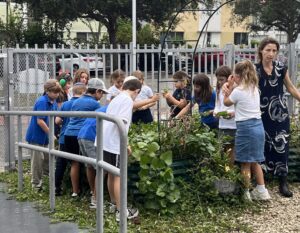 Together, the two schools now serve 220 students. And Horowitz said she and Eichberg could serve twice as many if they could only find a suitable building in Miami Beach, where 90 percent of the students live.
“We’re always looking to see what’s out there,” she said. “But it’s either totally unaffordable. Or it’s not big enough. Or we can’t zone it.”
Gan Katan and Pardes Day School are typical examples of what’s happening with Jewish schools in Florida.
On the one hand: Accelerating growth.
On the other: Speed bumps, just ahead.
A new report from Teach Coalition and Step Up For Students sets the scene well.
Over the past 15 years, the report shows, the number of Jewish schools in Florida has nearly doubled, boosted by growing numbers of parents using state school choice scholarships, and bolstered by the migration of families from other states, particularly New York.
Between 2007-08 and 2022-23:
 All of this was before 2023-24, the year every student in Florida became eligible for choice scholarships.
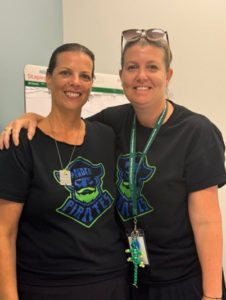
Sharon Eichberg, left, and Katy Horowitz, right, founders of Gan Katan schools.
Horowitz said she’s really never had time to stop and think about her school’s growth. “But every once in a while,” she said, “I get this moment of whoooosh, I can’t believe this is a thing.”
“Every year this school has evolved,” she continued. “It’s beautiful, but tiring. It’s this shapeshifting, ever-evolving craziness. I can’t explain. But somehow it always comes out right.”
The same could be said for the growth of Florida’s Jewish schools overall.
At the same time, though, the Teach Coalition and Step Up report makes clear that limits on growth are looming, due to restrictive zoning codes, rising real estate values, and increased competition with other private schools.
The vast majority of newer Jewish schools in Florida are on the smaller side, with fewer than 250 students. That’s not a function of parental preference, the report suggests, pointing to data showing robust growth in larger Jewish schools. Instead, the limitation seems to lie with restrictive local zoning laws.
“With Florida’s existing Jewish schools at or near full capacity, more effort is needed to source suitably sized school buildings,” said Danny Aqua, director of special projects at Teach Coalition, which advocates for Jewish schools. “Without legislative and regulatory action to reduce the hurdles to opening new schools, the lack of school building space may throttle growth in Florida’s Jewish day schools.”
Gan Katan and Pardes Day School were able to expand in 2021, when Horowitz and Eichberg lucked into two, long buildings that once housed a charter school. Prior to that, the buildings had been an apartment complex in a snug neighborhood graced by oaks and figs and bright splashes of hibiscus.
“It was like finding a needle in a haystack,” Horowitz said. “We called it our unicorn.”
The unicorn worked for a while, but it’s not ideal. The buildings now house the pre-school and elementary school, while the synagogue, less than a mile away, houses the sixth- and seventh-graders. Meanwhile, Horowitz and Eichberg can’t grow more space, but they have installed walls to create more rooms. Stacks of books and school supplies, including in Horowitz and Eichberg’s office, hammer home the reality that the school is maxing out.
“We thought the school was going to be small,” Eichberg said. “This,” she said, gesturing around the office, “was not the plan.”
Horowitz estimates 10 percent of the families they serve are recent transplants from out of state. Some from New York and California. Some from Israel and France. The biggest cluster came from Montreal.
Dayna Westreich and her family moved from Manhattan to Miami Beach in 2021. All four of her children attend Jewish schools using choice scholarships, two of them at Pardes Day School.
Florida just had more going for it, Westreich said – better cost of living, better quality of life, fewer headaches in the wake of the pandemic, and more economic opportunity. Choice scholarships were “an added bonus,” she said, and she was “over the moon” with Pardes.
“My daughter was instantly happy there, and it made the transition easier,” she said. “The school’s like a big hug.”
Florida was already hard to beat with good weather and a reputation as a safe haven, Horowitz said. Now that the scholarships are universal, it’s even more so.
Before last year, 25 to 50% of the students at Gan Katan and Pardes Day School were using the scholarships, she said. Now all of them are – and word is definitely getting around.
“When a group from a certain place finds a new place, they bring all their friends with them,” Horowitz said. “They send the carrier pigeons back home and say, ‘Come to Florida!’ “
As our country was being formed, states such as Connecticut, Georgia, Maryland, Massachusetts, New Hampshire, South Carolina, and Virginia adopted state religions that citizens were taxed to fund and expected to follow. In response to this infringement on personal freedom, the U.S. Constitution was amended to include language, called the Establishment and Free Exercise Clauses, forbidding the establishment of a government religion and guaranteeing individuals the freedom to practice or not practice religion. These clauses read: "Congress shall make no law respecting an establishment of religion, or prohibiting the free exercise thereof.”
Opponents of education choice programs that allow students to voluntarily use publicly funded education choice scholarships to pay for tuition at religious schools assert that these choice programs are unconstitutional primarily because they violate the Establishment Clause. In essence, legally equating families who freely choose to send their child to a religious school using a publicly funded scholarship with a government coercing people to support a state religion. The courts have made clear this argument has no merit and is dead on arrival. But opponents keep trying.
Teachers unions are the most aggressive opponents of education choice programs. The National Education Association (NEA), the nation’s largest teachers union, says, “Voucher programs drain resources from public schools and funnel those resources to private and religious schools, violating the Establishment Clause.” The second largest union, the American Federation of Teachers (AFT), agrees.
Other prominent opponents concur with the teachers unions’ reasoning. People for the American Way believes that "By using taxpayer money to fund private religious education, voucher programs violate the Establishment Clause.” The Freedom From Religion Foundation (FRF) writes that, "School voucher schemes unconstitutionally entangle government with religion by directing public funds to parochial schools, thereby violating the Establishment Clause."
Americans United for the Separation of Church and State (Americans United) asserts that education choice programs violate both the Establishment and Free Exercise Clauses. "School vouchers funnel taxpayer money to private religious schools…This violates the Establishment Clause and the religious freedom of taxpayers."
The Southern Poverty Law Center (SPLC) makes a similar argument. "School voucher programs that funnel taxpayer dollars to private, religious schools violate the Establishment Clause of the First Amendment by compelling taxpayers to support religious instruction and activities. Such programs erode the separation of church and state, a foundational principle of our democracy."
Suggesting that the Establishment and Free Exercise Clauses give individual taxpayers the right to circumvent elected representatives and decide for themselves how government spends their taxes is a rejection of democratic governance. Expecting a fire department to check with its local taxpayers to determine whose taxes may be used to fund putting out fires at churches is impractical.
The American Civil Liberties Union (ACLU) invents a “constitutional principle” when it claims, "Voucher programs, which divert taxpayer dollars to private, often religious schools, undermine the fundamental constitutional principle of separation of church and state.”
The phrase “separation of church and state” is not a constitutional principle. It does not appear in the U.S. Constitution. Thomas Jefferson used this phrase in an 1802 letter to the Danbury Baptist Association in Connecticut to reinforce the intent of the Establishment and Free Exercise Clauses, which is that government should not interfere with citizens’ right to practice or not practice religion unless this practice violates public laws. The state will not allow a religion to construct a building without a government permit or abuse children. The U.S. Constitution requires the relationship between religion and government to be appropriate but not nonexistent.
Beginning with the Zelman v. Simmons-Harris ruling in 2002 and continuing with the 2020 Espinoza v. Montana Department Revenue case and the Carson v. Makin decision in 2022, the U.S. Supreme Court has consistently ruled over the past two and a half decades that programs providing public funds to help families pay for educational services offered by religious organizations are constitutional, provided families make these choices freely. These court rulings suggest an Establishment Clause violation occurs only when a family’s decision to use public funds to pay a religious organization for educational services is influenced by government coercion.
Despite the weakness of their legal arguments, the ACLU, AFT, Americans United, FRF, NEA, and SPLC have supported lawsuits in Arizona, Florida, Indiana, Maine, Montana, Nevada, New Hampshire, North Carolina, Ohio, West Virgina, and Wisconsin challenging the constitutionality of K-12 programs that allowed families to purchase education services from religious organizations using public funds. But these groups have never legally challenged the constitutionality of prekindergarten and higher education students using public funds to attend religious schools.
Why do they support legally forbidding a high school senior from using public funds to pay tuition at a Catholic high school but look the other way two months later when this same student uses public funds to pay for tuition at the University of Notre Dame? The answer is tribal politics.
Humans are tribal. We are all members of multiple tribes, including tribes organized around political beliefs. To remain a tribal member, we must conform to that tribe’s beliefs, no matter how irrational they may appear to those outside the tribe.
Most of the AFT’s and NEA’s dues-paying union members work in K-12 school districts. Consequently, the AFT and NEA are highly motivated to protect the jobs and compensation of these members by opposing students using public funds to attend private schools that employ non-union teachers. Since most private schools are faith-based, these unions use the Establishment Clause violation argument as a legal and political weapon despite its ineffectiveness.
The NEA and AFT have far fewer members working in prekindergarten and higher education institutions. Consequently, they are less willing to spend money and political capital opposing students using public funds to attend religious schools in these two sectors.
Education choice opponents such as the ACLU, Americans United, SPLC, and most Democratic Party elected officials, are in the same political tribe as the NEA and AFT, and these two unions provide much of the money and grassroots activists that give this political tribe its power and influence. Therefore, these groups conform with the AFT's and NEA’s legal reasoning for opposing publicly funded education choice programs and will continue to do so until the unions change their positions.
At a mid-1980s NEA convention, the delegates overwhelmingly rejected a resolution supporting magnet schools. As the floor manager for this resolution, I remember this defeat well. Opponents claimed magnet schools undermine neighborhood public schools and correctly argued that magnet schools are a manifestation of Milton Friedman’s initial school voucher proposal. A few years later, after thousands of NEA members began working in magnet schools, the union reversed its position and embraced magnet schools.
Today the NEA and AFT’s tribal partners all support magnet schools despite their school voucher lineage suggesting tribal loyalty is stronger than ideological consistency, and tribes will rationalize changing core positions to enhance their economic and political strength.
In Florida, teachers unions are slowly bleeding to death as thousands of unionized teachers leave to teach in a rapidly expanding array of new, non-unionized education settings such as homeschool co-ops, hybrid schools, and microschools. To survive, Florida teachers unions need to begin serving these teachers, including those working for religious organizations.
For more than 40 years, I have argued that teachers need to replace their old-school industrial unionism with a model that can serve teachers in diverse and decentralized settings. If they do not evolve, they will not survive. Nor will some of their tribal colleagues.
The number of Jewish schools in Florida nearly doubled over the past 15 years, boosted by parents using state school choice scholarships and the migration of families from New York, according to a new report from Teach Coalition and Step Up For Students.
Student enrollment between 2007-08 and 2022-23 rose 58 percent, from 8,492 to 13,379, while the number of Jewish day schools and yeshivas grew from 40 to 74, the report shows.
Over the same span, the percentage of Jewish school students using choice scholarships increased from 10 to 60 percent.
 The growth of Jewish schools in Florida is historic and unmatched anywhere else in America. The analysis is also likely to understate the trend lines, given it does not cover the 2023-24 school year, the first year every student in Florida became eligible for a choice scholarship. (The data for 2023-24 is not yet available.)
On a cautionary note, the report also points to increasingly pressing issues that could limit future growth – and not just for Jewish schools.
The vast majority of newer Jewish schools are on the smaller side, with fewer than 175 students. That’s not a function of parental preference, the report suggests, but the result of challenges schools face in navigating restrictive local zoning laws to find adequate and affordable facilities.
“With Florida’s existing Jewish schools at or near full capacity, more effort is needed to source suitably sized school buildings,” said Danny Aqua, director of special projects at Teach Coalition. “Without legislative and regulatory action to reduce the hurdles to opening new schools, the lack of school building space may throttle growth in Florida’s Jewish day schools.”
Full report here.
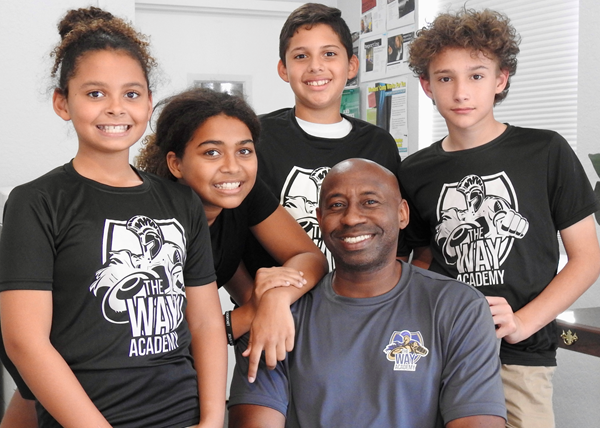
Charles Williams, founder of The Way Academy, surrounded by his daughters, Emma Williams and Elyn Williams, and students Christiaan Ruiz and Ezra Bartoli.
MINNEOLA, Fla. — The way Charles Williams sees it, if the human vessel comes to the conversation with humility, faith and willingness, the Almighty can communicate a message of divine purpose without resorting to special effects.
Sometimes — because God often whispers, Williams notes — all that is required is some contemplative quiet, especially if it can be managed during a season in which miracles are acknowledged and anticipated.
So it was, five winters ago, having listened carefully in the silent space between the hurly burly of Christmas events, an idea manifested itself. Too unpresuming to imagine he’d conjured it on his own, Williams is certain beyond debate divine intervention was afoot.
He brought the news to the extended family’s Christmas table and broke it gently, as you sometimes do when you’re about to ask your family to act boldly on God’s will. “What if we started a school?” he said. “How would it be?”
There are plenty of teachers in the Williams family, wife Betsy among them. As she recalls, “We all laughed. ‘We can’t start a school! How do you even do that?”
Now they know.
As the freshly minted principal of Real Life Christian Academy in nearby Clermont (after 17 years working up the public school ladder), he found himself in the right place to grasp the operations of a Christian school.
Also, he studied. It turns out there’s plenty of how-to information about school startups. The Florida Department of Education even has a webpage entitled Opening a Private School. Eventually, Williams found his way to the Drexel Fund, a Seattle-based nonprofit venture philanthropy that (from its website) “seeds new school models, scales networks of existing schools with a track record of academic and operational excellence, and strengthens the educational ecosystems needed to create the market conditions necessary for new private schools serving low-income students to thrive.”
When Drexel came on board, solving the puzzle of startup financing, things began to happen fast. Now, here we are, at an open house on an April Monday, and Williams is expounding on His vision — the capitalization intentional.
“The math, the science, the [English language arts], history … all will be coming from the Bible and being taught by Christian teachers and Christian leaders.”
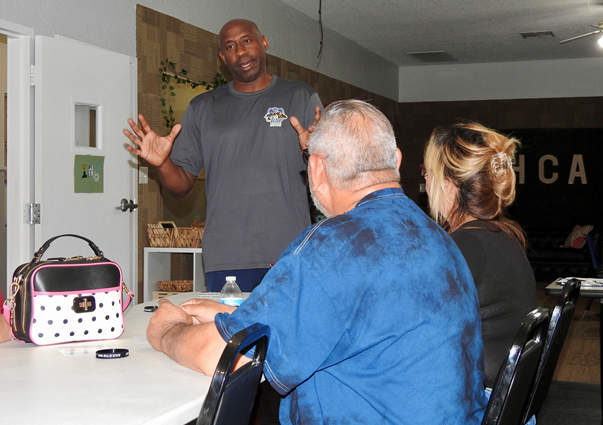
Williams, pictured here with parents Rigaberto Valle and Linette Bolanos, forges close relationships with The Way families.
Come August in Minneola, a small town northwest of Disney World, the vision planted in Williams’ obedient head is scheduled to become manifest when The Way Academy reopens the doors of the former New Hope Christian Academy.
The location, near the highlands of the Lake Wales Ridge, is appropriate. Williams and his board members mean to reach for heights of biblical proportions.
One would expect nothing less from a school designed to live out John 14:6, in which Jesus tells the disciples, “I am the way and the truth and the life. No one comes to the Father but through me.”
“Everywhere we turned, John 14:6 kept coming back,” Williams says. “We go to church and the preacher’s preaching on it. And we say, ‘This is it. The Way Academy. Showing kids, showing parents, showing the community, showing teachers, The Way. … And we’re going to be warriors about it. That’s who we are, the Warriors.”
Appropriately, Williams shares his name with the British poet, novelist, theologian and Inkling, a member of the Oxford Christian literary society that included C.S. Lewis (Chronicles of Narnia) and J.R.R. Tolkien (The Lord of the Rings). Appropriate because, like the Williams of Lake County, England’s Charles Williams was an out-of-the-box risk-taker.
The founder and first TWA headmaster, Williams didn’t need a new job. The Orange County School District had recruited him out of Real Life Academy to become its dean of students for the Orange County School District, meaning his professional future and, not insignificantly, retirement pension, were utterly tidy.
Now, brandishing a rich and varied academic background — from band director to teacher to coach to principal — to the task at hand, he’s left the secure nest and climbed out on that proverbial limb.
Parents who came to know him during two years he served in the administration of nearby Real Life Christian Academy are eager to join him on the bough.
“We called him ‘The Ghost,’” says Rosa Albalate, whose son Christian Ruiz, 11, is a prospective TWA student. “You could never find him in his office. He was always out with the kids. On the playground, in the cafeteria, in the hallways, in the classrooms. And the students loved it.”
Williams means to infuse the new school with a similar peripatetic spirit. A typical TWA day will include the usual middle-school shuffling among classrooms for various subjects, but also morning stretching and afternoons devoted to interscholastic sports.
And they’ll travel around Minneola’s cozy confines to use athletic and other extracurricular facilities offered up by the city, the YMCA, and a charter school.
Not that anyone involved doubts the difficulty of climbing their personal Mt. Ararat.
“Nobody wants to be in middle school these days,” Betsy Williams says. “Nobody wants to teach there, nobody wants to head it up. It’s hard to be a middle school parent. We know that middle schoolers go through a lot, even in general, now adding what they're going through” — here she punctuates with air quotes — “these days.”
“So, we're excited to be a school that commits to those kids.”
The excitement isn’t just infectious. It’s kinetic. Parents at the open house positively vibrated with enthusiasm.
“We’re looking for something a little smaller,” says Linette Bolanos, whose 11-year-old son, Aleksei, is set to transfer from Real Life Christian and its nearly 500-student K-12 campus. “Something family oriented that’s focused on Jesus.”
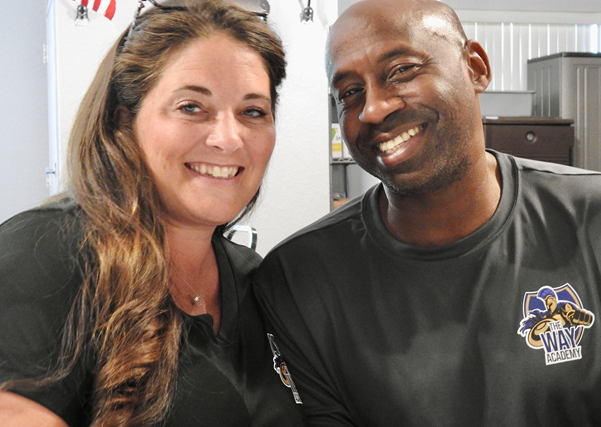
Williams and his wife, Betsy, who serves as the school’s admissions officer.
TWA ticks every box. TWA plans to limit first-year enrollment to 65 students across three middle-school grades. Parents and siblings will be invited to participate in a variety of TWA activities. And the Bible-based curriculum, stressing critical thinking and practical learning, comes straight from Bob Jones University Press — the same BJU that counts evangelist Billy Graham and former Arkansas Gov. Asa Hutchinson among its alumni.
“We’re interested in a school that has a background in faith, a school that provides spiritual guidance,” Albalate says. “Dr. Charles promised he will keep on it.”
Williams is big on standing by vows, including the one, shared with the Drexel Fund, about making the school affordable for low-income families. Excitement attends Florida’s massive expansion of school-choice opportunities through legislation signed by Gov. Ron DeSantis March 27. Moreover, through its close alignment with Step Up for Students, the school is acting to bridge the gap for families who may need a boost beyond the state’s per-student stipend.
That worry largely settled, TWA organizers can concentrate on what they’ve taken on.
Asked to enumerate TWA’s biggest challenges, Betsy Williams pulls a face. Several seconds pass. More air quotes. “These days,” she repeats. She’d rather talk about TWA’s opportunities, which come rapid-fire.
“To spread the Gospel is the biggest opportunity we have, and that’s what we’re called to do,” she says. “The next is to inspire kids in a way of healthy choices and getting moving in a world where all they want to do is look at a screen.
“The third opportunity is … to be a light in the community. We’re excited about all that.”
This is The Way, then. The Warrior way.
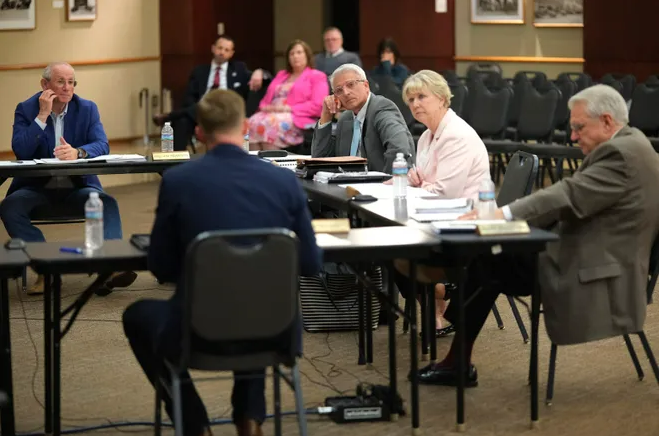
The Oklahoma Statewide Virtual Charter School Board met Tuesday to discuss a vote on whether to approve creation of St. Isidore of Seville Catholic Virtual School. PHOTO: Doug Hoke/The Oklahoman
Editor’s note: For related posts from reimaginED senior writer Lisa Buie, click here and here.
Concerned about conflicting attorney general opinions and the certainty of a lawsuit, members of Oklahoma Statewide Virtual Charter School Board unanimously voted to disapprove the application for what would be the nation’s first religious charter school.
The vote was a procedural move to buy time so board members could gauge the risk of personal liability following their final vote on St. Isidore of Seville Catholic Virtual School. Board members turned down the application on Tuesday after sidestepping the legal issue and instead raising questions about the school’s governance structure, special education plan, how it would prevent government money and private donations from co-mingling and technology.
“Do we have assurance from counsel if we are sued that we would have protection and support from the Attorney General’s Office?” board Chairman Robert Franklin asked during the discussion. “In recent history this board has been sued collectively and individually.”
The board’s counsel, Deputy Attorney General Niki Batt, said board members would receive representation if they were following state law and their actions were in the scope of their board position.
She said Oklahoma law explicitly states that no public money can be applied to support any religion.
That drew concern from board member Scott Strawn, who said, “Candidly, it feels like – intentional or not – that we’re basically being told make a decision against the advice of the attorney general and you may or may not have immunity.”
Heightening the tension are two conflicting legal opinions and statements the governor made about them.
Former Attorney General John O’Connor issued an opinion in December as his final official act that came as the statewide virtual charter school authorizing board was set to decide on the application for St. Isidore of Seville Catholic Virtual School, which the Archdiocese of Oklahoma City and the Diocese of Tulsa want to open to serve students in rural areas without a traditional Catholic school and to expand course offerings for students who already attend Catholic schools.
O’Connor said in his opinion that the state’s ban on publicly funded charter schools operated by sectarian and religious groups could violate the U.S. Constitution’s First Amendment and should not be enforced.
His successor, Gentner Drummond, withdrew O’Connor’s opinion and argued that it was based on precedent for private schools. Drummond said that state law defines, and the attorney general has previously recognized, charter schools as public schools, and that allowing the state to sponsor a religious school would create “a slippery slope” to use religious liberty to justify state-sponsored religion.
The clash promoted Gov. Kevin Stitt to weigh in by releasing a letter disagreeing with Drummond’s withdrawal of his predecessor’s opinion.
“You contend that the United States and the Oklahoma Constitutions permit, and indeed require, the state to discriminate against religious organizations seeking authorization to operate charter schools,” Stitt’s letter said. “In fact, the opposite is true.”
The letter continued, “These prohibitions run afoul of the non-discrimination principle articulated by the U.S. Supreme Court in recent cases.”
During Tuesday’s board meeting, state schools Superintendent Ryan Walters said he and the Oklahoma Department of Education would provide support to board members who approve the school’s application, thought it was unclear if that include legal representation.
Brett Farley, executive director of the Catholic Conference of Oklahoma, told The Oklahoman that the vote came as no surprise.
"This is fairly normal for their application process," Farley said. "It gives us more time to address their concerns, and so we'll do that and come back and present those and see where we go."
By turning down the application, members reset the clock on when a final vote must be taken. The rules allow applicants who are initially disapproved to make changes and resubmit their applications for a vote within 30 days. Had the board simply postponed Tuesday’s vote, the deadline for final approval would have been April 29.
You can watch a recording of the meeting here starting at the 49:22-minute mark.

Last week we discussed the Oklahoma attorney general’s advisory opinion against enforcement of the state’s prohibition on religious charter schools. After reading up on the subject, I declared myself president of the “Religious Charter Schools are Permissible, Mandatory and a Bad Idea” Club. My view on this is not motivated by apocalyptic opposition (Europe has the equivalent of religious charters) but on practicality. The path to religious charter schools goes through years of litigation which, even if successful, will find itself (all too easily) thwarted by the Baptist/Bootlegger coalition.
Before proceeding let me again repeat it is a travesty that school finance systems discriminate against families desiring a religious education, and we need to end that discrimination. Moreover, what I am about to describe below is not how I want the charter world to operate. Far from it. Also, again, I am open to challenge on all of this. It should be debated vigorously. Okay, let’s go.
Russ Roberts often references the “Baptists and the Bootleggers” problem during interviews on his invaluable EconTalk podcast. It is an idea from the economic study of regulation that is easy to grasp: both Baptists and bootleggers support the prohibition on the sale of alcohol, but for very different reasons. Baptists oppose the sale of alcohol for religious reasons, whereas bootleggers, those who create/import/sell alcohol illegally, support prohibition as a means of limiting their competition. Bootleggers are going to sell alcohol regardless, but they make bigger profits by restricting others from competing with them.
Charter school authorization in most states around the country, including Oklahoma, obviously suffers from a Baptist and the bootlegger malady. The “Baptists” in this case are teachers’ unions and the rogue’s gallery of fellow travelers who don’t want any charter schools at all. They have a great deal of political power. The bootleggers are at least as much if not a greater problem. With regards to charters, bootleggers make claims of being greatly concerned with “quality authorizing” but one need only be realistic rather than cynical in noting that “quality authorizing” has much more to do with limiting competition for incumbent charters than it does “quality.”
Quality of course is in the eye of the beholder, and our means for assessing it in the context of schooling has been quite primitive. Also, the self-serving “quality” rules can look awfully arbitrary and stupid with the slightest bit of examination. For example, Arizona has a charter school with a rate of academic growth rate 98.6% above the national average, which would have been in danger of closure if Arizona lawmakers had been gullible enough to adopt a default five-year closure law (a favorite of charter bootleggers).
As Lisa Graham Keegan explained:
Moreover, Arizona’s “wild” charter journey led to many low-income, highly performing charter management organizations that can only be found in the Grand Canyon State. Many are community-focused and community-developed, which we all say that we want, but their first priority was on stabilizing the communities they grew from. In other words, they weren't very good academically to start—but they did transform their neighborhoods, and parents trusted these new schools with their precious children over many other options that went out of business due to lack of enrollment. Years later, many of them, like Academies of Math and Science, Mexicayotl Academy, and Espiritu Schools, are now among the top performing schools in not just the state, but in the country, and were highlighted in last week’s Education Equality Index. The thing is it took a decade to do that. And we Arizonans let it happen.
The Baptist/Bootlegger Charter Alliance has been, alas, devastatingly effective around the country. A whole string of states has passed charter school statutes in recent years — states like Washington, Alabama, Kentucky, and Mississippi. National charter school groups have sung the praises of these laws, but then, they produce few actual charter schools. In Kentucky’s case, no charter schools. The “Baptists” don’t want any charter schools, and the “Bootleggers” only want charters from their own organizations to operate, and the compromise lands on few charters opening.
Oklahoma, for instance, passed its charter law in 1999, and the Oklahoma Charter Schools Association lists 30 or so charters operating in the state, which looks to be a net gain of 1.5 schools per year. The Baptist/Bootlegger coalition effectively wants few if any charter schools to open, and it won’t be overly difficult for coalition members to agree on a dislike of charter schools teaching religion as truth.
Years of litigation awaits the would-be religious charter school operator, the result of which may vary across jurisdictions. Regardless of how that plays out, the Baptist/Bootlegger coalition will be waiting. They’ve had to be barely creative (900-page applications, etc.) to throttle charter school growth, and motivated by a shared distaste for religious charter schools, I’m guessing they will get insidious if necessary.
Nonetheless, there will be those who make the attempt. My advice to you dear reader: Don’t be one of them. Your energies will be better rewarded elsewhere. As Sun Tzu wrote: “A victorious general wins and then seeks battle, a defeated army seeks battle and then seeks victory.” Even if you survive the courts, the B/B Alliance will be there to finish you off.
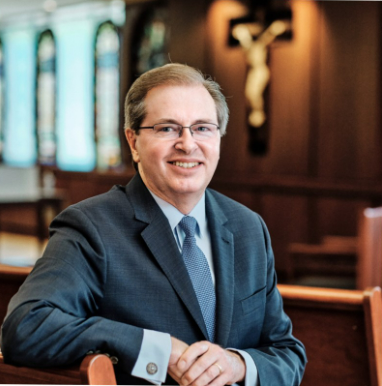
Thomas W. Carroll is a staunch promoter and defender of school choice in general and of Catholic education in particular.
Editor’s note: Daniel P. Schmidt, former vice president for program of The Lynde and Harry Bradley Foundation in Milwaukee, and Michael E. Hartmann, senior fellow and director of the Center for Strategic Giving at the Capital Research Center, recently spoke with Thomas W. Carroll about Catholic education and identity, creating a community of learners and believers, and the challenge of raising money for its mission in the current culture. Here are the results of their interview, which appear today on the Capital Research Center’s website. (You can listen to the interview here.
Thomas W. Carroll joined the Catholic Archdiocese of Boston’s Catholic Schools Office as superintendent in 2019, before which he held several positions at several various education-related nonprofits, including ones that ran schools and others that engaged in public-policy research and advocacy.
Carroll also was New York Gov. George Pataki’s deputy director for regulatory reform and played a leading role in the adoption of New York’s charter-school law.
The engaging Carroll is a principled and effective promoter and defender of school choice in general, and in his role as Boston Catholic schools’ superintendent, of Catholic education in particular. He believes the mission, properly understood and implemented, helps create community and academic outcomes, also helping students achieve eternal salvation, about which he is even more passionate.
“I think I bring to the job kind of a fresh set of eyes that’s different than if they hired a typical educator and see everything clearly, including all of its warts,” Carroll tells us. “We have an independent group called the Catholic Schools Foundation that raises roughly about, every year, $10 to $12 million in scholarships that gets spread across the Archdiocese, but with a concentration on school-lunch eligible, low-income kids,” according to Carroll.
For all students and their families, “community is really the right word to use in a Catholic sense” to describe the aim, “because we aren’t just educating children, we’re creating a community of learners, we’re creating a community of believers,” Carroll says. “We’re trying to create a community among parents as well—both within and around the school and the parish, but also across the Archdiocese.”
“In the current moment, it’s easier to raise money for charter schools than it is to raise money for Catholic schools,” he later notes. “The reason is, to be Catholic today … requires a certain amount of bravery given what the modern culture looks like, and people in corporate America are generally not particularly brave in terms of controversy.”
“When I converted” 20 years ago, Carroll continues, “most of the major propositions of the Catholic Church were not particularly controversial—God created men and women, for example. … As the culture has changed, particularly on social issues, … there are certain companies and certain individuals that have kind of pulled back.
”The people here are extremely generous, but there are specific companies that no longer will give money directly to the Catholic Church, and part of the reason so many people give money to the scholarship fund is its independent of the Catholic Church.”
In the conversation’s second part, Carroll talks more about Catholic education, the importance of remaining faithful to its core mission of eternal salvation, and the educational and societal benefits of school choice.
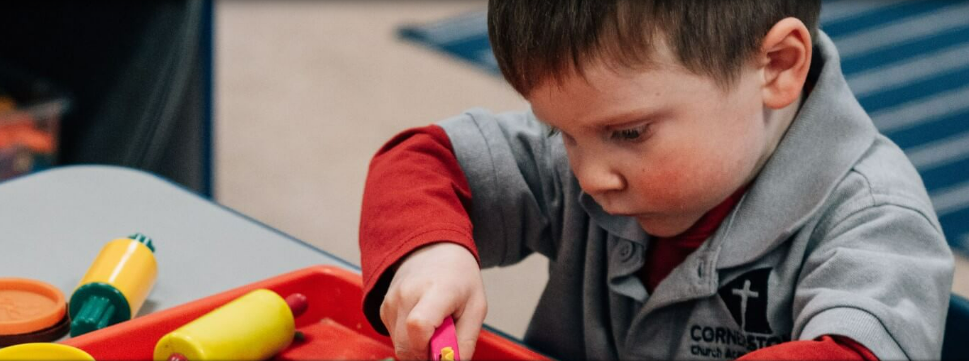
Cornerstone Christian Academy in Las Vegas is one of 171 private schools in the state serving nearly 30,000 students. Cornerstone’s vision is to encourage development of the whole child, engaging the student’s spiritual, academic and physical growth to prepare him or her to become productive kingdom citizens ready to be used for God.
Editor’s note: This commentary from Valeria Gurr, director of external relations for the American Federation for Children, and Shaka Mitchell, director of State Strategy and Advocacy for the American Federation for Children, appeared Friday on thenevadaindependent.com.
This spring, the U.S. Supreme Court has done its level best to stay in the headlines, but one pivotal case has yet to receive its due.
In the case of Carson v. Makin, the court found in favor of parents who wanted to use public funds to send their children to private, religious schools. While this case involved parties in the state of Maine, it could have major, positive effects for families in Nevada, too.
Parents who live in rural Maine and lack a local public high school could already use education funds apportioned by the government to put their kids in a private school. Unfortunately, for some families, they could not choose schools that provide religious instruction (though they could select a school that has a religious mission — the implication being that some schools are too religious).
The high court determined that if a state decides to allow education funds to be used for private school tuition, it may not discriminate against schools simply because they are religious. Parents in Maine may now choose schools according to their conscience, not the whim of a bureaucrat at the state Department of Education.
So, what does this mean for children in Nevada?
Some may erroneously believe the ruling will create programs that are de facto religious, causing some parents to reject the programs altogether. This is an argument that misses the point.
The high court’s ruling should be viewed as a possible pathway to help Nevada lawmakers fulfill their constitutional obligation. Article IX, Section 1 of the Nevada Constitution expresses the intent for the government's involvement in the educational system. It reads:
“A general diffusion of knowledge and intelligence being essential to the preservation of the rights and liberties of the people, the Legislature shall encourage by all suitable means the promotion of intellectual, scientific, moral, and agricultural improvement.”
To continue reading, click here.
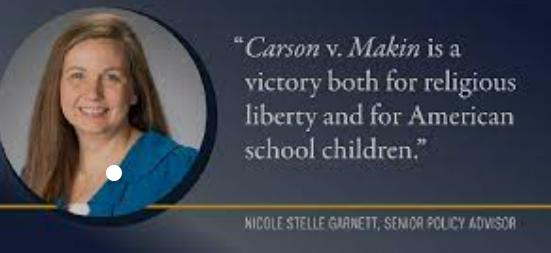 Nicole Garnett, senior policy adviser to the Alliance for Catholic Education and a Notre Dame University law professor, recently joined Tim Uhl, secretary of education/superintendent for the Catholic Diocese of Buffalo, on the Catholic School Matters podcast to discuss the recent Carson v. Makin Supreme Court case and implications for school choice moving forward. Here are some excerpts of the podcast:
The Catholic school movement has been advocating for the position that the court finally endorsed in Carson v Makin, which is that you cannot exclude a religious school from public benefit programs like school voucher programs because they’re religious. That is a position the Catholic Church has taken for over 175 years … So, there is a long history here of Catholic schools seeking public resources and being rebuked both politically and legally.
Neutrality toward religion isn’t math, it’s law. So, it’s not we don’t count up how many kids are in what kind of school and decide what neutrality is. It’s not a neutrality question, it’s a legal question ... The First Amendment requires neutrality toward religion.
It is true that Catholic schools have been flirting with being charter schools for a long time. It’s always important to keep in mind … it’s not necessarily a good idea that even if you could be a charter school that you want to be a charter school … there’s lots of political reasons you might not want to do it … it’s arguable that you should be permitted to if you want to.
You can listen to the full podcast here.

