
Primer Microschools Leader Fellow Adam Tweet with his wife, Paloma, and their daughter, Harper
Growing up, Adam Tweet loved learning. Until he didn’t.
Kindergarten was amazing, but as he got older, Adam wanted the freedom to pursue things he enjoyed. He loved reading but not books typically found on school reading lists. Comic books and interactive Choose Your Own Adventure books fed his passions.
But teachers told him he couldn’t read those books, even if they sat on school library shelves. He needed to read what they assigned.
“And that just turned me off reading,” Adam said. Now, the former Florida public school teacher and administrator wants to offer a learning environment for kids who were like him, who chafed under rigid rules and found joy by pursuing their passions, which for Adam included soccer and ice hockey.
Adam is one of 50 people across the United States chosen to be part of Primer Microschools’ inaugural Leader Fellowship program.  Likened to an evening MBA program, its goal is to help participants open and run Primer Microschools in their communities. Adam is among 28 fellows across Florida, where universal eligibility for education savings accounts has created a supercharged environment that allows the state to celebrate National School Choice Week with gusto.
A Minnesota native and self-described “average student,” Adam majored in P.E. and health. After graduation, he found few opportunities to teach those subjects. He fell into elementary school teaching after RCMA Immokalee Community Academy, a Florida charter school that serves primarily migrant farm working families, turned him down for the P.E. job but offered him a position teaching third grade. That started an education career that spanned more than a decade, including a year in Brooklyn, New York, and eight years in administrative roles for the School District of Lee County in Florida.
Then he became a parent, and his perspective changed.
“I was going on with my career and I’m like, ‘Public schools, public schools, I love them,’” he recalled. “And then I had my daughter, and it kind of switched.”
Adam and his wife, Paloma, wanted to examine every option to find the best education for their daughter, Harper, who is now 4 and in voluntary pre-kindergarten.
That exploration included research into microschools, which are intentionally small, teacher-led learning environments. They have been called a modern version of 19th-century one-room schoolhouses.
Florida has a plethora of such schools, including Kind Academy of Coral Springs, which began in 2016 and offers full-time and hybrid homeschool programs. Kind’s founder, Iman Alleyne, started her own 10-week training program for aspiring founders in 2022, with a goal of opening 100 microschools in 10 years. About a half-hour south in Davie, Colossal Academy offers middle school students the chance to spend part of their time on a farm. Partnerships with other nearby providers such as Surf Skate Science, which provides a hands-on approach to learning math, science, and design through the pursuits of surfing and skateboarding. Acton Academy has also brought its brand of student-directed learning to Florida, with 15 schools that put students on a “heroes’ journey.”
The National Microschooling Center estimates 95,000 microschools across the United States served more than 1 million students last year. With the passage or expansion of education savings accounts, microschools are expected to grow more in 2025.
When Adam and Paloma discovered Primer Microschools, they liked what they saw: competency-based learning with no age-based groups and with dedicated time for students to pursue passion projects that can range from setting up an art gallery to making and selling lip gloss. As a former P.E. teacher, Adam also liked the emphasis on outdoor activities.
Adam could also relate to Primer founder Ryan Delk’s story growing up as a homeschooler in central Florida. Delk’s mom, a teacher, wasn’t satisfied with the low-rated zoned school after moving to his grandparents’ home in 1996. So, she started a small homeschool for him, his siblings, and a few neighborhood kids. Rather than relying on textbooks, Delk’s mom made learning an adventure. She took them on field trips to historic sites to learn about the American Revolution and created a network of cardboard tunnels for students to crawl through to learn how the human digestive system works.
Adam wanted that experience for his daughter. And himself. Last summer, while his car was being serviced, he decided on a whim to fire off a text to Delk asking about the launch of a new fellowship program to help teachers start their own Primer Microschools.
To his surprise, Delk responded immediately.
“We talked for about 10 to 15 minutes,” while the mechanics worked on his car, Adam said.
Delk was moved by Adam’s sharing his sadness at watching once wide-eyed kids gradually lose their love for learning as they progressed through the traditional model and invited him to apply for the fellowship program.
“I really believed in what he was doing,” Adam said. “Academics are certainly important. Mastering reading, mastering math. But their project-based learning is amazing. Behavior problems are non-existent. Engagement is through the roof.”
Adam applied and was accepted. Primer is funding the program with a $1 million Yass Prize last year and is working to scale its established networks beyond South Florida and Arizona, and into new locations throughout Florida — from the Gulf Coast to the Panhandle — and into Alabama.
Fellows attend weekly live virtual training and work toward key milestones, such as finding a location. A new Florida law that Delk helped get passed last year eases certain zoning rules for those opening in locations such as religious buildings, libraries, community centers, former schools, and even theaters.
Fellows also receive a $500 monthly stipend. Training is held during the evenings to enable participants to continue their day jobs.
When they open their schools in August, they will become Primer employees and receive a salary and benefits.
Adam, who has enrolled his daughter for next year, plans to start his school in Fort Myers. His goal is to enroll 45 students, with three groups, one for kindergarten through second grade, another for grades three through five, and a third for grades six through eight. His school, like other Primer Microschools, accepts state school choice scholarships. Primer also works with qualified families to secure other need-based financial aid.
Now, Adam and the other fellows are working hard to prepare. They are learning from Primer leaders about the school’s proprietary software, its instructional methods, how to recruit students and navigate real estate matters.
Adam said the software program is “very user-friendly” and allows parents to keep track of what their kids are working on and their daily progress. The best thing, however, is being able to ask questions, share ideas, and celebrate wins with other fellows through a Slack group.
“Having the community of Primer has been incredible,” Adam said. “I don’t feel like I’m doing it alone.”
He looks forward to being able to “help other families in our community whose kids are similar to mine – they have passions but where they’re at now is not meeting those passions.”
Adam said he is working to finalize a location and anticipates an August opening.
Mornings will be devoted to core academics, while each afternoon, students will have an opportunity to pursue dreams that could include learning to code, creating podcasts, baking cakes or writing songs.
Adam’s classroom will be well stocked with reading materials, including lots of Choose Your Own Adventure and comic books.
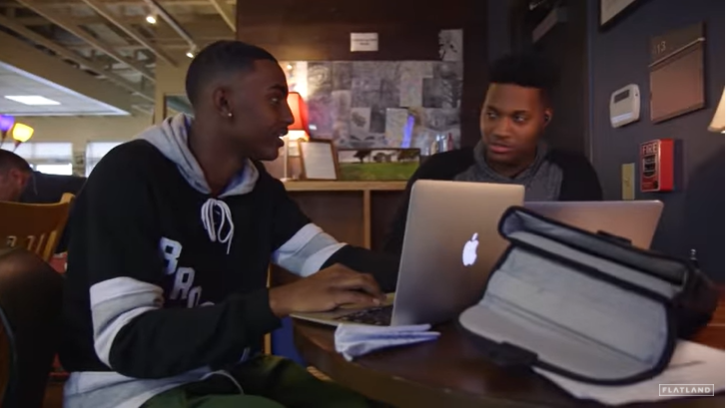
At Liberty Academy High School, learning is project and competency based with no traditional grades and no traditional seven-period day. Students are encouraged to work in small groups and interact frequently with teachers.
Editor’s note: You can watch videos of how Liberty Academy High School is rethinking education here and here.
A virtual tour of Liberty Academy High School in Liberty, Missouri, a suburb with a population of 30,167, is as notable for what you don’t see as much as for what is visible.
Instead of traditional classrooms crammed with desks, you’ll see multipurpose spaces with comfy chairs. The walls and ceilings are decorated with student artwork. Teachers collaborate with groups of students on projects and chat about goals for the day.
Rather than responding to a bell schedule, students move freely from area to area and are encouraged to come and go from campus as they practice the skills they’re learning in real life settings, thanks to agreements with more than 100 community business partners.
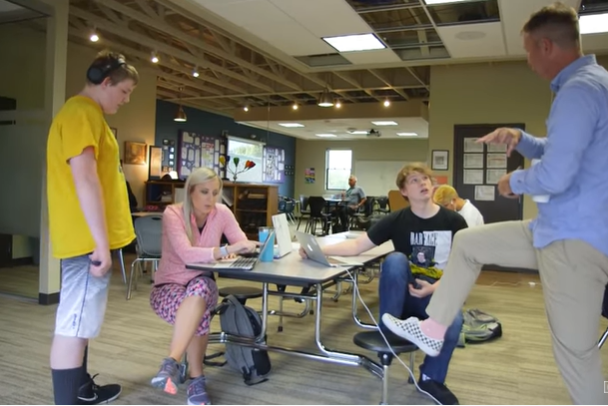
Social studies teacher Art Smith, right, believes strongly in each student's ability to pursue projects that interest them as a way to keep them focused on school.
Social studies teacher Art Smith, a 24-year veteran of Liberty Public Schools and a self-described “crazy guy,” redesigned the 26-year-old alternative high school’s format in 2016 with his colleagues so it would be more in line with what he calls “schools of the future.”
“We’re probably in a period of history where technology is allowing us to rethink schools,” said Smith, who doesn’t shy away from the title “education disruptor.”
During his career, Smith has tried almost every possible way to help kids derive meaning from what they’re learning, from carving canoes to building Conestoga wagons to staging archeological digs. He is among a rapidly expanding breed of educators who believe a break with the established educational model is necessary to improve the existing one.
Though Liberty Academy is a traditional district school, it looks and feels more like a public charter or private school with a model that draws inspiration from the unschooling movement of the 1960s, which encouraged exploration of activities initiated by students themselves. The basic idea is that the more personal learning is, the more meaningful it will be.
Here’s how it works. When students enter the program, they are allowed four weeks to determine their interests and long-term goals. Learning is then organized in six-week bursts of interest-based learning, which often includes participation with one of the school’s community partners in what school officials describe as “a reverse internship.”
Among the partners: a miniature horse farm, a greenhouse operation, cosmetology schools, a homeless shelter, and a host of nonprofit organizations. The aim is to allow students to explore careers, help others, and solve problems.
Students set goals based on three or four success skills during each segment. Teachers, who are referred to as advisers, help students document their growth each week and link their projects to standard and class credits.
At the end of each project, students give a presentation to a panel of at least three adults. At the end of each semester, they write an essay and display artifacts for a school and community showcase.
Learning is project based and competency based; there are no traditional grades and no traditional seven-period day. For staff members, it all adds up to an environment that looks more like life than school.
“Until you come and visit, it’s really hard to describe,” said Summer Kelly, Liberty Schools’ 2020-21 Teacher of the Year. (You can learn more about her here.) “I’m obviously a teacher, but I do way more than just teaching.”
A former middle school math teacher, Kelly left her traditional teaching job in the district three years ago to join the faculty at the alternative high school, which serves about 100 at-risk students.
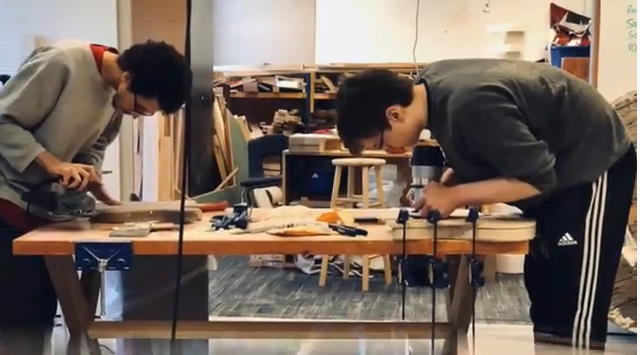
Among the project-based activities available to students at Liberty Academy High is guitar building, which teaches math and engineering skills.
A typical day starts with physical activity, with a yoga class offered weekly. Afterward, students gather for a “circle meeting” and check in with their advisers and learn about trips available that day. Students then go out in small groups to participate with advisers.
“Nothing about our building is traditional in any way, and I think that’s where I needed the change,” Kelly said. “It gave me new motivation.”
Smith, the social studies teacher who helped redesign the school, said he came to a conclusion early in his career that school needed to look different to be effective, especially for students who don’t like going to school.
“They’re forced to be there, and they’re compliant and sitting in their classroom and sitting in their desks, but a lot of kids weren’t interested in anything happening on a day-to-day perspective, and that bothered me,” he said. “If they don’t love it and don’t feel intrinsically driven to be a part of it, then we should try to build a framework that does that, because no human wants to be a part of something that they don’t have ownership of and empowerment in.”
The school, which has the support of the district and school board, has won several awards and was named a grand prize winner in the 2020 Magna Awards sponsored by the National Association of School Boards. Other nearby districts have taken notice and are seeking to incorporate parts of Liberty Academy's model.
Said Smith: “We all feel blessed to be in this position at this time and to continue pushing the envelope of what school can be for kids.”
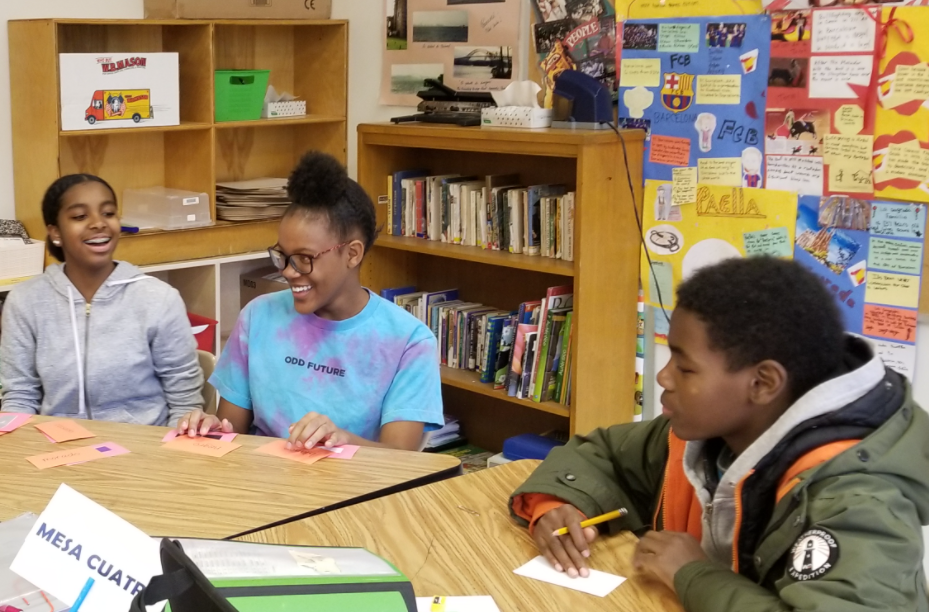
White Oak Middle School in Silver Springs, Maryland, is partnered with Project Lead the Way, the nation’s leading provider of science, technology, engineering and math programs, presented through projects and activities geared toward hands-on learning.
Middle school often is the black sheep of the educational family.
Lacking the youthful joy of elementary school and the sense of accomplishment of high school, most students consider middle school the worst segment of their education (see here and here). And while many parents and students complain about middle school, considerably less time is spent looking for a solution to the problem.
Luckily, new innovations in education informed by better research that indicates children grow rapidly psychologically between ages 11 and 13 may help improve middle school outcomes. While parents generally are aware of their middle schooler’s physical maturation, they may not be aware he or she is becoming more sociable, caring more about his or her status, and wanting attention from adults.
Middle school educators also can be unaware, and as a result do little to accommodate these psychological changes. Rather than increasing the time kids have to play together and learn cooperatively, middle schools often adhere to the most regimented programs.
Subject-based classes replace homerooms. Middle school principals are stricter about shuttling kids from class to class on time. Hallway socializing is discouraged, and unrestricted recess time is diminished. Instead of recess or general physical education, kids are sometimes funneled into after school sports.
Given these factors, it is any wonder that middle schoolers struggle to adapt to their school environment?
School administrators at White Oak Middle School in Silver Springs, Maryland, thought there was a better way to work with preteens. School leaders changed the structure to facilitate group learning by basing their entire curriculum, other than math instruction, on project-based learning. The school also increased collaboration across ages by eliminating traditional middle school grades altogether.
And, White Oak increased peer interaction across grades based on the idea that children develop at different speeds both physically and mentally, and understanding that children at this age are looking for mutual affirmation, something from which both older and younger youth can benefit.
Children have responded positively to these changes. A report authored by Douglas J MacIver, a research professor and director of Center for the Social Organization of Schools at Johns Hopkins University, found that students engaged in project based learning had scale scores 4 points higher than other students when it came to understanding text and vocabulary. This learning style also helped students feel socially engaged with their peers.
Additionally, the study found that the school’s collaborative approach helped reduce educational inequalities, which should be of primary interest given that the COVID-19 pandemic exacerbated educational inequities along racial and economic lines.
Yet concerns about the school’s radical departure from previous educational techniques remain. One concern centers upon the difficulty of scaling the approach so more schools can follow it. A project-based learning environment requires a higher level of personal supervision and may only be feasible in certain areas. And while eliminating grades may be a worthwhile goal, it is unlikely to become the norm given that colleges expect a certain level of standardizations across schools.
Nevertheless, there are remarkable takeaways that could, and should, be implemented in more school systems across the country. Middle schools could focus, for instance, on allowing kids to interact more with each other, either through unstructured play time or through collaborative learning environments. Some states are accomplishing this via mandates that their schools increase play time, and others should follow suit.
Middle school is a difficult time for most budding teenagers. Hormones are flowing and the stakes of education are rising. Some of their difficulties, however, are unnecessary byproducts of a rigid education system. Schools should be proactive in giving students an active social environment so they can mature.
Research has shown a better way forward, and now is the best time to innovate.
 Back in February, the George Lucas Educational Foundation released four studies using random assignment and matched comparison studies on project-based learning. You may have missed the release, distracted as you were by a global plague, but cumulatively, these studies seem very important.
The studies covered different subjects and grade levels, including Advanced Placement exams, middle school science, social studies and literacy at low-income schools, and social and emotional learning. The Lucas Foundation sponsored research with academics at the University of Southern California, Stanford University, the University of Michigan and Michigan State University, among others.
You can see all four studies here.
Three of the four studies used random assignment methods. One used a matched comparison methodology. All found positive learning gains associated with project-based learning.
How positive? Well let’s let the studies speak for themselves.
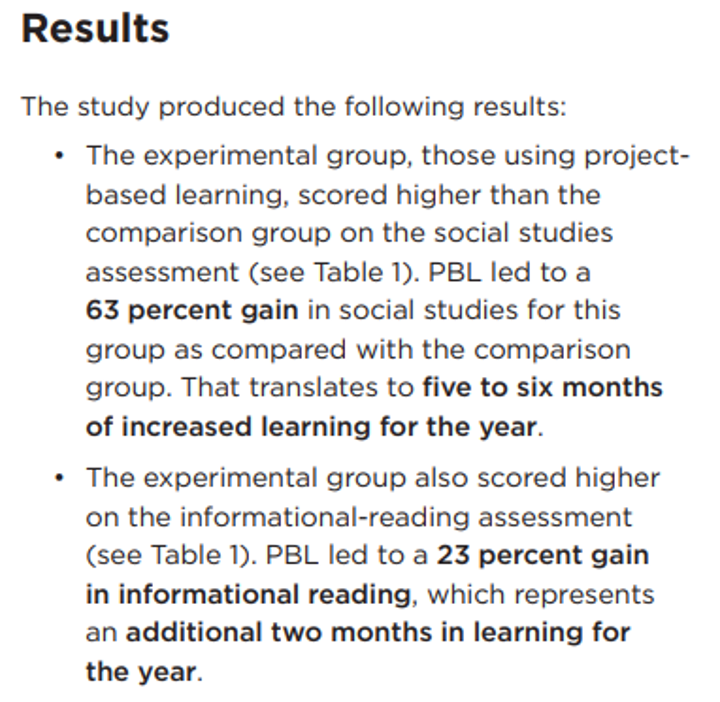
On social studies and literacy in low-income schools the random assignment study found:
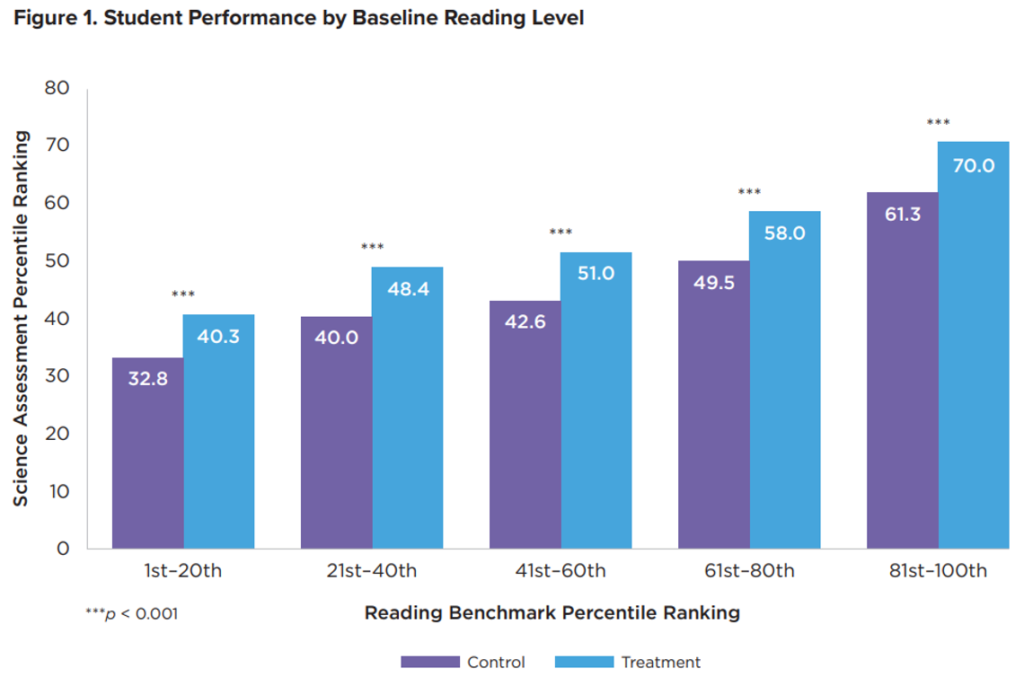
 Here are some of the main findings from the science study, which showed statistically significantly higher performance across initial benchmark groups based on reading ability.
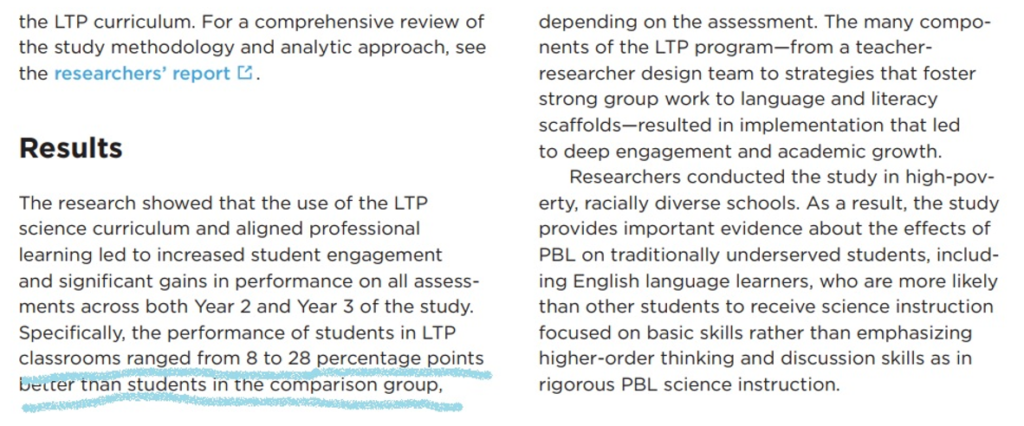
 The matched comparison study on middle school science also found sizeable positive results.
The Advanced Placement study found the experimental group participating in project-based learning was 8% more likely to score 3 or better in the first year of the program and 10% more likely in the second year. In combination, these studies show strong results across a variety of different subjects and types of students.
Project-based learning also happens to be part of the “secret sauce” driving micro-schools. As I wrote last year for the American Enterprise Institute:
A set of promising new schooling techniques has gained traction during the pandemic, which could bring joy back to education. Combined, they could create new opportunities for families and educators to make education more productive, more centered on family preferences, and even more fun for students and educators.
It’s great to see research showing that project-based learning can be very effective. I’ve seen with my own eyes micro-schools that have made project-based learning fun for both students and teachers. A new hope arises from a very old innovation strategy: combining pre-existing techniques or technologies to create something new.
 Science writer Matthew Ridley has described the innovation process as one of trial and error in which individuals combine pre-existing techniques and/or technologies.
One example: Horizontal drilling and hydraulic fracturing were around for many years before innovators figured out how to put them together to revolutionize the energy market.
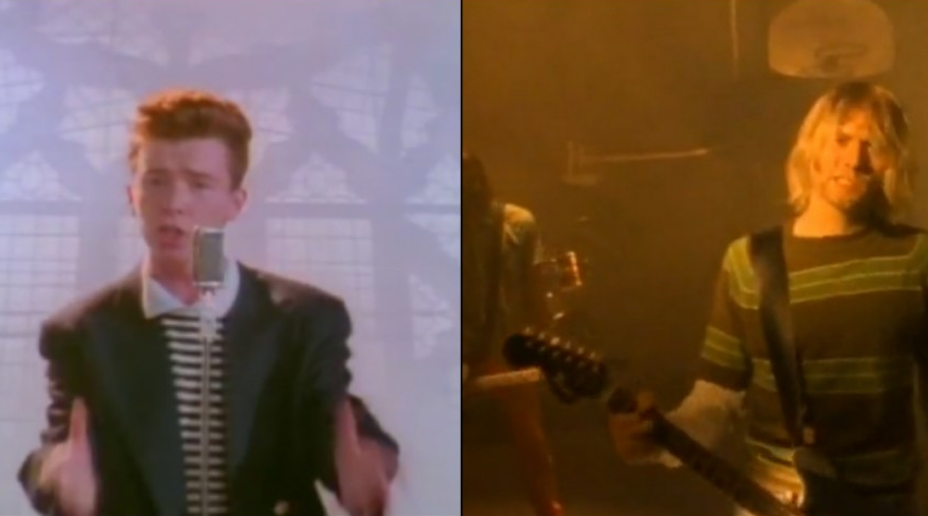
Another example: Rick Astley’s “Never Gonna Give You Up” and Nirvana’s “Smells Like Teen Spirit” were around for decades before some unknown innovator combined them to create the greatest song in the English language.
Likewise, a new policy brief posted to the Arizona Charter Schools Association website suggests that combining project-based micro-schools with rigorous live distance learning can create a new path, to scale, for high-demand schools and can unleash new opportunities for teachers while addressing equity concerns with pandemic pods.
A Phoenix radio host interviewed a 44-year (!) classroom veteran teacher last year. The teacher observed that the main problem with education today isn’t a lack of funding, which he said has “always been tough.” The real problem, he said, is that “the joy of teaching has been strangled out of the profession.”
This can and must change, and combining small education communities with rigorous distance learning just might do the trick.
If you’ve ever visited a project-based learning micro-school, you quickly see the joy so sorely lacking in most education settings. With Sal Khan, founder of a free educational video library that allows blending learning, as your scout-troop/school leader, you’re watching an excited group of kids engaging in 3-D print design. An education guide leads students through some daily academic work on computers, but then the students tackle group projects.
I watched students engaged in 3-D print design at a Prenda micro-school on the Apache Nation in San Carlos Arizona. These kids were not just learning, they were learning and loving it. These types of schools have great potential because they do not require educators to raise funds for multi-million facilities.
This style of education, which took an early hold prior to the pandemic, has been thrust into the limelight now through the advent of pandemic pods. Educators can address equity concerns, such as a low-income family’s ability to pay teachers and gain access to computers, with enlightened public policy.
Success Academy of New York developed another innovation to pair with micro-schools. Success Academy changed the roles of instructional staff for distance learning, with teachers variously tackling the roles of lecturers and small group facilitator/student problem solvers.
The most skilled math instructor in the network gave a live internet broadcast lecture via the internet. Students divided into small groups to interact with teachers to discuss the material and work out issues. Teachers then graded and monitored student achievement and scheduled individual online tutoring sessions with struggling students.
The Success Academy distance learning model is itself potentially revolutionary. In theory, the network could offer this version of itself to both enrollment lottery winners and enrollment lottery losers. Many parents on the waitlist might very much prefer this option over a spot in a district that numbers rather than names schools.
Education, however, is very much a social enterprise for many, as most of us want and need access to instructors and classmates. We need community. The Arizona Center for Student Opportunity brief referenced above calls for educators to combine Prenda-style micro-schools with Success Academy-style distance learning programs.
This proposal could take a variety of forms. Education service providers could reach agreements with pandemic pod providers to “adopt” them into their distance learning programs. Alternatively, high-demand schools could gauge interest in creating pods among their current students and their waitlisted families.
Equity-related concerns connected to pandemic pods could be addressed through funding students. Private choice programs focusing on disadvantaged student populations, such as Florida’s scholarship programs, could be used to help low-income students and those with disabilities afford micro-schools. Alternatively, public school distance-learning statues could defer costs.
In Arizona, Prenda operates schools through district, charter and private choice mechanisms. All Prenda students take the state’s AZMerit exam, and students whose education is funded through district and charter mechanisms have their results factored into school ratings.
In partnering with a Success Academy-style distance learning provider, the “mothership” would provide the live lecture, while the small group facilitation function would be conducted by in-person by guides. Different flavors of micro-schools can be created through affiliation with different mothership institutions. Teachers can run the show rather than being part of all-too-often hugely indifferent bureaucracies. All we need are some trailblazing educators and enlightened policy.
To paraphrase the Gen-X bard:
“With the schools out, it’s less dangerous! Here we are now, liberate us! Don’t feel stupid or contagious! Here we are now, educate us!”
In our everyday lives, we have choices.
We rarely buy whole LPs. We use programs like Spotify and Pandora to build custom playlists based on our individual tastes.
In everything from cars to spaghetti sauce, options have multiplied. Choice and customization reign.
As our culture has moved away from a ‘one size fits all’ approach to personalization to better meet an individuals’ preferences, the education field is following suit.
However, there is one problem.
Experts say there is not one universal term to describe “personalized learning." It means different things to a wide range of people who have different agendas.
Some say it is an excuse for unremarkable lessons with computers babysitting students for hours. Others say it is a new phrase that simply describes good instruction, where teachers connect with individual students. (more…)
Ryan Wallace left his big, cliquish high school last spring for The Foundation Academy, a non-denominational Christian school with vegetable gardens and an aquaponic farm. “I wanted a chance to try something new,’’ said Ryan, now a 17-year-old junior planning a dodge-ball fundraiser for his class president campaign.
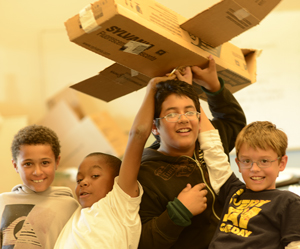
Boys in Aaron Unthank's single-gendered fifth- and sixth-grade class learn from each other, too. The setup gives Unthank more freedom to cater classes to meet boys' learning styles.
Twelve-year-old Marc’Anthony Acevedo came to the academy as a second-grader after being bullied at his old school. This year, he’s part of a single-gendered class of fifth- and sixth-grade boys. “Sometimes we have arguments, but we get over it,” he said. “We’re all friends.’’
For Cori Hudson, the Foundation was his last shot at a diploma. He messed up at the school district’s option of last resort. “I come to school every day now,’’ said the 16-year-old. “I feel like school is the most important thing to me.’’
These transformations are exactly what principal Nadia Hionides hoped for when she started the academy near Jacksonville Beach, Fla. nearly 25 years ago.
With a style that’s part Montessori, part Waldorf, the Foundation offers hands-on, project-based learning with a college-preparatory curriculum based on the philosophy that everyone learns differently.
The school has 280 students in kindergarten through 12th grade; 100 are in high school. They share a 23-acre campus that Hionides and her husband, a ship deck builder and painter, bought in 2008 for $600,000. The couple spent another $5 million for eight, prefabricated steel structures, which include a front-office foyer where the floor is made from vinyl records.
Tuition starts at $6,000 a year. But 81 students receive tuition assistance from Step Up For Students, the nonprofit that administers Florida’s tax-credit scholarship program for low-income kids and co-hosts this blog.
The academy separates students into groups of two grade levels - kindergarten and first-graders, second- and third-graders, etc.
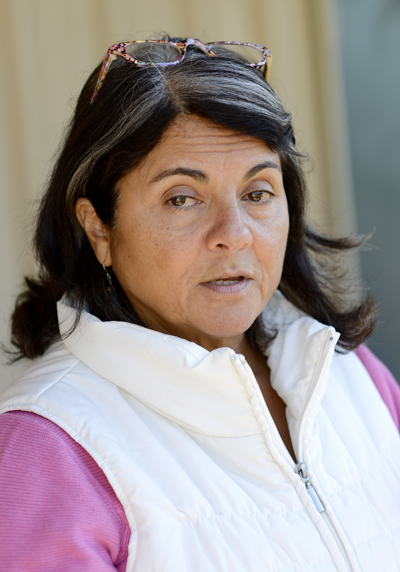
Hionides
“Because that’s real life,’’ Hionides said. Also, “they push each other to shine.’’
It seems to work in the fifth- and sixth-grade boys’ class – for the students and their teacher.
“It’s fantastic,’’ said Aaron Unthank, a longtime private school music teacher and baseball coach. “There’s a different kind of camaraderie as a class and there’s a lot more freedom I have as a teacher to talk about guy things.’’
The younger boys learn from the older boys, and the older boys gain confidence, Unthank said. He paraphrased Einstein: “You don’t know a thing well enough unless you can talk about it.” (more…)

