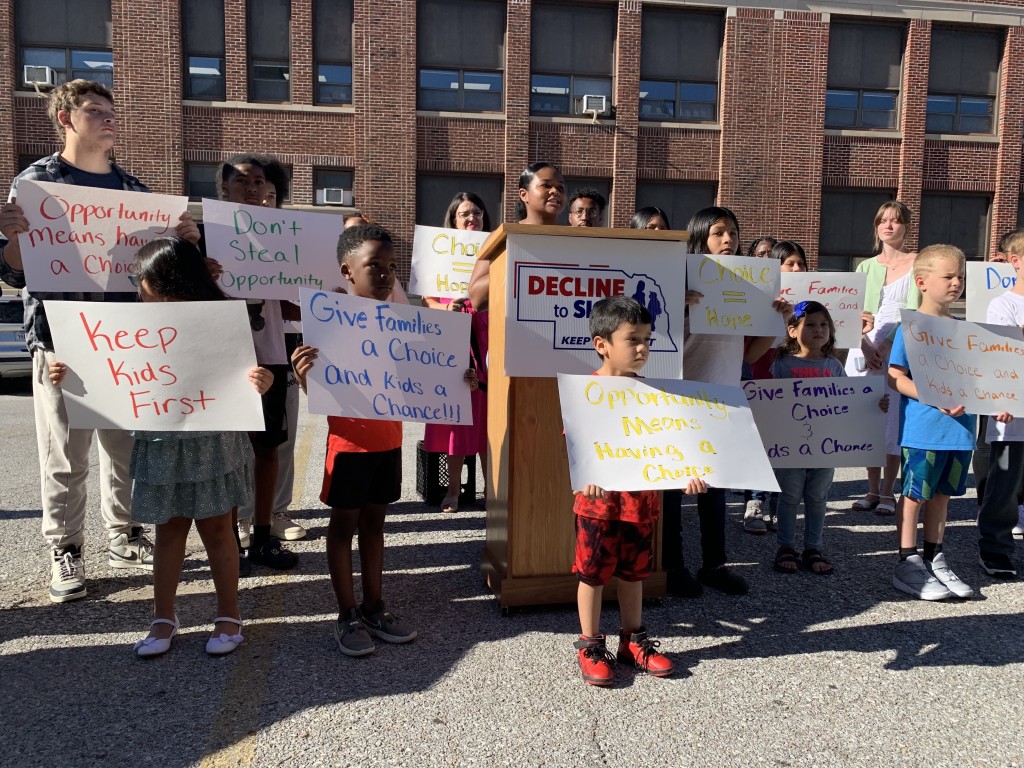
Jayleesha Cooper sat in her apartment at the University of Chicago and watched with hope as the election results rolled in.
The college senior from Omaha had marked her mail-in ballot to retain Nebraska Measure 435, upholding a $10 million tax credit Opportunity Scholarship program state lawmakers passed a year ago.
If the ballot referendum passed repealing the bill, families of 1,500 students would be forced to return to public schools next year or find enough funding to stay in their private school.
After a look at the Nebraska Secretary of State’s website, her hope turned to disappointment.
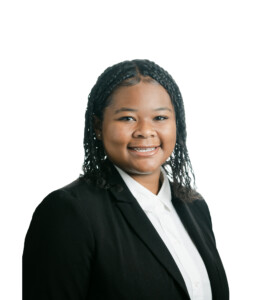
 “It was sad,” said Cooper, who was among a volunteer squad of young adult school choice alumni from the American Federation for Children who spent the summer of 2023 working to keep opponents from gathering the required number of signatures to get a previous scholarship bill put up for repeal. The college students reported being harassed by opponents, including some who photographed them and called in police.
Lawmakers repealed that bill and passed a new one to fend off a prior referendum attempt by the state teachers union. But opponents got enough signatures to put the new measure up for a veto referendum.
Choice opponents won on Election Day, with 57% of the vote compared with 43% who voted to continue the program.
Asked why the modest scholarship program drew such trenchant opposition, Cooper could only speculate.
“Maybe the people who were benefiting weren’t able to get out to vote,” she wondered. “Did the people who had to opportunity to vote – were they are aware of what they were repealing?”
National experts were stumped as to why choice initiatives in Nebraska, Colorado and Kentucky all suffered defeats. There is a long history of school choice measures failing at the ballot box in a wide range of states and political climates.
“The track record for school choice on the ballot has been so poor, but the poll numbers (for school choice) are always so strong,” said Ben DeGrow, senior policy director for ExcelinEd, a national education think tank founded by former Florida Gov. Jeb Bush.
DeGrow and others cited vague ballot language in Colorado that prompted a homeschooling group to oppose enshrining parental education rights in the state constitution. The group was concerned unclear wording might open the door to government regulation of homeschoolers.
In Kentucky, the “No” campaign outspent the “Yes” campaign more than three to one on a measure permit the creation of a future school choice program.
In the end, the unknowns proved to be too much, wrote Mike McShane, the director of national research at EdChoice. While the benefits of school choice may have seemed distant and hypothetical, the fears promoted by opponents about harms to public schools felt immediate and concrete.
For Cooper, the defeat in Nebraska felt deeply personal. A private donor scholarship made it possible for her to attend Duchesne Academy, an all-female Catholic school.
She credits that opportunity with ensuring she did not become a teen mom like many other girls she knew and for putting her on a path to a prestigious college. She is now applying to law schools and recently scored in the 92nd percentile on her LSAT.
She said she did her best to educate everyone she knew about the need to keep the Opportunity Scholarship program alive, including her 90-year-old grandmother, who cast a retention vote.
Despite the setback, Cooper says she won’t give up. She holds out hope that the new Republican majority in Washington will boost the chances of passing a federal education choice tax credit bill. That would offer some relief to families in states where the fate of parent-directed education continues to look grim.
Not that her home state should be let off the hook.
“It’s still important for Nebraska to keep working on a state program,” she said.
In the meantime, she promised to keep sharing the truth and debunking the myths about education choice.
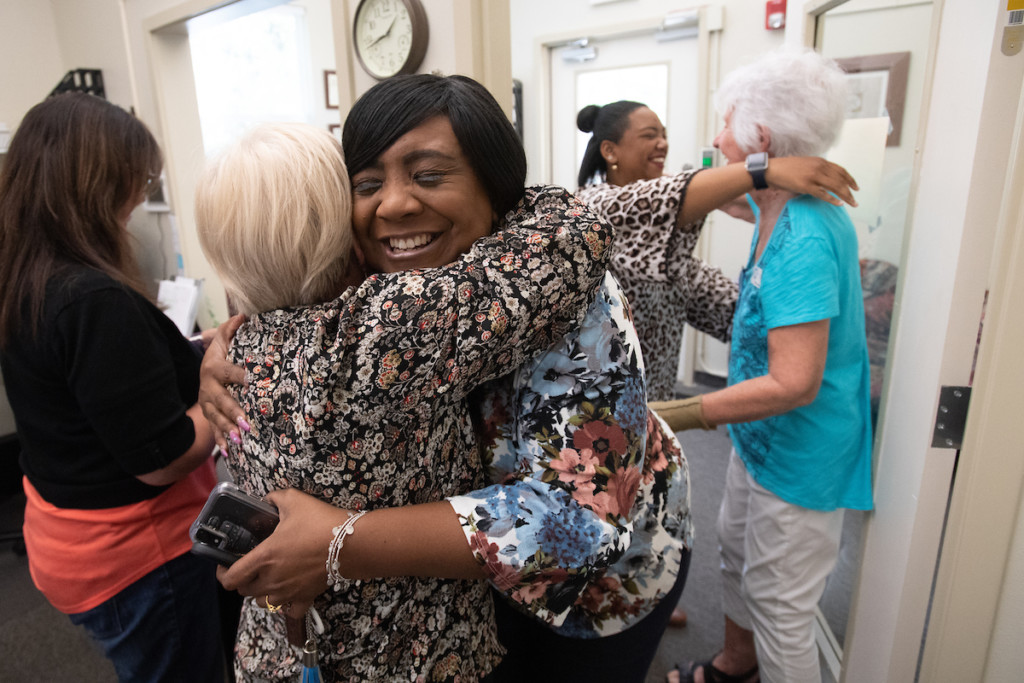
Tracy James and her daughter, Khaliah Clanton-Williams, are greeted by principal Maria Mitkevicius and administrator Mary Gaudet at the Montessori School of Pensacola. Khaliah
participated in Florida's Opportunity Scholarship program in early 2000. PHOTO: Michael Spooneybarger
Editor’s note: During this holiday season, redefinED is republishing our best articles of 2019 – those features and commentaries that deserve a second look. This article from Step Up For Students’ director of policy and public affairs Ron Matus was part of our “Education Revolution” series marking the 20th anniversary of the far-reaching K-12 changes Gov. Jeb Bush launched in Florida. Originally published May 30, it spotlights a mom and daughter who participated in Florida’s historic Opportunity Scholarship.
PENSACOLA, Fla. – Tracy James finished the graveyard shift to find her car a casualty of the “voucher wars” – and her 8-year-old, Khaliah, needing another ride to school.
This was 20 years ago, when this Deep South Navy town became the front in the national battle over school choice. In June 1999, Florida’s new governor, Jeb Bush, had signed into law the Opportunity Scholarship, the first, modern, statewide, K-12 private school voucher in America. Khaliah and 56 other students in Pensacola were the first recipients, and now enmeshed in a political clash drawing global attention.
CNN came. A Japanese film crew showed up. So did a member of British Parliament. All wanted to see the “experiment” a Canadian newspaper said “will shape the future of public education in this state and perhaps across the United States.” Tracy and Khaliah were in the thick of it, with Tracy among the most outspoken of an unconventional cast of characters. The single mom with the self-described rebel streak wouldn’t hide her joy at this opportunity for her only child – and refused to cave to anybody who suggested she was being “bamboozled.”
“If you want something better for your children,” she told one paper, “you would do the same thing.”
Not everybody appreciated her resolve.
Tracy walked out of her shift as a phlebotomist to find her car sabotaged, three tires flat as week-old Coke. She called her dad, who said he could take Khaliah to her new school, one Tracy could not afford without the scholarship. The flats left Tracy shocked and ticked – and more determined.
I guess I need tougher skin, she thought. Because we ain’t going back.
Lots of folks know Ruby Bridges. But Khaliah Clanton-Williams? Maybe one day.
The original Opportunity Scholarship students, their parents, and the five private schools that welcomed them have never gotten their due. After an epic legal battle, the Florida Supreme Court ruled the school choice program unconstitutional in 2006, and the decision in Bush v. Holmes seemed to close the chapter. But it didn’t. Many of those whose lives were touched by the scholarship have untold stories, with some still unfolding in ways that attest to the power of that experience.
In one sense, the Opportunity Scholarship was as small-scale as it was short-lived. Students were eligible if their zoned public schools earned two F grades in a 4-year span, and in 1999 only two schools – both in Pensacola – fell into that category. At the same time, most private schools sat it out. Among other restrictions, the law barred them from charging tuition beyond the scholarship amount of $3,400 to $3,800. At its height, the Opportunity Scholarship served 788 students.
And yet, it loomed so large. Florida’s “first voucher” stirred the imagination about what could be with a more pluralistic, parent-driven system of public education. It exposed the festering dissatisfaction many parents had with assigned schools. It enabled and amplified voices that still aren’t heard enough.
Pensacola may be best known for its Blue Angels and sugar-sand beaches. But most of the parents who applied for the school choice scholarships were working-class black women – nursing assistants and bank tellers, cooks and clerks, Head Start workers and homemakers. They had a lot to say about schools in Pensacola’s low-income neighborhoods, and for a few months in 1999, they had the mic.
***
Khaliah’s assigned school was modest red brick, five blocks from her home, named for the district’s first “supervisor of colored schools.” Khaliah would be starting kindergarten, so Tracy stopped to visit. She never got past the front office. “It was a zoo,” she said. “Kids were running around. They were screaming. There was no discipline. There was no structure.”
Nobody with the school acknowledged her, so after a few minutes, Tracy left … for good. She turned to her only option: another district school near her mother’s house, two miles away. Tracy said her mom, a former custodian for the school district, became Khaliah’s guardian so Khaliah could attend. But that school didn’t pan out either.
One day, Tracy watched through a window as kids in Khaliah’s class danced to music blaring from a boom box. She found the teacher in a side office and asked what was going on: “ ‘She said, ‘It’s reading time.’ I said, ‘They’re not reading.’ “ Tracy opened her eyes wide for emphasis.
Khaliah, meanwhile, shy and soft-spoken, was falling behind. “I had a hard time concentrating because it was so loud,” she said. “I’d ask for help and it was like, ‘just a moment.’ But the moment never came.”
Tracy heard about Opportunity Scholarships while working another job as a hotel desk supervisor. Some guests asked her in passing about local schools, and as fate would have it, they were lawyers with the Institute for Justice, the firm that would later help defend the scholarship in court.
Ninety-two students applied for the scholarships, including Khaliah, who had come back to live with Tracy. That exceeded the available seats in the four Catholic schools and one Montessori that opted to participate, so a lottery was held.
Khaliah emerged with a golden ticket.
***
Tracy took her time before deciding on a school. She read up on Catholic schools, talked to friends and co-workers who attended Catholic schools, learned everything she could about Montessori. She was intrigued by the latter – by the mixed-age classrooms, the cultivation of creativity, the curriculum that was so different. In the end, the rebel and her daughter decided they wanted different.
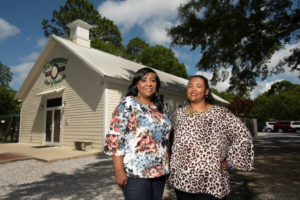
Khaliah Clanton-Williams, left, used an Opportunity Scholarship to attend the Montessori School of Pensacola.
Khaliah attended Montessori School of Pensacola from second through seventh grade, and, in Tracy’s words, “blossomed” in confidence and knowledge. She returned to public school in eighth grade (Tracy wanted her re-acclimated to public school before high school) and graduated from Pensacola High in 2010. For most of the next few years, she worked as a mortgage loan officer. She earned her associate degree in business administration from Pensacola State College in 2018. She’s on track to earn a bachelor’s in human resources management (with honors) in 2020.
Without the Montessori, Khaliah said, much of that would not have happened.
“It made me better,” she said. “I don’t think I would have gone to college. I don’t think I would have gotten my degree. (Montessori) made education more important. It was a higher standard.”
The upside wasn’t just academic. Tracy and Khaliah said nearly everyone in the school embraced Khaliah as family. There were only a few black students before a few more enrolled with the scholarships, but race was not a divide, they said. Khaliah made fast friends. They invited her to sleepovers, to ride horses, to U-pick blueberries. “These things were normal to them, but not to me,” she said.
Montessori co-owner (and head of elementary and middle school) Maria Mitkevicius said increasing diversity was a big reason the school opted into the scholarship program. So was the belief the school shouldn’t be limited to parents of means.
The staff knew the stakes, even if they didn’t know how much things might change. Twenty years after five private schools and 57 kids cracked the door, at least 26 private schools in Escambia County (Pensacola is the county seat) participate in Florida’s K-12 school choice scholarship programs, serving at least 2,163 students. Statewide, 2,000 private schools serve more than 140,000 scholarship students, with thousands more on the way.
“We thought this might change the face of education,” Mitkevicius said. “I guess it did.”
***
The news on Pensacola TV showed 10,000 sign-waving students and parents, marching at a 2016 school choice rally in Tallahassee with Martin Luther King III. As Khaliah watched it again last week, tears fell.
It hurt, she said, to see so many who still don’t have choice or fear their choices could be taken from them. At the same time, how nice to see strength in numbers.
“Back then,” she said, meaning 1999, “it was just us.”
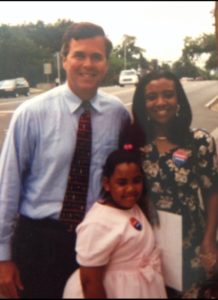
Tracy James and her daughter, Khaliah, with former Florida Gov. Jeb Bush circa 1999.
Remembering back then is tough for Tracy too. Some in Pensacola’s black community could not understand why black parents would support anything connected to Jeb Bush. “We were looked on as kind of those people who are being arm twisted by the governor, like you’re letting the Republicans bamboozle you,” said Tracy, now a clinical recruiter for a Pensacola hospital.
It got ugly. Dirty looks. Heated words. The tires. Tracy said some friends and family stopped speaking to her, and she switched jobs because she felt she was being harassed for taking a stand.
But the rebel has no regrets.
“I wanted to try something different, I wanted to be different, I wanted a different opportunity for my daughter,” Tracy said. “From what I saw happening, I wanted to be able to make the choice, myself, of where she’d end up as an adult.”
“I had no idea that it’d turn out to be such a controversial issue,” she continued. “To be thrown into sort of the limelight of a political battle, I had no idea. I had absolutely no idea how important it would be.”
Or how much of a struggle.
“When we went through that program, I was thinking that was kind of the end of an era,” Tracy said. “But it was actually the beginning.”
***
The shy girl who helped pioneer school choice is now a tough-minded mom who needs more.
Khaliah is married to a paper mill machine operator, and their oldest, Kyrian, will begin kindergarten this fall. His zoned school is one of 11 D-rated schools in the district, so like her mom before her, Khaliah looked for alternatives. She applied to three higher-performing district schools through an open enrollment program, but all were full. On a second go-round, Kyrian got into a new elementary north of Pensacola. It’s not ideal. The drive will be up to 45 minutes each way, and Khaliah switched jobs – to drive for Shipt, Lyft and Uber – so she can have flexibility.
Still, she’s worried. Kyrian has special needs – he’s hyperactive, averse to change in routine and undergoing speech therapy – but has not been formally diagnosed with anything. At this time, he wouldn’t qualify for any of Florida’s private school scholarships.
The irony isn’t lost on Tracy and Khaliah. School choice helped them. They helped pave the way for more. Yet 20 years later, there still isn’t enough choice for Kyrian.
The rebel’s daughter said that just means the work isn’t done.
“I’ll continue to fight for my children as my mom fought for me,” Khaliah said. “I’m not taking no as an option.”
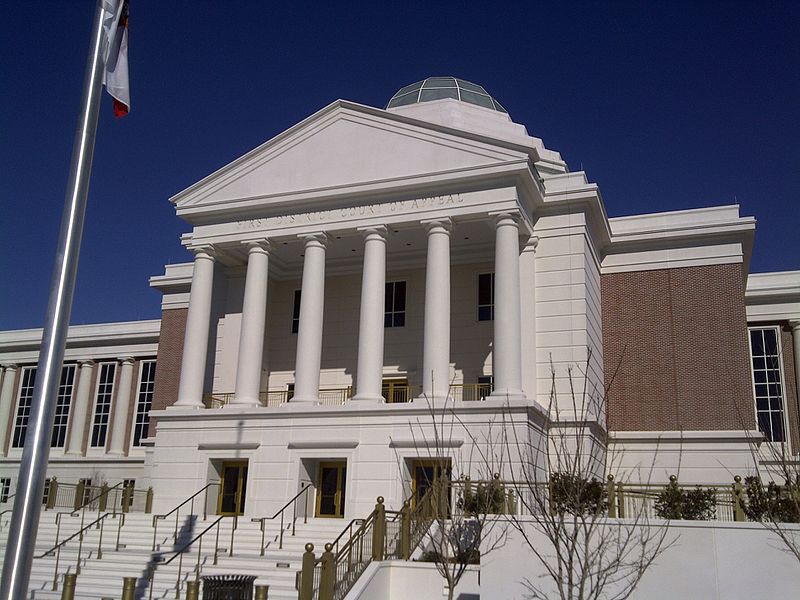
Florida's First District Court of Appeal
This is the second of two posts on the judicial history of Florida's Blaine Amendment with regard to public aid to private religious institutions. Part one can be read here. The U.S. Supreme Court is expected to weigh in on the constitutionality of state Blaine Amendments in 2020.
Lawyers defending Florida’s first school voucher program in Bush v. Holmes demonstrated the state historically allowed public funding to flow to many religious organizations providing public services, including through the McKay Scholarship for children with special needs. The First District Court of Appeal refused to acknowledge these programs.
Supporters of the Opportunity Scholarship program also cited several Florida Supreme Court cases which upheld aid to religious institutions as constitutional. But the appellate court found a way to ignore this precedent too.
Koerner v. Borck (1958) dealt with the last will and testament of Mrs. Lina Downey, who had donated a parcel of land to Orange County for use as a county park, but with the provision that Downey Memorial Church be granted a perpetual easement to access the lake for the privilege of baptizing members and swimming.
The court upheld the will, concluding,
“to hold that the Amendment is an absolute prohibition against such use of public waters would, in effect, prohibit many religious groups from carrying out the tenets of their faith; and, as stated in Everson v. Board of Education, supra, 67 S. Ct. 504, 505, "State power is no more to be used so as to handicap religions, than it is to favor them."
In 1959 the Florida Supreme Court heard Southside Estates Baptist Church v Board of Trustees, a case in which the court ruled religious institutions could use public buildings (in this case a public school) for religious meetings.
The court was not persuaded that minimal costs associated with the “wear and tear” of the building constituted aid from the public treasury, and concluded there was “no evidence here that one sect or denomination is being given a preference over any other.”
In Johnson v. Presbyterian Homes of Synod of Florida, Inc. (1970), tax collectors for Bradenton and Manatee County challenged a law that gave property tax exemptions to non-profits operating homes for the elderly after a religious organization applied. Presbyterian Homes of Synod, a religious non-profit operating homes for the elderly, maintained a religious atmosphere, offered religious services and employed an ordained Presbyterian minister who conducted services every day except Sunday. Most residents were even practicing Presbyterians.
The Florida Supreme Court determined the tax exemption benefit was available to all, not just Presbyterians, and ruled:
“A state cannot pass a law to aid one religion or all religions, but state action to promote the general welfare of society, apart from any religious considerations, is valid, even though religious interests may be indirectly benefited.”
Nohrr v. Brevard County Education Facilities Authority (1971) dealt with the issue of government issue bonds potentially being received by religious schools. The Florida Supreme Court found no problem here either.
In all four cases the Florida Supreme Court held the law did not violate the constitutional prohibition on direct or indirect aid to religious institutions. In all instances, the court examined who benefited from the aid, and required that the aid benefit the general public and/or required that no religious group be favored over the other.
The appellate court majority brushed aside these arguments, noting that the Opportunity Scholarship was different because the financial aid came directly from the state treasury, making the scholarship “distinguishable from the type of state aid found constitutional.” In fact, it appears the appellate court restricted Florida’s “no aid” provision to “payment of public monies,” though it failed to consider other similar programs such as McKay.
Having crafted itself exemptions to prior state Supreme Court precedent, the appellate court cited cases in Washington (2002), South Carolina (1971) and Virginia (1955) where state supreme courts held that direct subsidies to students were, in effect, benefits to religious schools.
This directly contradicted the U.S. Supreme Court decision in Zelman v. Simmons-Harris (2002), which determined the benefit to religious institutions from school vouchers were merely “incidental.”
The Florida Supreme Court had even weighed in on whether these benefits were direct or incidental during a 1983 case, City of Boca Raton v. Gilden, which upheld the city’s subsidy to a religiously affiliated daycare provider. The court declared:
“The beneficiaries of the city's contribution are the disadvantaged children. Any ’benefit‘ received by the charitable organization itself is insignificant and cannot support a reasonable argument that this is the quality or quantity of benefit intended to be proscribed.”
The appellate court in Bush v. Holmes failed to understand that the constitutional question hinged not on the method of aid, but who was the intended beneficiary of the aid. Though Florida’s constitutional language may appear clear, its longstanding history of neutrality in funding medical and educational services at secular and religious institutions, has muddied the waters.
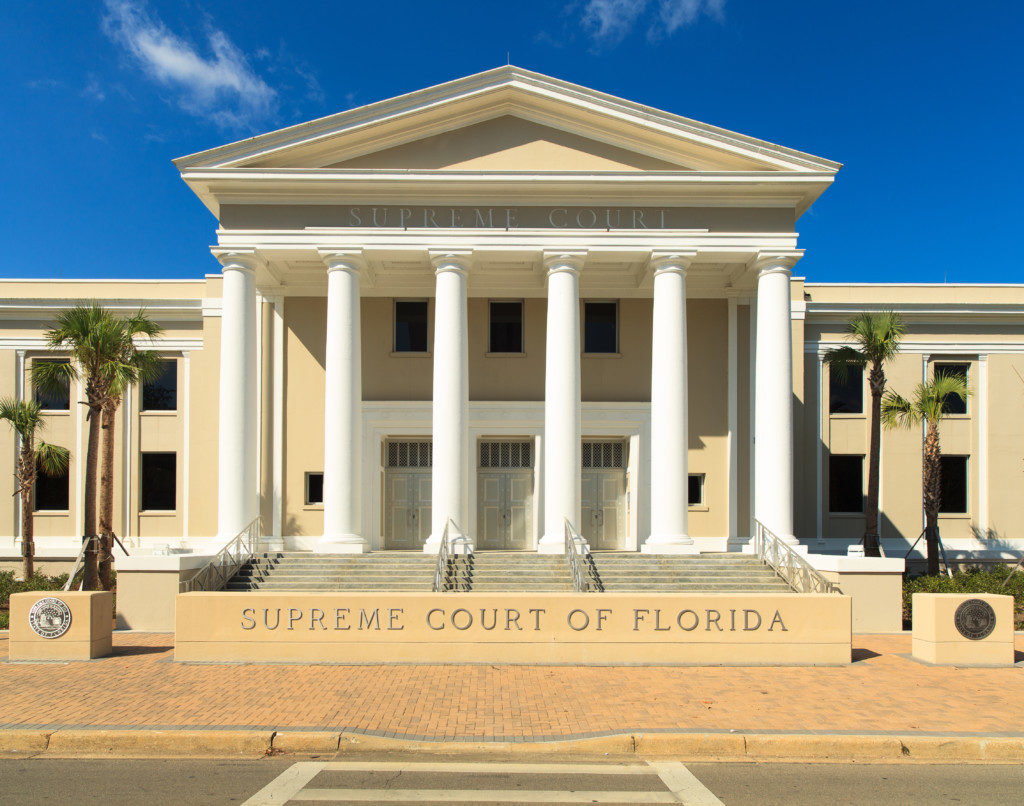
On June 7, 2005, opposing sides met for the final time to argue before the Florida Supreme Court over the constitutionality of the state’s first voucher program, the Opportunity Scholarship. Supporters of the program for low-income students had won several important victories, forcing opponents to abandon all but one remaining argument -- that the voucher violated Florida’s “Blaine Amendment.”
Florida’s Blaine Amendment, Article 1, Section 3 of Florida’s constitution, is one of the most restrictive in the country. It reads:
“No revenue of the state or any political subdivision or agency thereof shall ever be taken from the public treasury directly or indirectly in aid of any church, sect, or religious denomination or in aid of any sectarian institution.”
Just seven months earlier the First District Court of Appeal issued an “en banc” decision, with eight of the justices declaring the program violated Article 1, Section 3.*
A ruling by Florida’s Supreme Court on the matter could have sent the case to the U.S. Supreme Court to resolve, once and for all, how state Blaine Amendments could be applied to restrict or support state-funded scholarships to attend religious schools. But the Florida Supreme Court ducked the issue altogether. In a stunning move, the Court reversed course and resurrected two arguments it had rejected just four years before.
The U.S. Supreme court isn’t expected to resolve the lingering questions over state Blaine Amendments until 2020.
Florida’s First District Court of Appeal had the last word on the matter, but despite claiming a “clear meaning” and “unambiguous history” of Florida’s no aid clause, the court’s decision left gaping holes and many unanswered questions.
Lawyers defending the voucher program argued the scholarship did not violate the Florida Constitution because the benefit was to the student and the general public, and not intended to aid religious organization. In fact, the entire program was neutral with respect to religion because the vouchers were issued to parents who could use them at any private religious or non-religious school of their choosing.
Furthermore, the Opportunity Scholarship forbid private schools from selecting students on a religious basis and stated that scholarship students could not be compelled to pray, attend worship or even take religious courses.
Supporters noted several state programs benefiting Florida residents were provided at religious or religiously-affiliated institutions. Programs included Florida Bright Futures Scholarship, John McKay Scholarships, Florida Private Student Assistance Grant Program and eight other scholarship programs, along with the 23 private religious colleges accepting them. Supporters pointed to direct financial support for religiously-affiliated colleges, including $8.9 million in 2002 for libraries at Bethune-Cookman, Edward Waters College and Florida Memorial College.
Attorney General Robert Butterworth pointed to other direct appropriations, such a rent paid to churches used as polling places and subsidized pre-K at religious preschools.
Butterworth even noted that state funds provided subsidized medical care at religiously affiliated hospitals such as St. Mary’s in West Palm Beach or Baptist Medical Center in Jacksonville.
A direct taxpayer subsidy to a sick patient to attend any hospital, religious or non-religious, of their choosing, should not be treated any differently under the law that a scholarship to attend a religious or non-religious school, the Attorney General argued.
The appellate court majority responded to these arguments with deafening silence, with no mention of the McKay Scholarship, the state’s only other K-12 voucher program funded by direct appropriations at the time. The ruling was narrowly tailored to only one single K-12 scholarship program.
Even Judge Wolf, who concurred in part, criticized the majorities incoherent constitutional interpretation stating,
“In order to avoid catastrophic and absurd results which would occur if this inflexible approach was applied to areas other than public schools, the majority is forced to argue that the opinion is limited to public school funding and article 1, section 3 may not apply to other areas receiving public funding.”
The court would not only fail to grapple with these important constitutional questions, it would end up ignoring Florida’s own legal precedent on the matter.
Coming Thursday: Florida has a long history of court cases that upheld the constitutionality of providing aid to religious institutions.
*Seven justices ruled the OSP should be struck down entirely for violating the state’s “Blaine Amendment.” Just one justice ruled the OSP should be partially struck down by requiring religious schools to be excluded from the program. Five justices ruled the program should be upheld.
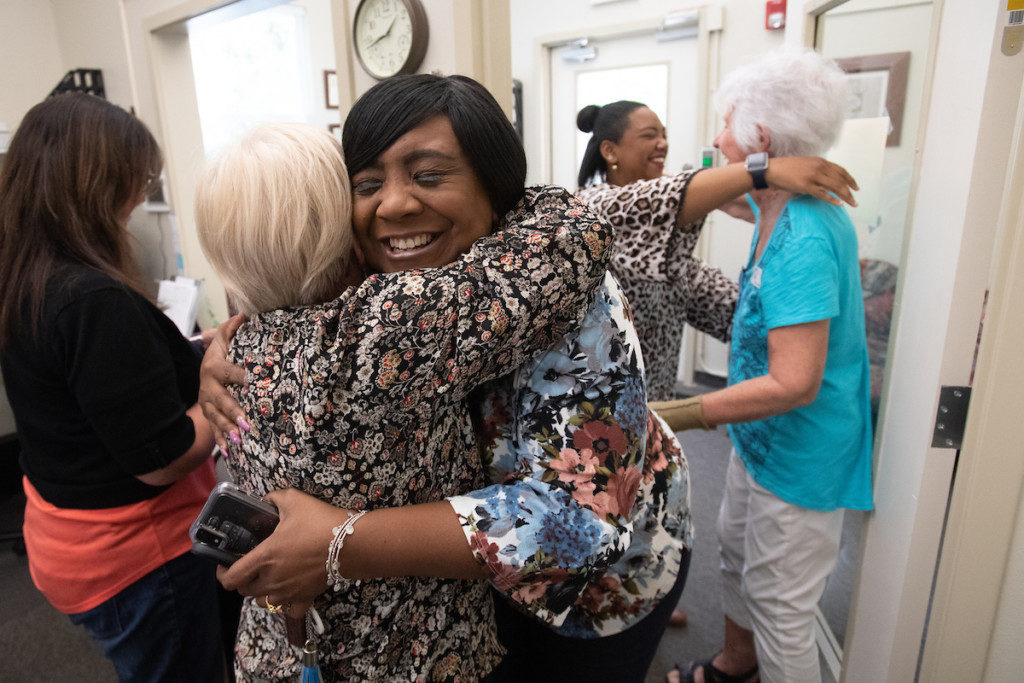
Tracy James, foreground, and her daughter, Khaliah Clanton-Williams, are greeted by principal Maria Mitkevicius and administrator Mary Gaudet at the Montessori School of Pensacola. Khaliah was one of the first students to use Florida's "first voucher," the Opportunity Scholarship, in Fall 1999. PHOTO: Michael Spooneybarger
Editor's note: 2019 marks the 20th anniversary of the far-reaching K-12 changes that Gov. Jeb Bush launched in Florida, including creation of the first, modern, statewide private school choice program in America. To highlight those changes, redefinED embarked upon a series of articles that examine Bush's "education revolution" and how it continues to reverberate. Today's piece spotlights a mom and daughter who participated in Florida's historic Opportunity Scholarship.
PENSACOLA, Fla. – Tracy James finished the graveyard shift to find her car a casualty of the “voucher wars” – and her 8-year-old, Khaliah, needing another ride to school.
This was 20 years ago, when this Deep South Navy town became the front in the national battle over school choice. In June 1999, Florida’s new governor, Jeb Bush, had signed into law the Opportunity Scholarship, the first, modern, statewide, K-12 private school voucher in America. Khaliah and 56 other students in Pensacola were the first recipients, and now enmeshed in a political clash drawing global attention.
CNN came. A Japanese film crew showed up. So did a member of British Parliament. All wanted to see the “experiment” a Canadian newspaper said “will shape the future of public education in this state and perhaps across the United States.” Tracy and Khaliah were in the thick of it, with Tracy among the most outspoken of an unconventional cast of characters. The single mom with the self-described rebel streak wouldn’t hide her joy at this opportunity for her only child – and refused to cave to anybody who suggested she was being “bamboozled.”
“If you want something better for your children,” she told one paper, “you would do the same thing.”
Not everybody appreciated her resolve.
Tracy walked out of her shift as a phlebotomist to find her car sabotaged, three tires flat as week-old Coke. She called her dad, who said he could take Khaliah to her new school, one Tracy could not afford without the scholarship. The flats left Tracy shocked and ticked – and more determined.
I guess I need tougher skin, she thought. Because we ain’t going back.
***
Lots of folks know Ruby Bridges. But Khaliah Clanton-Williams? Maybe one day.
The original Opportunity Scholarship students, their parents, and the five private schools that welcomed them have never gotten their due. After an epic legal battle, the Florida Supreme Court ruled the school choice program unconstitutional in 2006, and the decision in Bush v. Holmes seemed to close the chapter. But it didn’t. Many of those whose lives were touched by the scholarship have untold stories, with some still unfolding in ways that attest to the power of that experience.
In one sense, the Opportunity Scholarship was as small-scale as it was short-lived. Students were eligible if their zoned public schools earned two F grades in a 4-year span, and in 1999 only two schools – both in Pensacola – fell into that category. At the same time, most private schools sat it out. Among other restrictions, the law barred them from charging tuition beyond the scholarship amount of $3,400 to $3,800. At its height, the Opportunity Scholarship served 788 students.
And yet, it loomed so large. Florida’s “first voucher” stirred the imagination about what could be with a more pluralistic, parent-driven system of public education. It exposed the festering dissatisfaction many parents had with assigned schools. It enabled and amplified voices that still aren’t heard enough.
Pensacola may be best known for its Blue Angels and sugar-sand beaches. But most of the parents who applied for the school choice scholarships were working-class black women – nursing assistants and bank tellers, cooks and clerks, Head Start workers and homemakers. They had a lot to say about schools in Pensacola’s low-income neighborhoods, and for a few months in 1999, they had the mic.
***
Khaliah’s assigned school was modest red brick, five blocks from her home, named for the district’s first “supervisor of colored schools.” Khaliah would be starting kindergarten, so Tracy stopped to visit. She never got past the front office. “It was a zoo,” she said. “Kids were running around. They were screaming. There was no discipline. There was no structure.”
Nobody with the school acknowledged her, so after a few minutes, Tracy left … for good. She turned to her only option: another district school near her mother’s house, two miles away. Tracy said her mom, a former custodian for the school district, became Khaliah’s guardian so Khaliah could attend. But that school didn’t pan out either.
One day, Tracy watched through a window as kids in Khaliah’s class danced to music blaring from a boom box. She found the teacher in a side office and asked what was going on: “ ‘She said, ‘It’s reading time.’ I said, ‘They’re not reading.’ “ Tracy opened her eyes wide for emphasis.
Khaliah, meanwhile, shy and soft-spoken, was falling behind. “I had a hard time concentrating because it was so loud,” she said. “I’d ask for help and it was like, ‘just a moment.’ But the moment never came.”
Tracy heard about Opportunity Scholarships while working another job as a hotel desk supervisor. Some guests asked her in passing about local schools, and as fate would have it, they were lawyers with the Institute for Justice, the firm that would later help defend the scholarship in court.
Ninety-two students applied for the scholarships, including Khaliah, who had come back to live with Tracy. That exceeded the available seats in the four Catholic schools and one Montessori that opted to participate, so a lottery was held.
Khaliah emerged with a golden ticket.
***
Tracy took her time before deciding on a school. She read up on Catholic schools, talked to friends and co-workers who attended Catholic schools, learned everything she could about Montessori. She was intrigued by the latter – by the mixed-age classrooms, the cultivation of creativity, the curriculum that was so different. In the end, the rebel and her daughter decided they wanted different.
Khaliah Clanton-Williams, left, used an Opportunity Scholarship to attend the Montessori School of Pensacola from second through seventh grades. She and her mother, Tracy James, revisited the school last week for the first time in years. PHOTO: Michael Spooneybarger
Khaliah attended Montessori School of Pensacola from second through seventh grade, and, in Tracy’s words, “blossomed” in confidence and knowledge. She returned to public school in eighth grade (Tracy wanted her re-acclimated to public school before high school) and graduated from Pensacola High in 2010. For most of the next few years, she worked as a mortgage loan officer. She earned her associate degree in business administration from Pensacola State College in 2018. She’s on track to earn a bachelor’s in human resources management (with honors) in 2020.
Without the Montessori, Khaliah said, much of that would not have happened.
“It made me better,” she said. “I don’t think I would have gone to college. I don’t think I would have gotten my degree. (Montessori) made education more important. It was a higher standard.”
The upside wasn’t just academic. Tracy and Khaliah said nearly everyone in the school embraced Khaliah as family. There were only a few black students before a few more enrolled with the scholarships, but race was not a divide, they said. Khaliah made fast friends. They invited her to sleepovers, to ride horses, to U-pick blueberries. “These things were normal to them, but not to me,” she said.
Montessori co-owner (and head of elementary and middle school) Maria Mitkevicius said increasing diversity was a big reason the school opted into the scholarship program. So was the belief the school shouldn’t be limited to parents of means.
The staff knew the stakes, even if they didn’t know how much things might change. Twenty years after five private schools and 57 kids cracked the door, at least 26 private schools in Escambia County (Pensacola is the county seat) participate in Florida’s K-12 school choice scholarship programs, serving at least 2,163 students. Statewide, 2,000 private schools serve more than 140,000 scholarship students, with thousands more on the way.
“We thought this might change the face of education,” Mitkevicius said. “I guess it did.”
***
The news on Pensacola TV showed 10,000 sign-waving students and parents, marching at a 2016 school choice rally in Tallahassee with Martin Luther King III. As Khaliah watched it again last week, tears fell.
It hurt, she said, to see so many who still don’t have choice or fear their choices could be taken from them. At the same time, how nice to see strength in numbers.
“Back then,” she said, meaning 1999, “it was just us.”
Tracy James and her daughter, Khaliah, with former Florida Gov. Jeb Bush circa 1999. Bush championed creation of the Opportunity Scholarship program, which allowed Khaliah to attend a private school. PHOTO: Courtesy of Tracy James
Remembering back then is tough for Tracy too. Some in Pensacola’s black community could not understand why black parents would support anything connected to Jeb Bush. “We were looked on as kind of those people who are being arm twisted by the governor, like you’re letting the Republicans bamboozle you,” said Tracy, now a clinical recruiter for a Pensacola hospital.
It got ugly. Dirty looks. Heated words. The tires. Tracy said some friends and family stopped speaking to her, and she switched jobs because she felt she was being harassed for taking a stand.
But the rebel has no regrets.
“I wanted to try something different, I wanted to be different, I wanted a different opportunity for my daughter,” Tracy said. “From what I saw happening, I wanted to be able to make the choice, myself, of where she’d end up as an adult.”
“I had no idea that it’d turn out to be such a controversial issue,” she continued. “To be thrown into sort of the limelight of a political battle, I had no idea. I had absolutely no idea how important it would be.”
Or how much of a struggle.
“When we went through that program, I was thinking that was kind of the end of an era,” Tracy said. “But it was actually the beginning.”
***
The shy girl who helped pioneer school choice is now a tough-minded mom who needs more.
Khaliah is married to a paper mill machine operator, and their oldest, Kyrian, will begin kindergarten this fall. His zoned school is one of 11 D-rated schools in the district, so like her mom before her, Khaliah looked for alternatives. She applied to three higher-performing district schools through an open enrollment program, but all were full. On a second go-round, Kyrian got into a new elementary north of Pensacola. It’s not ideal. The drive will be up to 45 minutes each way, and Khaliah switched jobs – to drive for Shipt, Lyft and Uber – so she can have flexibility.
Still, she’s worried. Kyrian has special needs – he’s hyperactive, averse to change in routine and undergoing speech therapy – but has not been formally diagnosed with anything. At this time, he wouldn’t qualify for any of Florida’s private school scholarships.
The irony isn’t lost on Tracy and Khaliah. School choice helped them. They helped pave the way for more. Yet 20 years later, there still isn’t enough choice for Kyrian.
The rebel’s daughter said that just means the work isn’t done.
“I’ll continue to fight for my children as my mom fought for me,” Khaliah said. “I’m not taking no as an option.”
 Financial emergency: The Jefferson County School District is in a financial emergency, the Florida Department of Education declares. The state requires districts to have a 3 percent reserve fund, and the district's is now under 2 percent. The state has asked for and received two financial improvement plans, but Education Commissioner Pam Stewart says neither is adequate. Tallahassee Democrat. Gradebook.
Lawsuit hearing: A Leon County judge schedules a hearing today to consider a request for an injunction against the state's retention policy for third-graders. A group of 14 parents is suing the state and several school districts over the policy, which calls for retention of third-graders who do poorly on the Florida Standards Assessments reading test or opt out of it. Gradebook. The Sarasota County School District relents and promotes one of the 14 students whose parents are suing the state. The 9-year-old boy had opted out of the FSAT and declined to take any approved alternative tests, and was detained. After the announcement, the Sarasota district was dropped from the suit. Sarasota Herald-Tribune.
Zika and schools: Gov. Rick Scott is launching a statewide Zika awareness campaign for schools and students. He told the 67 district superintendents that the state will produce posters and other educational materials for school display and to be sent to parents. The state also is producing classroom materials that can be worked into science courses. Tampa Bay Times. Palm Beach Post. Miami Herald. Highlands Today.
Top high schools: A Florida high school, Stanton College Preparatory School of Jacksonville, is ranked the sixth-best in the United States, and it and nine other state schools are listed among the top 500 in the country in a magazine's annual ratings. Last year, 23 Florida schools made the top 500. The ratings are compiled from graduation rates, college enrollment, standardized test scores and other factors. Newsweek. (more…)
A recent report from Harvard researchers offers more compelling reasons why expanded learning options are so needed for struggling students. Based on data from four urban school districts, the Strategic Data Project at Harvard's Center for Education Policy Research found lower-performing students are placed with brand-new teachers far more often than their higher-performing peers.
Given high turnover in high poverty schools, and the reluctance of school boards to address it, you’d expect more of these match-ups there. But the researchers found them across all schools. And given what we know about the effectiveness of rookie teachers, the tragic impact is obvious: “The systematic placement of novice teachers with lower-performing students can be expected to compound these students’ academic difficulties and exacerbate achievements,” the researchers wrote. They termed it a “double whammy.”
That’s putting it mildly. There is no justification for saddling students with the greatest need with teachers who are often the least effective. It’s a clear case of public schools perpetuating a vicious cycle that they can, within their power, do much to help mitigate.
The practice isn’t good for teachers either. The researchers ask, “Is it the best strategy to develop and retain highly effective teachers by placing them in challenging situations when they are at a critical stage in their development as teachers?”
The report suggests potential remedies, including paying teachers more to work in tough schools. Maybe, someday, school districts will get around to doing that in a meaningful way. In the meantime, how can anyone deny parents the chance to find better odds in an alternative setting?
While defending his sponsorship of Pennsylvania’s proposed Opportunity Scholarship, state Sen. Anthony Hardy Williams has been known to draw parallels between opponents to school choice and the demagogues who blocked the advance of the civil rights movement. But there have been an increasing number of critics who blanch at the analogies, most recently from Kevin Ferris at The Philadelphia Inquirer. Ferris acknowledges that “education is indeed a civil right” and he supports the educational options that would result from the Opportunity Scholarship. “But voucher opponent does not equal Klansmen,” he writes.
That may be a harsh indictment of Williams, who hardly appears ready to adorn his political adversaries with a white hood, but it raises a fair question in our discourse over education reform: Is it appropriate to resurrect the history of the civil rights movement and relate its struggles to today’s effort to establish more educational alternatives for disadvantaged children?
The name of the Rev. H.K. Matthews may not be as familiar as the Rev. Martin Luther King Jr. in history books, but Reverend Matthews is well known in the Southeastern United States as a pioneer in the movement who led the first sit-in demonstrations at segregated lunch counters in the Florida panhandle and was jailed 35 times during the process. He also marched with Dr. King at Selma, and his achievements have been celebrated and his life story chronicled in the biography Victory After The Fall. But for the past several years, Matthews, who’s now 83, has been active in the cause for school choice for low-income children, calling the effort “a natural extension of the civil rights movement.” (more…)
Many of you are aware that the New Jersey legislature is considering a tax credit scholarship bill modeled on Florida’s successful program. Sponsored by some prominent Democrats, this bill has inspired spirited debate in legislative committees, at rallies at the Capitol, and in the press. Today, former Democratic Gov. James Florio weighed in with a column published in the Newark Star Ledger, the state’s largest newspaper. I don’t often do this, but I couldn’t resist adding my own comments after the Governor’s (His column is below, and my comments are in italics).
By James J. Florio
The establishment of a system of universal public schools for all American children was a historic event for the world and the key to our nation’s development and prosperity. It provided unmatched literacy levels for our citizens and a commitment to excellence as a national goal. It enabled people from every country to be blended into one people, representing an amalgam of ideas of freedom and opportunity through upward mobility. Our diversity was molded in the public schools and became our strength. [Democracy does require a publicly funded education system that embraces and develops our diverse strengths into a unified whole, but empowerment and customization are necessary for this to occur. Top-down, command and control education systems are the wrong way to go. In this century we cannot expect a one-size-fits-all model, where we assign students to schools by zip codes, to work effectively.]
Now, we find — through proposed voucher systems — a rejection of our unifying universal educational model. [Not true. Parental empowerment is a part of a new, more democratic model of publicly-funded education. The old model gave taxpayer dollars to a monopoly system that disempowered parents by assigning students to schools by geography. The new empowerment model allows parents to choose from qualified, properly regulated suppliers of many kinds—without preference for who the provider is.] (more…)
UPDATED: New Jersey's proposed Opportunity Scholarship Act won unanimous approval Thursday in the state assembly's Commerce and Economic Development Committee. Of the five members who approved the plan, three were Democrats, including the committee chairman, Albert Coutinho. While Coutinho acknowledged there are concerns over the measure within his party's caucus, he said the vote was "a sign that we're serious about education reform and considering all options."
Newark Mayor Cory Booker testified in favor of the proposal: "This bill doesn’t remove our moral obligation to fix the failing public schools in New Jersey, nor does it relieve the crime that’s happening every day when we fail our children. [But] it’s about time we give some small sliver of immediate hope for parents who are desperate in our city."
Before approving the plan, Coutinho said the overall size of the program would be reduced from nearly $1 billion over five years to $360 million, the Asbury Park Press reported. Proponents said they expect further amendments as the bill heads to the assembly's Budget Committee.

