 If you look at enrollment trends in the Arizona districts with the largest total enrollment losses, look at the Arizona Open Enrollment report and the Quarterly ESA report, you get Figure 1. In Figure 1, both the gains from open enrollment (blue columns) and the losses to other districts and to charter schools (red columns) are presented. The purple columns represent the ESA enrollment of students who live in each of these districts.

Note that the ESA students reside in these districts; many of them were never enrolled in the district where they reside when they enrolled in the ESA program. Some students were already attending private schools, in which case they effectively transferred from the private scholarship tax credit program to the ESA program. Others were in those red columns, attending charter schools and other district schools through open enrollment. Others enrolled in kindergarten straight into the ESA program; others moved in from other states. Others, of course, transferred into ESA directly from their resident district. The purple columns, however, undoubtedly overstate the impact of the ESA program on district enrollments.
Even if they did not, I invite you to compare the red and the purple columns. The financial impact to a district school is identical whether they transfer to another district school, to a charter school, to the ESA program, or move out of the state.
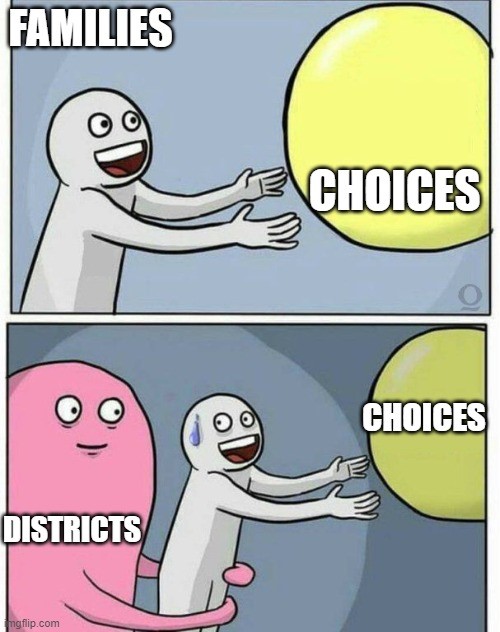
Medieval serfdom in Europe involved landed aristocrats exploiting serfs who were bound to the land. Aristocrats owned the land and their serfs worked land which they did not own, attempting to scratch out an existence after the aristocrats took their cut of the harvest. Life was nasty, brutish and short for the serfs, who lacked anything in the way of rights, as Britannica explains:
The essential additional mark of serfdom was the lack of many of the personal liberties that were held by freedmen. Chief among these was the serf’s lack of freedom of movement; he could not permanently leave his holding or his village without his lord’s permission.
Of course, we’ve long since left serfdom behind here in the land of the free and the home of the brave. We would never abide with a system in which you had to go ask some modern-day baron to grant you permission to move. The idea is entirely absurd, with one very incongruous exception: K-12 education.
Available to All’s indispensable report on the laws governing open enrollment transfers reveals that many states restrict movement within and between district schools. Four states (Hawaii, Virginia, Washington and Wisconsin) treat families as serfs by requiring them to seek the permission of their residentially assigned school to transfer within their district. Another four states sometimes require such permission.
The serf is up, however, when it comes to those wishing to transfer to a school in a district in which they do not reside. Thirteen states require serfs to seek the permission of their neo-feudal overlords (their resident district) to transfer to another district. These 13 states are colored purple in the map below:
Figure 2: Permission of Resident District Required to Transfer to Another District
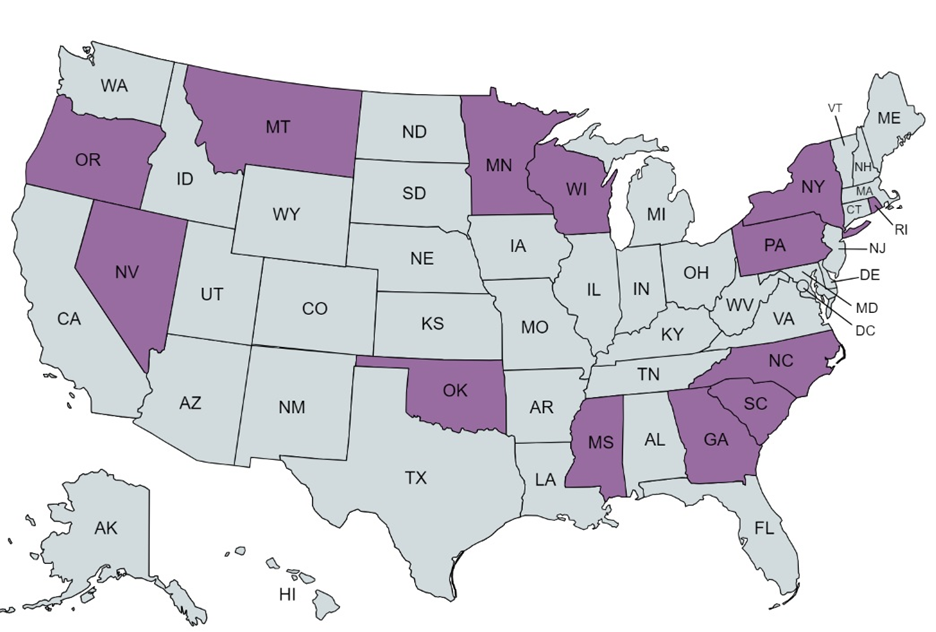
Hawaii only has a single school district, so there can be no transfers between districts, making the school level permission requirement all the worse. Another 11 states sometimes require students to seek the permission of their resident district.
Not everybody has gone serfing, however. There are 21 states where no one must seek the permission of their resident school to transfer, and 21 states where you never have to seek the permission of your resident district. While we are busily reducing the amount of funding discrimination against families wishing to send their children to private schools, we ought to expand family access to public schools as well.
 Aaron Churchill, Ohio research director for the Thomas B. Fordham Institute, has released a new report on charter schools in his state for the institute.
Broadly speaking Churchill praises an effort that began in 2015 to tighten up accountability for authorizers, advocates for funding and other efforts to expand “quality” charters, and calls for funding equalization between brick-and-mortar district and charter schools.
Churchill writes: "Ohio can’t afford to slip back into the dark ages of lax accountability and anything-goes in the charter sector. Lawmakers need to maintain the commitment to accountability for sponsors and schools to ensure that student achievement remains a priority and that the performance of the sector continues its upward trend."
This bit of text in the study got your humble author’s attention: "Through much-needed reforms, state lawmakers have reinvented Ohio’s charter school sector. The Buckeye State is no longer the “wild west” of charter schools, as dozens of low-performing schools have closed, and more than forty sponsors have departed."
Out in Arizona, we take the “wild west” term as a badge of honor, given our remarkable results and the unfortunate stagnation of much of the rest of the charter movement. I don’t live in Ohio, and thus will offer no opinion on any of Chu’s recommendations. I will however offer a different perspective.
Let’s start with exhibit A, the Brookings charter school access map from 2014-15.
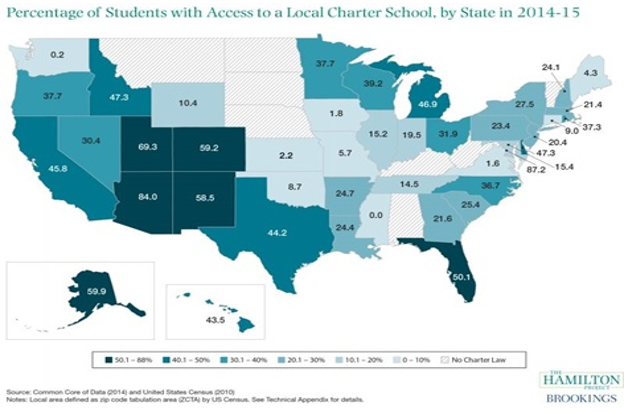
The map shows the percentage of students in each state with one or more charter schools operating in their ZIP code. Even before the 2015 reforms that Chu noted led to 100 Ohio charter schools eventually closing, the state’s charter school sector operated in fewer than one-third of all Ohio ZIP codes.
This was according to the initial design of the Ohio charter statute. Until a recent change in statute supported by both Fordham and yours truly effectively prevented charter schools outside urban areas.
The Stanford Educational Opportunity Project has compiled academic achievement data on schools from around the nation by linking state exams. This chart shows the average rate of academic growth by school for Ohio charter schools, 2008-2018.
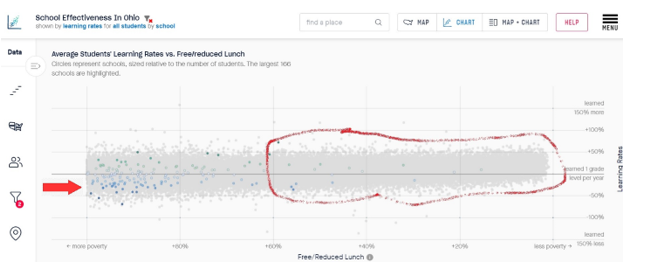 Figure 1: Average Academic Growth Rates for Ohio Charter Schools, 2008-2018 (Source: Stanford Educational Opportunity Project)
Two things to note: First, the circle. Ohio has very few charter schools with either median or low levels of student poverty. The lack of schools in the red circle constitutes further confirmation of the heavily geographically segregated nature of Ohio’s charter school sector seen in the Brookings map.
Second, note the red arrow. Ohio had a large number of high-poverty charter schools with low levels of average academic growth (blue dots below the “learned 1 grade level per year” line. This is disturbing. It means the already large achievement gaps grew in these schools over time.
Finally, take note of the blue-to-green dot ratio: High grow schools do not outnumber schools with low levels of growth.
Now, let’s compare Ohio’s geographically segregated charter sector to the nation’s most geographically inclusive charter sector in Arizona. As shown in the Brookings map, 84% of Arizona students had one or more charter schools operating in their ZIP code.
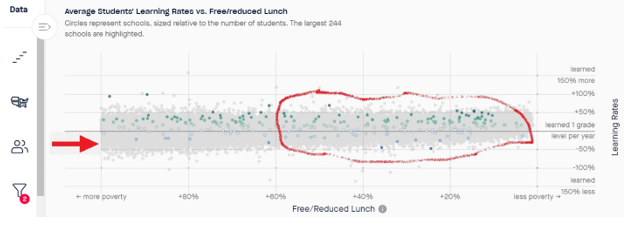
Figure 2: Average Academic Growth Rates for Arizona Charter Schools, 2008-2018 (Source: Stanford Educational Opportunity Project)
Look again in the red circle. Lots of charter schools and lots of charter schools with high levels of academic growth.
Next, let’s examine the high poverty area of the chart near the red arrow: very few low-growth schools.
Finally, notice the total ratio of green-colored schools to blue-colored schools in the entire chart. Arizona has high growth schools across the entire sector, relatively few low-growth schools.
Data from the National Alliance for Public Charter Schools reveal that Arizona has a larger absolute number of urban charter schools than Ohio. How did the state avoid a large number of low-growth schools-urban or otherwise? Closures, but largely not of the administrative variety.
The Arizona State Board for Charter Schools listed 106 charter school closures between 2010 and 2014 and the reasons for the closures, a few more than the 100 closed in Ohio since 2015. The board describes a wide variety of reasons for closures including lack of enrollment, loss of a facility, merger with another charter, etc. The explanations are broad enough to require interpretation, but approximately 16 of the school closures involve a clear administrative action by the board to either close or merge.
Arizona charter schools that closed between 2000 and 2013 had an average tenure of operation of four years and an average of 62 students enrolled in the final year of operation for closed Arizona charters. Arizona law grants 15-year charters, but the competitive environment in Arizona closes charters early and often.
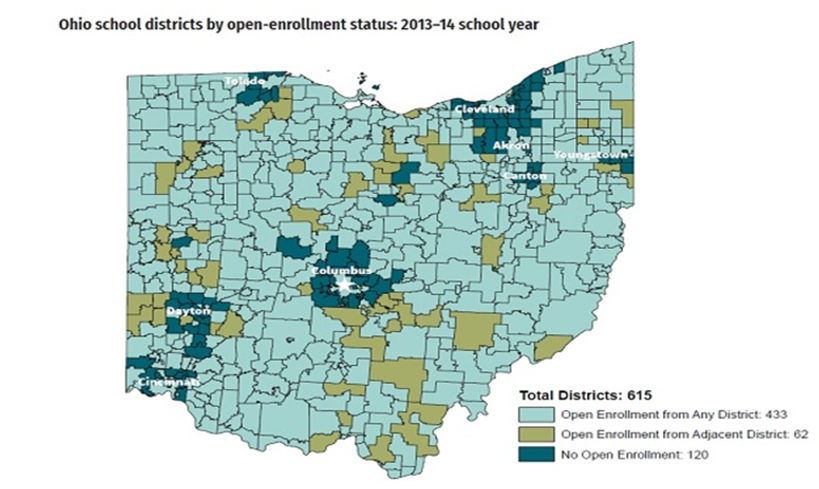
Why does Ohio have so many low-growth charter schools? I believe that this map from the Fordham Institute explains much of the difference between Ohio and Arizona:
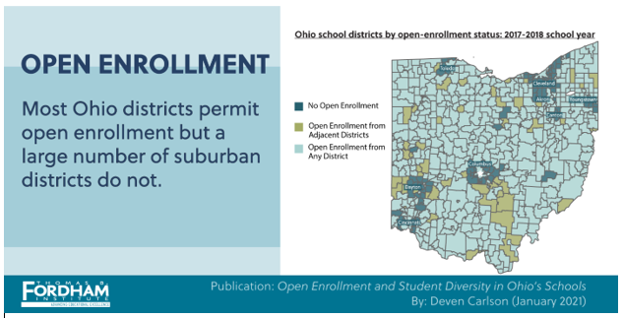
Notice that not every suburban district in Ohio participates in open enrollment. Notice also the sickly, green-colored districts that only participate in open enrollment with adjacent districts. One can’t help but wonder just which students they might be trying to avoid.
My theory is as follows. Low-growth urban charter schools survived in Ohio but quickly closed in Arizona because Arizona students have lots of other options. Nearly all Arizona school districts participate in open enrollment. This includes relatively affluent districts like Scottdale Unified, which brings in over one-quarter of its total enrollment from outside the district’s boundaries.
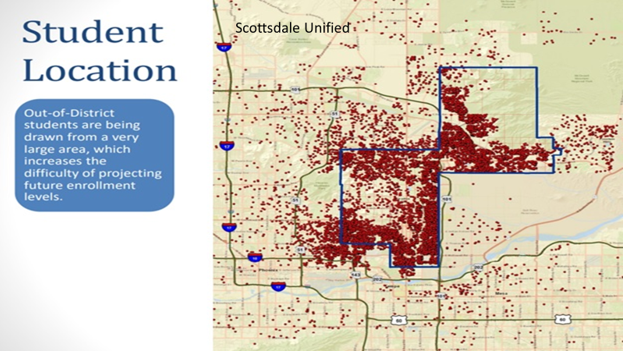
Scottsdale Unified enrolls approximately 20,000 students, with 4,500 students coming to the district through open enrollment. The 9,000 students who live within the boundaries of Scottsdale Unified who attend schools in charters, other districts, private schools, etc., doubtlessly play a large role in making open-enrollment opportunities available. Suburban districts in Arizona prefer to participate in open enrollment rather than close campuses.
Arizona’s suburban charter schools opened suburban districts to open enrollment, leading to closure of low-demand charter schools. This virtuous cycle does not have the chance of occurring in charter sectors constrained exclusively to urban areas.
Wisely, Ohio lawmakers recently expanded choice options by removing geographic restrictions on charters and expanding private choice options. The limitations of Ohio’s charter sector thus seem to owe more to poor central planning than to “wild west” liberality.
Author and podcast host Steven Berlin wrote: “The strange and beautiful truth about the adjacent possible is that its boundaries grow as you explore them. Each new combination opens up the possibility of new combinations.”
Arizona’s experience shows that choice programs, far from being siloed, interact with each other out in the field. Allowing families and teachers to shape the K-12 space is a much better idea than leaving it to state officials and is the best solution to the elimination of low-performing schools of any sort: more options.
Embracing liberality takes humility and wisdom, but without it, choice sectors quickly hit a low ceiling in serving the interests of the poor.
Ohio’s charter failure, by my way of thinking lies in central planning. The goal ought not be to replace bad central planning with better central planning. Rather, the goal should be to create a fully inclusive and demand-driven system of education that allows educators and families to act as the hands of a potter at a wheel, molding the K-12 space over time to create the types of schools educators want to run – and that families want to support.
 National Charter Schools Week is upon on us, which is an excellent time to review the differences between awesome and less than awesome charter school sectors.
Charter schools have an intrinsic value in providing new opportunities and in creating competitive effects, but geographically inclusive charter sectors might have the additional benefit by encouraging district open enrollment. Suburban charter schools may be force multipliers because they can create a powerful incentive for suburban districts to participate in open enrollment. Private choice can do the same.
After one suburban district participates in open enrollment, it increases the incentives for others to do the same. Before you know it, all districts may participate.
We can use the Stanford Educational Opportunity Project to visualize this, which allows us to select only charter schools by state (all the figures below). The project displays a variety of metrics, but we are using academic growth, which is broadly recognized as the best measure of school quality; each dot is a school, dots below the central “leaned 1 grade level per year” have below average growth.
The green dots have above-average growth. Furthermore, by pressing another button, all the charts below will be showing charter schools located in suburbs.
Why only suburbs? One of the main ways charter schools can help state K-12 sectors in your author’s mad-scientist mind is when charter schools to help states to avoid this:
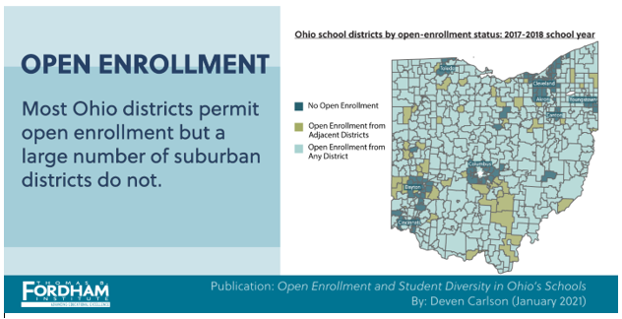
This is a school district map of Ohio showing every urban district in the state either completely surrounded or else mostly surrounded by districts that do not participate in open enrollment. Why do Ohio districts avoid open enrollment? Well because they can:
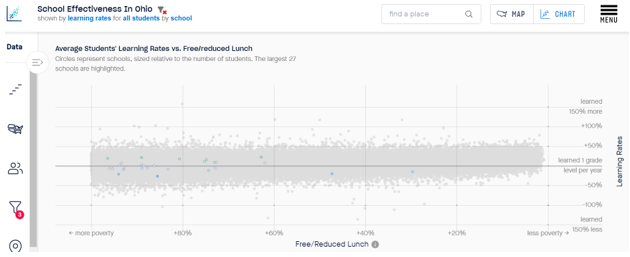
If you squint, you can find one charter schools to the right of the 40% Free and Reduced Lunch line. Fancy Ohio school districts, in other words, were almost perfectly safe from charter school competition. Ohio charter schools did almost nothing to get them to participate in open enrollment, which is why Ohio lawmakers removed geographic restrictions on charter schools and passed new private choice programs a couple of sessions ago.
Next up would be a state that is more of a work in progress: Texas. Texas has no statewide policy on open enrollment, and it really has yet to take off. If Texas had more charter schools in the suburban areas, it might get an open-enrollment virtuous cycle going, especially if Texas lawmakers would also pass private school choice.
Needs more work, and private school choice would help, but further along than Ohio toward getting a geographically and economically inclusive sector of the sort that will encourage open-enrollment to flourish.
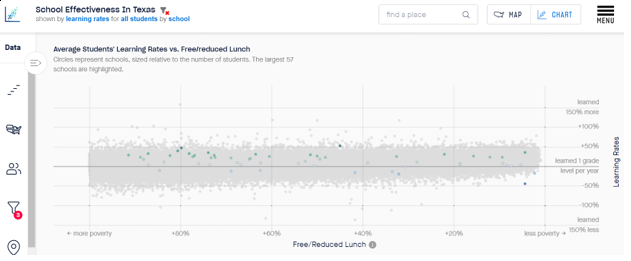
Texas suburban charters are delightfully green from a performance standpoint, but not yet numerous enough to put a chill in the spine of Plano ISD. Let’s call it “getting there.”
Here is one of the larger state charter sectors for a charter law passed since the year 2000: Tennessee.
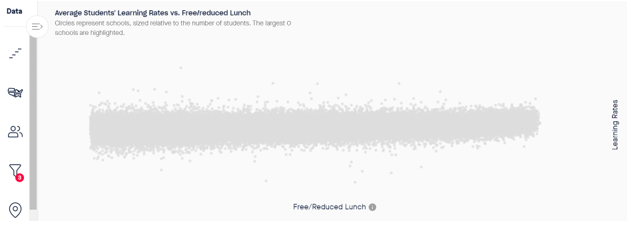
There are some very high growth charter schools in Tennessee, which is great, but they have zero suburban charter schools, which is not great. If you are looking for a charter sector that leaves suburban districts as walled-off fortresses, alas, Tennessee has a how-to manual charter statute. Tennessee has out-Ohioed pre-reform Ohio itself.
Ironically, California can show Tennessee how to do it:
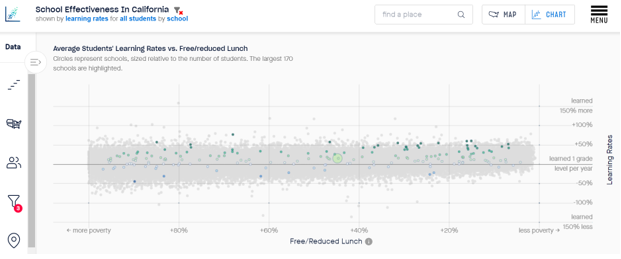
California is the nation’s largest state with the largest K-12 population. I’m uncertain as to whether the California suburban charter school sector was large enough to encourage an open-enrollment revolution, but they were certainly trying.
The California suburban charter sector is large and green. Unfortunately, it is also politically hamstrung and contained. While there is no prospect for private choice programs in California, lots of Californians seem to be yomping their K-12 on their own-definitely something to keep an eye on.
Open enrollment may have begun to stir to life in Indiana, but it isn’t getting much help from the charter sector:
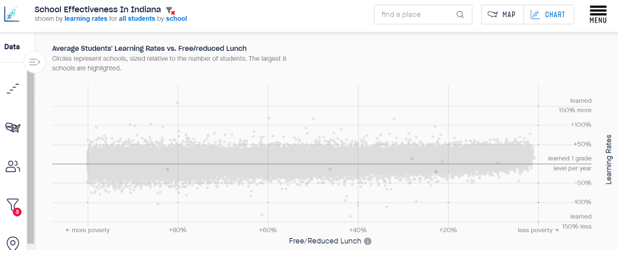
Luckily, Indiana has a robust private choice system which lawmakers just made stronger.
Arizona lawmakers passed both charter school and statewide open enrollment legislation in 1994 and the first scholarship tax credit program in 1997. Lawmakers expanded the tax credit in several different ways before passing the first Education Savings Account program in 2011, which was made universal in 2022.
Arizona has the nation’s largest charter school sector at 22% of public-school students, and the suburban charter school sector looks like:
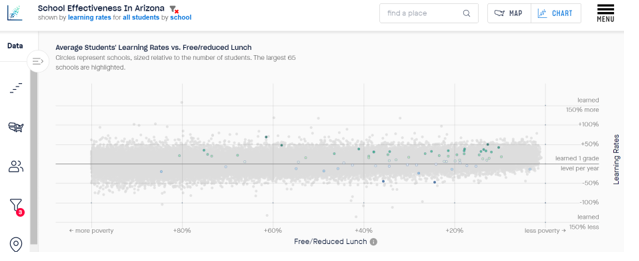
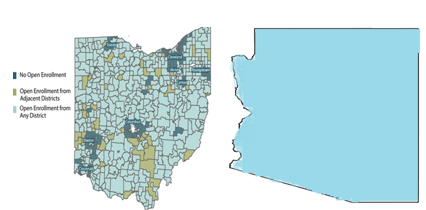
Arizona doesn’t have the size of the California suburban charter sector, but it is a much smaller state, which may be why my (very) homemade equivalent to the Fordham open enrollment map for Arizona looks like:
Which might have something to do with:
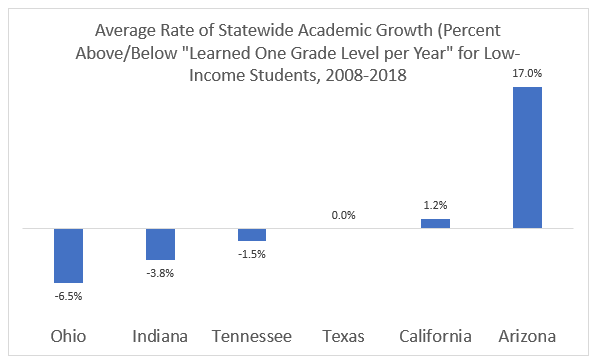
It’s best to turn the choice knob all the way to “11.”


Tabernacle Christian School in Hickory, North Carolina, one of 844 private schools in the state serving more than 13,000 students, teaches all subjects from a biblical worldview and encourages social development through the teaching of good manners, high moral standards, respect for parents and authority, and patriotism. All teachers at the K-12 school are Christians who serve at their local church.
Editor’s note: This article appeared Friday on the centersquare.com.
With an estimated 77,000 on charter school waiting lists, lawmakers in the North Carolina House of Representatives on Tuesday will consider several bills designed to open up school choice for families.
The House Education Committee will hear three bills that could provide more school options for North Carolina families: one to expand Opportunity Scholarships, another to streamline charter school approvals, and a third to allow open enrollment in public schools.
House Bill 823, known as Choose Your School, Choose Your Future, is sponsored by top House Republicans including Speaker Tim Moore, R-Cleveland, to expand Opportunity Scholarships to all students through a tier-based system based on income.
The program is currently restricted to low- and moderate-income families to cover private school tuition and other educational expenses. Parents for Educational Freedom President Mike Long contends the expansion would mark “an incredible step toward funding students over systems in North Carolina,” while the state’s teachers association is lobbying against the bill.
The program currently helps more than 25,000 students attend 544 private schools.
The committee will also review House Bill 618, to create a Charter School Review Board to take over responsibility for approving, amending, renewing and terminating charter schools. It would reshuffle the authority of the State Board of Education; the legislation is aimed at streamlining the process, though the state board would retain oversight over the review board.
To continue reading, click here.

Cole Valley Christian Schools in Meridian and Boise, Idaho, one of 157 private schools in the state, infuses scripture into every subject, not just Bible class, and gives children the opportunity to connect with God outside of daily classwork.
Editor’s note: This news release appeared Wednesday on yes. every kid. website.
In response to Gov. Brad Little’s signature of Senate Bill 1125 expanding public school access by ending discrimination against students based on their ZIP code, an advocacy group with a families-first approach to expanding the country’s education policy landscape, had this to say:
“Access to a great school should not be determined by a family’s income or where they live,” said Craig Hulse, executive director of yes. every kid. “With Gov. Little’s leadership and bipartisan support from the Idaho Legislature, the state has taken critical steps toward creating a truly student-centered education experience by opening up public schools so a student is no longer limited by ZIP code and can access more educational options.
“This is a much-needed opportunity to modernize learning and streamline the ability for children to attend a school that meets their individual needs.
“We thank Gov. Little, Sen. Lori Den Hartog, and Rep. Wendy Horman for their unwavering commitment to Idaho families and look forward to working together to continue advancing public policy that respects the dignity of every kid.”
Idaho’s Senate Bill 1125 passed with overwhelming bipartisan support, reflecting families’ growing desire for more opportunities other than the district school they are assigned to attend.
SB 1125 rewrites the state’s open enrollment law for the first time in three decades, removing barriers that prevented students from accessing the right school that’s best for them. The law will:
Now signed into law, SB 1125 cements Idaho’s status as a national leader in ending school zoning discrimination.
 Editor’s note: This analysis appeared last month on the Thomas B. Fordham Institute’s website.
Open enrollment—when students are allowed to enroll in district schools other than the one to which they would be assigned based on their residence—is one of the oldest school choice options in the country. It is also widely available (43 states have some form of it) and utilized heavily by parents looking for alternatives to their zoned district school.
However, program rules and operations can differ widely from state to state, including features that inhibit use or favor systems over families. A new report from the Reason Foundation analyzes the various versions of open enrollment and ranks them based on observed best practices in state policy.
First up, analyst Jude Schwalbach spells out the difference between intradistrict open enrollment—where students can choose other schools within their district of residence—and interdistrict open enrollment—where students are allowed to attend schools in a different district than the one in which they reside.
Both are considered best practices, but only if districts are required by the state to offer such options (on a space-available basis) rather than given the option to do so. Additional identified best practices include transparent state- and district-level reporting of seat availability and open enrollment utilization; simple and readily-available information for parents on how, when, and where to apply; and zero tuition or fee charges for application and participation.
(Interestingly, transportation is not on the radar here, even though the Reason Foundation has touted its importance to school choice previously.)
Unsurprisingly, no state hits all of these best practices, but several are close. Arizona, Florida, and Utah top the list, lacking only the state-level reporting requirements. Also among the high-flyers are Kansas and Oklahoma, which meet all of Reason’s best practices save for requiring intradistrict open enrollment.
The list drops off quickly from there. The most common best practice among states is zero tuition for family participation, in force in 24 states.
To continue reading, click here.
 'Cause we got a great big convoy
Rockin' through the night
Yeah, we got a great big convoy
Ain't she a beautiful sight?
Come on and join our convoy
Isn’t nothin' gonna get in our way
We gonna roll this truckin' convoy
'Cross the USA
Convoy!
I’ve previously described how a combination of outrageous fortune and inspired policy led to Arizona’s unexpected status as the top state for K-12 academic growth.
The Readers Digest version: Great Recession property price drops allowed high-demand charters to grow, which along with private choice programs, created strong incentives for district participation in open enrollment, which is nearly universal in the Grand Canyon state.
Getting the open enrollment dominoes to fall seems key, as open enrollment students outnumber charter school students. Choice programs don’t exist in hermetically sealed silos; rather, they interact with each other out on the road.
And when they all are heading in the same direction, they tend to ignore things arbitrary and unproductive things, like, for instance, arbitrary and inappropriately mandated 55-mile-an-hour speed limits.
Wisconsin lawmakers passed the nation’s first voucher program in 1990 – the Milwaukee Parental Choice Program. Subsequently, Wisconsin lawmakers created voucher programs for Racine and a statewide voucher program for students with disabilities. Finally, a statewide means tested voucher program passed in 2013.
In combination, the voucher programs educated 48,919 students in the 2021-22 school year. Wisconsin also has an underrated charter sector educating 49,678 students.
These sectors are important in their own right. But have Wisconsin school districts joined the school choice convoy?
That’s a big 10-4 good buddy, and they are about to put the hammer down!
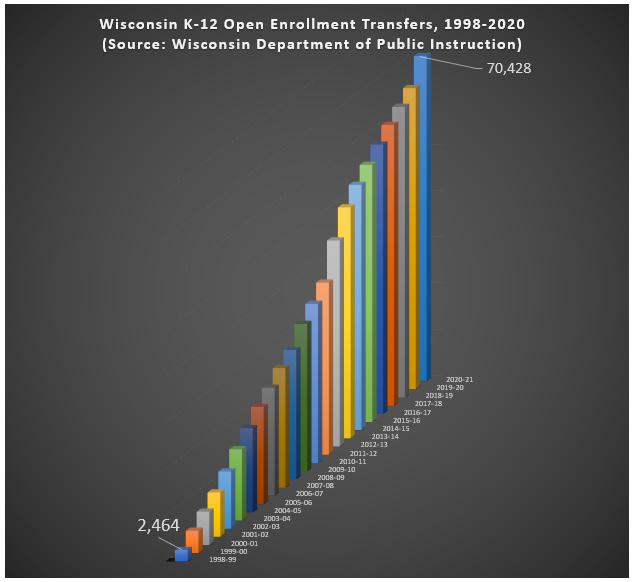
Wisconsin’s voucher, charter and open enrollment programs al are loaded up and trucking, but there is more to be done.
Any Wisconsin family can use the open enrollment process or attend a charter school. Wisconsin’s largest voucher programs, however, don’t allow students to participate if their parents paid too many taxes. Hard to see how that makes any sense.
All these schools also have the same academic standards and give the same test. Wisconsin’s K-12 system would be more pluralistic and diverse if both public and private schools accepting choice students could select tests from a menu of linked exams.
Some won’t be happy, but mercy sakes alive, Wisconsin just might have itself a school choice convoy!
 Deadweight loss, also known as excess burden, is a cost to society created by market inefficiency. It occurs when supply and demand are out of equilibrium. Mainly used in economics, it can be applied to any deficiency caused by an inefficient allocation of resources.
Here is how Wikipedia defines deadweight loss:
A measure of lost economic efficiency when the socially optimal quantity of a good or a service is not produced. Non-optimal production can be caused by highly concentrated wealth and income (economic inequality), monopoly pricing in the case of artificial scarcity, a positive or negative externality, a tax or subsidy, or a binding price ceiling or price floor such as a minimum wage.
One way we can think of the education reform movement is to view it as an attempt to lessen an artificial scarcity of different school models. Left to their own devices, teachers and families might develop all sorts of different schools.
The development of the American public-school system involved a local, publicly funded monopoly, widespread standardization, and regulatory capture. The K-12 choice movement has changed this in a limited way.
Only a tiny handful of state charter school laws have grown robust enough to provide tension in the system. The same would be the case if charters, private choice, and homeschooling practices are considered in combination. Ergo, deadweight loss in K-12 education, with an artificial scarcity of diverse schools, endures.
Two studies ranked cumulative choice. The first debuted in 2000 and was followed by another study 20 years later. Arizona ranked first in both studies.
The Arizona of 2000, with a liberal but still small charter sector and a single, small private choice program, seems quaint by today’s standards. To maintain the No. 1 ranking, Arizona lawmakers expanded the nation’s first scholarship tax credit, created three new ones, passed the first education savings account program, and created a charter school sector that currently educates 22% of public-school students.
Perhaps most consequential, Arizona’s choice programs induced a very active open enrollment process within and between school districts.
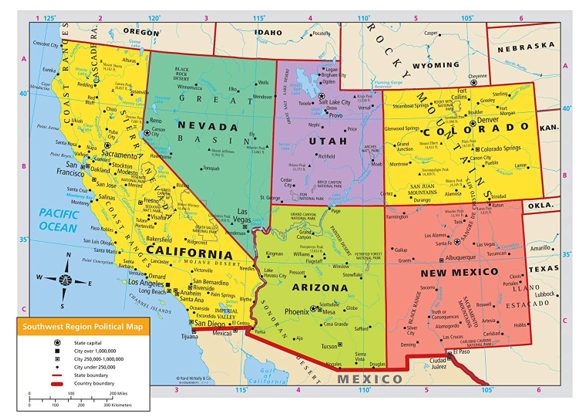
The Educational Opportunity Project at Stanford University linked state testing data across all 50 states, with current data covering 2008-18 for grades 3-8. The chart below compares Arizona with its five border states – California, Colorado, Nevada, New Mexico and Utah – showing academic growth for poor and non-poor students.
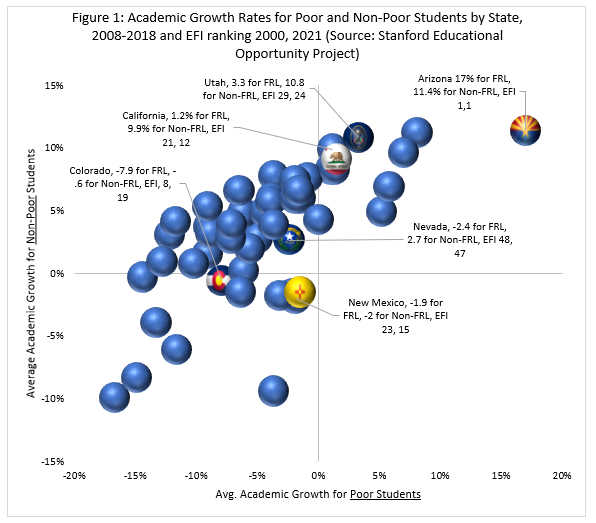 These states have demographic similarities, and all have been marked by the large increase in Hispanic students over the past 40 years.
A noteworthy point: California has the second highest EFI rating in the Southwest. California’s large charter sector has a lot to do with this, but sadly, politics recently have surfaced to create an artificial shortage of seats.
Figure 2, below, presents the same Stanford data:
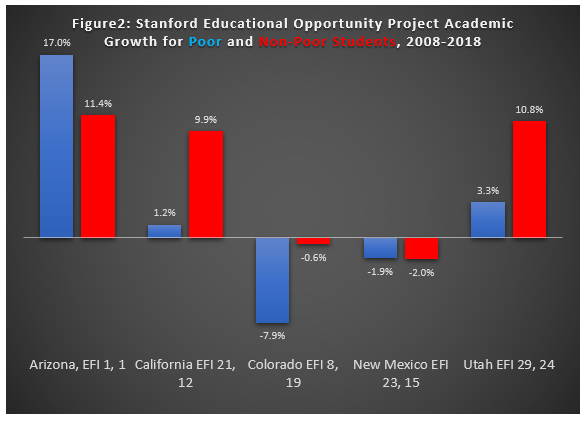 The Education Freedom Index studies demonstrated a statistical association between education freedom scores and academic trends. The Stanford data shows that although Arizona has the highest rate of academic growth for middle/high income students, there are a few other states in their neighborhood, including California and Utah.
When it comes to academic growth for low-income students, Arizona has no peer either inside or outside of the Southwest. We don’t fully understand what drives academic growth, but outside the very active system of choice, Arizona’s K-12 policies are fairly typical, and the state’s student demographics are not wildly different from neighboring states.
So, what is so different about the K-12 system for low-income kids in Arizona? In a word: access.
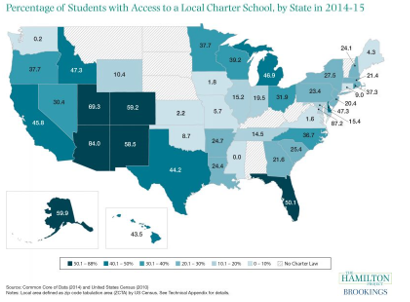 Poor children in Arizona have greater access to charter schools. They also have access to leafy suburban districts:
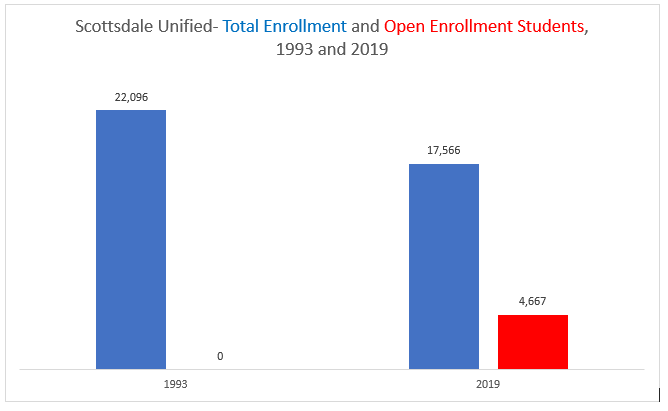 The 9,000 students who live within the boundaries of Scottsdale Unified but attend school elsewhere probably have a great deal to do with the access provided to the open enrollment kids. Just as a reminder of how unusual this is, see if you can locate the fancy suburb in Ohio participating in open enrollment at all:
 Finally, four different scholarship tax credit programs and the Empowerment Scholarship Account program increase the accessibility of low-income families (and others) to attend private schools. It appears to me that with access comes accountability: charters with low demand close quickly. District schools with low demand persist longer, shuffling along before eventually being closed.
This is far from ideal, as zombie schools draw resources from other schools in the same district.
Rationally, districts should expand high-demand schools and close low-demand schools. While politics rather than reason rules the affairs of districts in Arizona and elsewhere, the incentives are pointed in the right direction.
Arizona families seem pretty good at picking schools with which to entrust with their children. Meanwhile, rather than viewing high-demand schools as a fixed and scarce asset, Arizona policies have created incentives for educators to open new ones.
As these circumstances unfolded over time, deadweight loss lessened. The kids who start with the least gained the most from this process. Let there be more of it.
 Videos have surfaced recently of starving residents of Shanghai screaming in the night a week into an incredibly misguided COVID-19 lockdown that has imprisoned Chinese citizens in their homes.
A reporter from The Economist noted that a Chinese drone flew through the area blaring a message: “Please comply with COVID restrictions. Control your soul’s desire for freedom. Do not open the window or sing.” Other videos show HAZMAT-suited soldiers beating and arresting their fellow citizens for walking outside in search of food.
Shanghai residents have made their feelings about their oppressors clear in a variety of ways.
 Decades ago, George Orwell’s account of being a British soldier in India during imperial occupation explained that he hated imperialism and his own role in it. “Feelings like these are the normal by-products of imperialism,” Orwell wrote. “Ask any Anglo-Indian official, if you can catch him off duty.”
Orwell hauntingly described the task of going through the motions and playing the role expected of him: “He wears a mask, and his face grows to fit it.”
We, of course, would never see public officials justifying entirely unconscionable policies here in the United States. Or would we?
Take a moment to read this recent news report titled, “Suburban school officials predict ‘chaos’ if Kansas lets out-of-district students transfer freely. Go ahead, click the link and read it from start to finish. I’ll wait for you to come back.
Finished already? That was fast.
Okay, so the article really jumps the shark with this quote: “We believe in neighborhood schools,” said Brett White, superintendent of Andover schools east of Wichita. “The open borders would just throw into chaos what’s an established policy.”
If you are scoring at home, the superintendent of a school district in which 75% of students are white identified as being to the east of Wichita, which is 70% non-white. In any case, Superintendent White supports “neighborhood schools,” because obviously, to do otherwise would throw an established policy into “chaos.”
One person’s “chaos” is another person’s “freedom,” but “chaos” does sound risky. Would it be best if Wichita’s families controlled their soul’s desire for freedom?
Martin Luther King Jr. was in effect asked to control his soul’s desire for freedom, and he had quite a remarkable response, written by hand in the margins of a newspaper from jail. The letter read in part:
History is the long and tragic story of the fact that privileged groups seldom give up their privileges voluntarily. Individuals may see the moral light and voluntarily give up their unjust posture; but, as Reinhold Niebuhr has reminded us, groups are more immoral than individuals. We know through painful experience that freedom is never voluntarily given by the oppressor; it must be demanded by the oppressed.
Superintendent White might want to think about taking off that mask before it gets too late.

