Florida’s National Assessment of Educational Progress (NAEP) results in reading and math place the Sunshine State squarely in the middle of the pack (except in 4th grade reading where Florida ranks in the top 10). But comparing states without controlling for demographic differences isn’t entirely fair.
Since every state has differences in student demographics, the most accurate way to compare states is to compare similar subgroups. And one of the best ways to judge the efficacy of a state’s education system is to see how it performs for the students in most need of help.
We looked at the results for low-income students by race in Florida and compared the results with their peers in other states. The table below provides both a raw score comparison with the national average and Florida’s rank for each subgroup. As you can see, Florida performs quite well.
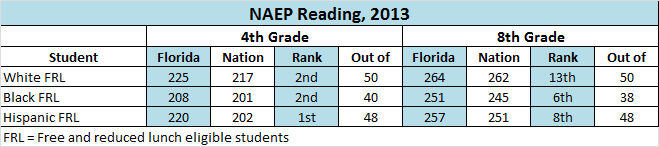
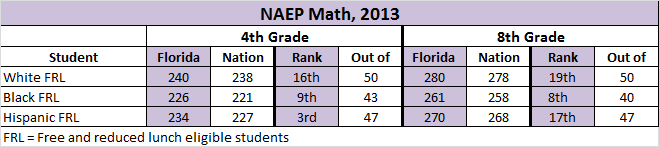
UPDATE: Two points of praise for Florida on the NAEP 4th grade reading exam: Florida's low-income Hispanic students beat the average (of all students regardless of race or income) in 18 states and D.C. Florida's low-income black students best the average (of all students) in New Mexico and D.C.
Note: the reason there are not 51 places in the ranking is because not every state has a large enough sample size of the racial demographic group to compare with other states.
Supporters and critics of former Florida Gov. Jeb Bush’s education reforms have long missed the mark. In 1998, when he was first elected, Bush used the tools available to him, most notably the bully pulpit, to drive gains in student achievement, but he did not make the systemic changes necessary to sustain these large yearly gains. He’s advocating for those systemic improvements today and making progress, but we’re not there yet.
One of the former governor's more sophisticated critics is Michael Martin, a research analyst at the Arizona School Boards Association, who recently analyzed Florida’s reading gains on the National Assessment of Education Progress (NAEP) from 1998 to 2009, and issued this challenge:
People who claim various programs were responsible for the improvement in NAEP test scores in Florida over the past decade must explain why their improved NAEP reading scores primarily occurred among the lowest scoring students while other student scores largely stagnated, and why those increases were most dramatic from 1998 to 2002, diminishing afterward.
Based on what I saw and heard in schools and school districts during this period, the primary reason for these initial reading gains was Bush’s leadership. Beginning with his election in 1998, he used his political power to pressure school districts to improve the basic literacy skills of low-income and minority students, and the districts responded. Educators are good people who care about children and want them all to succeed, but the message from the top has never identified the achievement of low-income and minority children as a top priority. That changed when Bush took office.
After he turned up the heat, talk about improving the literacy skills of low-performing students started dominating formal and informal meetings in school districts across the state. Even Bush’s harshest in-state critics admit no other leader in Florida history put as much focus on improving the achievement of low-income and minority students as he did.
Initiatives such as eliminating social promotion, grading schools and bringing more professional development into high-poverty schools reinforced Bush’s commitment to increasing the achievement of low-performing students, but it was the governor’s drive and forceful personality that convinced schools and school districts to reorder their priorities.
Martin asked why the impressive reading gains from Bush’s first term tapered off in his second. I’ll address that in a post tomorrow.

