 Education lawsuit: The groups suing the state over the quality of public education are asking an appeals court to send the case directly to the Florida Supreme Court for an immediate review. Citizens for Strong Schools claims the lengthy appeals process is harming students. The state, and groups that support the state's position, say there's no reason to subvert the normal appeals process. The suit was dismissed in May by a circuit court judge. Politico Florida.
Gifted plan stalls: A plan to add gifted programs at eight Duval County middle schools meets with skepticism by the school board. Superintendent Nikolai Vitti says the programs are needed to curtail dwindling enrollment. School board members question why there's a lack of programs for inner-city schools. Florida Times-Union.
Charter school searched: The FBI searches the Okaloosa Academy Charter School, and seizes several boxes of materials. An FBI spokeswoman declined to comment, citing the ongoing investigation. The Fort Walton Beach school, which serves at-risk students in grades 4-12, is run by the Rader Group of Miramar Beach. Its representatives also declined comment. Northwest Florida Daily News.
Cops in schools: Leon County School Superintendent Jackie Pons tells the school board he wants to hire police officers for almost every county school. He says the escalating violence in the country prompted his recommendation. There are deputies assigned to all middle, high and certain alternative schools, but many elementary schools share deputies. Hiring an additional eight officers would cost the district at least $350,000 each year. In other action, the school board approved the merger of Woodville middle and elementary into a single K-8 Woodville School. Tallahassee Democrat. (more…)
Rhee
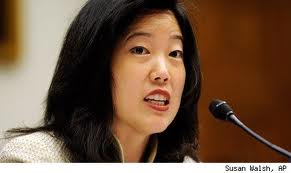
Michelle Rhee's education reform group is scaling back its Florida operations, saying it wants to focus on policy battles elsewhere.
StudentsFirst will maintain a nominal presence in the state, but it's pulling out most of its policy and outreach resources. Some of its leadership positions in the state, including state director, had already been vacant.
Lane Wright, the group's regional spokesman, said StudentsFirst will keep operating in neighboring states. The group has been active in Alabama, Georgia and South Carolina.
"We will still weigh in publicly on some education reform issues in (Florida)," Wright said late last week. "We will not be as heavily involved as we have been with our outreach and our policy."
Wright said the decision was shaped in part by the fact that Florida has already adopted more of its policy agenda than any state besides Louisiana.
StudentsFirst's state report card gives Florida especially high marks for teacher effectiveness, but its efforts to win changes in other areas met resistance. It was among the groups that pushed for the "parent trigger" legislation that died on tie Senate votes in 2012 and 2013. This year, it shifted focus to spending and governance, but a bill that would have required the state to measure schools' return on investment did not make it out of the Legislature. (more…)
Teacher evaluations. The NEA and FEA file a federal suit against the new teacher evaluations system in Florida. Coverage from the Orlando Sentinel, Associated Press, Times/Herald, Tallahassee Democrat, Gainesville Sun, Pensacola News Journal, Gradebook, Education Week, PolitiJax, State Impact Florida, New York Times, Answer Sheet. FEA statement here. Lawmakers need to fix glaring flaws, editorializes the Lakeland Ledger. The Miami-Dade system plows ahead with its own remedies, reports the Miami Herald. School districts around the state are cooperating more to create the hundreds of new tests needed for the teacher evaluations, reports the Tallahassee Democrat.
 Tony Bennett. Indiana folks make up his inner circle at DOE. Gradebook.
Michelle Rhee. Michelle Rhee was in Tallahassee Monday, meeting with lawmakers. Naked Politics.
School choice. With rezoning issues out of the way, Bay County cranks up its district school choice process. WJHG.com.
Career education. A big hit in Okaloosa. Northwest Florida Daily News.
School spending. The state Board of Education is not happy after the Department of Education says it overestimated the budget request for new technology by $342 million, reports StateImpact Florida. The Pasco school board decides, for now, not to follow Superintendent Kurt Browning's proposal to cut media specialists and reading coaches, reports the Tampa Bay Times. The Sarasota board follows through on plans to cut media specialists, reports the Sarasota Herald Tribune. (more…)
I am grateful to Rebecca Sibilia and Sean Gill for their thoughtful response to my blog post encouraging Michelle Rhee to replace her failing schools model of school choice with an approach based on equal opportunity.
Rebecca and Sean defended StudentsFirst’s support of the failing schools model on pragmatic grounds. They wrote: “When state resources are limited or the existing supply of desirable private schools is limited, it also makes sense to prioritize vouchers or scholarships for those low-income children attending a low-performing school or living in low-performing school districts.”
Every community suffers from an insufficient supply of effective schools for low-income students. But in Florida we’ve learned that increasing demand - not limiting demand - is the best way to increase supply.
Access to Florida’s tax credit scholarship program for low-income students, which I help administer, is limited by a state-imposed cap. But our demand is not limited, so it often exceeds supply. This excess demand has not had a negative effect on students or the program. Instead, it has generated political pressure on the state Legislature to allow our cap to rise to meet this additional demand.
In 2010, as a result of excessive demand, the Florida Legislature voted to allow our program to grow 25 percent every year the demand hits or exceeds 90 percent of supply. The result has been extraordinary growth of supply and demand. While we have been awarding scholarships since 2002, 34 percent of our growth has occurred in just the last two years. This school year we added 10,000 more students to the program and had more than 12,000 students add their names to our waiting list after we hit our cap.
We’ve also been adding about 100 new private schools per year to the program, and some have started to expand their physical capacity to serve more students. Had we adopted the StudentsFirst approach of limiting demand when faced with limited supply, this extraordinary growth would not have occurred.
Today, more than 43 percent of Florida’s preK-12 students attend a school other than their assigned district school. Charter schools, magnet schools, virtual schools, career academies, dual enrollment and homeschooling are all growing dramatically. Private schools are already struggling to maintain their market share given all these choices. If we were to limit our scholarships to low-income students in state-designated failing schools, then many private schools serving low-income students might be forced to close - to everyone’s detriment. (more…)
Editor's note: This guest post from StudentsFirst is authored by Vice President of Fiscal Strategy Rebecca Sibilia and fiscal policy analyst Sean Gill.
We appreciate Doug Tuthill’s recent redefinED post challenging StudentsFirst to consider supporting voucher or tax-credit scholarship programs that aren’t just limited to what he describes as the “failing schools” model. We agree with his assertion that school choice policies, including private school options, are about empowering parents to select the best school for their child.
It is true that we believe voucher programs should prioritize low-income students in low-performing schools. However, we want to make clear that this position is not based simply on a “politically safe compromise.” Indeed, our entire State Policy Report Card judges not what is politically popular, but rather the laws and policies we believe, through evidence, best practices, and common sense, will deliver the best results for kids.
We think it is important that states focus on more than policies that just provide access to schools; states must prioritize expanding access to high-quality choices for families that traditionally lack them. A Brookings study found that students from low-income households are much more likely to attend low-performing schools than middle or high-income students. This is important because the same study further confirms that low-income kids can actually achieve at high levels when they attend high-performing schools. Unfortunately, as Florida Education Commissioner Tony Bennett has mentioned, low-income families often lack the resources to enroll in potentially higher-performing private schools or to relocate to a school district that offers a better public education.
Policymakers must always consider tradeoffs and unintended consequences when considering how to budget limited resources. Consider if a state adopted a universal voucher program. This would provide the most theoretical choice, but it could also easily have the unintended effect of simply subsidizing the students already enrolled at private schools and those in families who may otherwise be able to afford private school tuition. This would result in few new students being able to attend a high quality school option, and wouldn’t expand access to those who need it the most. Presumably, avoiding this problem is one of the reasons why the Florida Tax Credit Scholarship program is currently limited to low-income children.
Using this logic, we believe that when state resources are limited or the existing supply of desirable private schools is limited, it also makes sense to prioritize vouchers or scholarships for those low-income children attending a low-performing school or living in low-performing school districts. There are practical, administrative considerations that also make targeted programs more effective. For instance, when looking at the state of Tennessee, where Gov. Haslam has proposed a voucher program, we’ve determined that the four districts with the lowest performing schools also have both higher concentrations of low-income families and private schools in their communities.
We find that most voucher and scholarships programs are capped by enrollment or appropriation levels. Given that low-income students can be found in most counties throughout a state, these caps then create an unintended consequence of spreading out scholarship recipients among multiple communities, which would not provide enough demand to create new private school options. (more…)
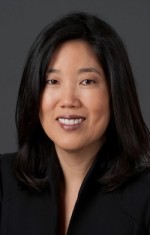
Rhee’s failing schools model for vouchers and tax credit scholarships misinterprets the relationship between students and schools. With rare exceptions, schools are not good or bad independent of the students they serve. Some schools are good for some students and bad for others. A state-designated “A” school can be a terrible match for a particular student, which means for that student the school is a failure.
In recent weeks, Tony Bennett, Florida’s new education commissioner, and Michelle Rhee, the CEO of StudentsFirst, offered conflicting rationales for supporting school choice. Bennett told participants at a National School Choice Week event in Tampa, Fla., that school choice is a necessary condition for equal opportunity and social justice. Low-income children should have access to the same options as the affluent, Bennett said, and this is why he supports providing low-income families with publicly-funded vouchers and scholarships to attend private schools.
StudentsFirst, on the other hand, released a state policy report card that docked Florida a few points for extending school choice to all low-income children. The group favors policies that restrict vouchers and tax credit scholarships to low-income students in state-designated “failing” schools. Within the choice movement, Rhee’s position is called the failing schools model.
Ten years ago, the failing schools model was the most favored, and it’s still popular with state legislators who see it as a politically safe compromise that allows parents to use vouchers only when their assigned district school is “failing.” But school choice, at its core, is about empowering parents to match their children to the schools that best meet their needs. Those judgments don't necessarily align with school-wide standardized test scores.
Rhee’s failing schools model misinterprets the relationship between students and schools. With rare exceptions, schools are not good or bad independent of the students they serve. Some schools are good for some students and bad for others. A state-designated “A” school can be a terrible match for a particular student, which means for that student the school is a failure. Bennett’s approach assumes the relationship between a student and a school is what succeeds or fails, which is why he thinks all parents should be empowered to access the schools that work best for their children.
The failing schools model also tends to inappropriately pit public versus private schools by implying private schools are better, which is not true. (more…)
 Florida earns a C- for policies and program aimed at empowering parents, but that’s good enough for a No. 4 ranking nationally, according to a report card released today by StudentsFirst.
Overall, the state earned a No. 2 rank – and a B- grade – from the report, which looked at progress in three areas: elevating the teaching profession; empowering parents; and spending wisely/governing well. Louisiana came in at No. 1, also with a B- grade. A dozen states earned F’s. StudentsFirst is led by Michelle Rhee.
In the parent category, Florida racked up points for grading public schools and requiring public school parents to be notified when their kids are placed with ineffective teachers. But the group says Florida should require consent from parents whose children are placed with such teachers. It also says Florida should pass a parent trigger bill.
Among other areas, Florida got dinged a bit for its tax credit scholarship program (which is administered by Step Up For Students, the co-host of this blog). In short, StudentsFirst doesn’t think the program is funded enough or accountable enough, although the report doesn’t spell out how it falls short on the latter.
The program is available to all low-income students – which we think is a good thing - but the report says it should be limited to low-income students in “chronically failing public schools.” The report also says Florida should amend the program to provide a scholarship amount “that is competitive with private school tuition.” The amount this year, $4,335, is far below the amount spent per student in Florida public schools.
With charter schools, the report says Florida should allow other bodies besides school boards to be authorizers (although that involves issues with the state constitution). It also says the state should reform "skimming provisions" that allow school districts to keep up to 5 percent of charter school funding.
Rick Scott at the BOE. Not much to report beyond board chair Gary Chartrand’s brief dig at No Child Left Behind. redefinED here. Gradebook here. Orlando Sentinel here. AP here. Sun-Sentinel here.
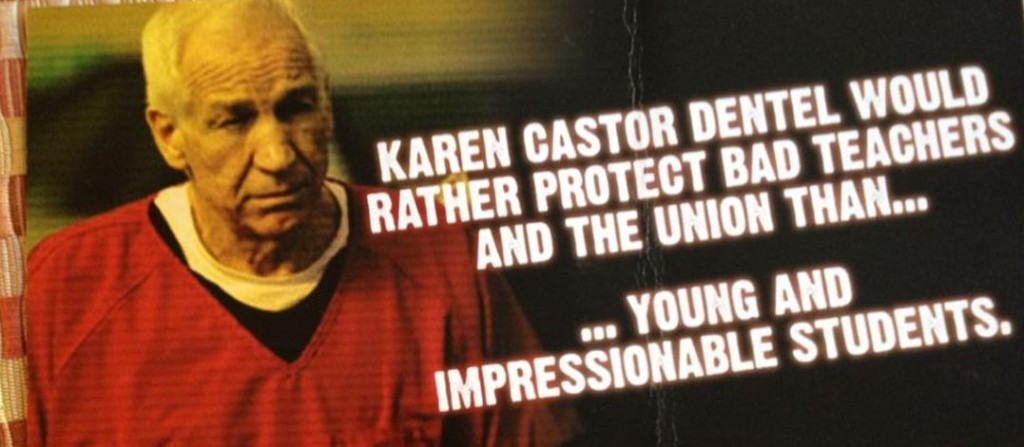 More on that ad. The campaign ad that seeks to tie a Democratic state House candidate with Jerry Sandusky is the kicker to this piece by Tampa Bay Times columnist Daniel Ruth. AP picks up the story.
Think tank doesn’t like Amendment 8. Add Education Sector to the list of those who don’t like Amendment 8 and say it’s about vouchers – but could benefit from more homework. This post on the Ed Sector blog, the Quick and the Ed, is written as if Florida doesn’t already have private-school vouchers.
StudentsFirst endorsement. Michelle Rhee’s group likes Aaron Bean, the Florida Times Union reports, in a northeast Florida race for state senate.
Michelle Rhee, in this morning's Tampa Bay Times:
I'm a Democrat because I believe in the party's basic principles, particularly the idea that we have to look after one another and stand up for those who need help. I believe in fighting for the civil rights of all Americans, especially children and those facing injustices.
That's why I was heartened to see Chicago Mayor Rahm Emanuel advocating for the rights of kids in his standoff with the Chicago Teachers Union. Although his stance made perfect sense to me, it surprised many political observers.
Emanuel went head to head with the union to get a better contract for the city's schoolchildren. In the process, he underscored a transformation in the Democratic Party. Increasingly, those who staunchly side with unions at any cost appear to be in the minority, while more Democrats are saying we have to look at education differently. Full op-ed here. RedefinED interview with Rhee, on why ed reform must be bipartisan, here.

