School vouchers and tax credit scholarships may not always improve participants' standardized test performance, but a growing crop of studies suggest they are cost-effective when it comes to encouraging economically disadvantaged students to pursue a college education.
Two recent Urban Institute studies, one on Milwaukee and the other on Washington, D.C., continue that trend. The reports follow similar results from a 2017 Urban Institute study of Florida's Tax Credit Scholarship program.
Students in Milwaukee using vouchers to attend private schools were more likely to attend college, while students in Washington were no more or less likely, to attend college than their public-school peers. Past Urban Institute research in Florida showed modest positive college attendance and associate degree gains among school choice participants.
Researchers Patrick Wolf, John Witte and Brian Kisida found Milwaukee voucher students were 6 percentage points more likely to attend a four-year college than their public school peers. Milwaukee choice students were 1-2 percentage points more likely to graduate college, but that difference was not statistically significant.
The researchers conclude, "students in the Milwaukee Parental Choice Program tend to have higher levels of many measures of educational attainment than a carefully matched comparison of Milwaukee Public School students."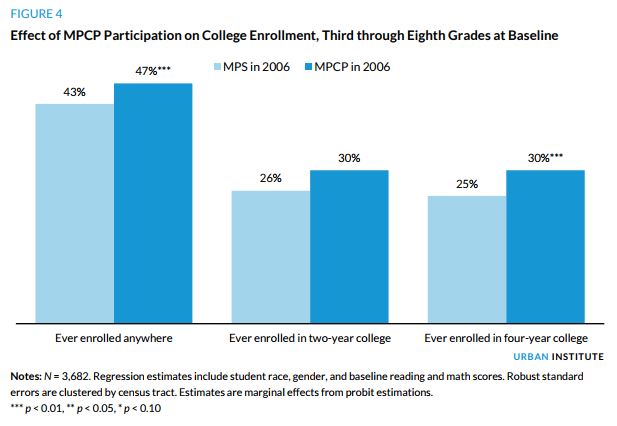

Robinson
Standardized test costs. They total about $1.7 billion a year nationwide, according to a new report from Brookings that includes state-by-state figures. Not much, concludes researcher Matt Chingos, who adds “perhaps we’re spending less than we should.” Coverage from Education Week and Huffington Post. Former Florida education commissioner Gerard Robinson tells the latter about test anxiety: “I won't pretend that tests don't matter and there's no anxiety -- but I also tell people there's anxiety with sex. There's anxiety with sex, but there isn't any talk about getting rid of that.”
And still more Jeb summit coverage. Politic365 on the “Florida Formula.” EdFly Blog on the crucial center. Rick Hess on "The Common Core Kool-Aid."
More protests from Hillsborough parents. They want better training for employees who work with special-needs children, StateImpact Florida reports. More from Tampa Bay Times.
Black students who won private school vouchers through a lottery in New York City were much more likely to later enroll in college than other low-income students who applied but did not win, according to a study released this morning.
The study of a privately funded New York voucher program for elementary school students showed no significant impacts for students overall, including Hispanic students. But the story was different for black students: 34 percent who attended private schools with vouchers were enrolled full-time in college three years after graduation from high school, compared to 26 percent for the non-voucher group – a rate 31 percent higher. For black students enrolled in college either full- or part-time, the voucher boost was 24 percent. The researchers called those differences large and statistically significant.
The study is the first to use a “randomized trial” – considered the gold standard for researchers - to determine effects on private school vouchers on college enrollment. It was conducted by Matthew M. Chingos, research director of the Brown Center on Education Policy at the Brookings Institution, and Paul E. Peterson, who directs the Program on Education Policy and Governance at Harvard.
The students participated in the New York School Choice Scholarships Foundation Program, which, in 1997, offered three-year, private school scholarships worth up to $1,400 annually for up to 1,000 low-income kids. Recipients could attend any private school in the city. At the time, the total per pupil cost in the city’s Catholic schools was $2,400.
The researchers offered words of caution about interpreting the results, given statistical estimates they described as “fairly noisy.” But they also said further discussion was warranted given the apparent differences in outcomes for black and Hispanic students. (more…)

