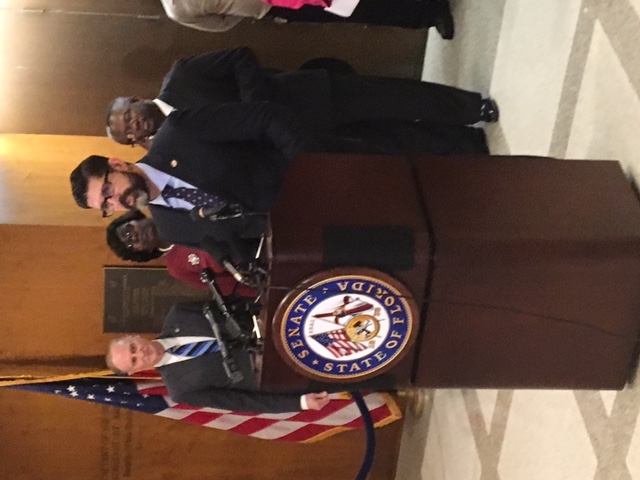
Sen. Manny Diaz (R-Hialeah) unveiled the Senate education leadership's priorities for the 2019 legislative session today in Tallahassee.
TALLAHASSEE – Florida state Sen. Manny Diaz Jr. on Thursday said Senate leaders hope to implement a “Family Empowerment Scholarship” to eliminate a waiting list for the Florida Tax Credit Scholarship for lower-income families.
Gov. Ron DeSantis made a similar pledge last week, saying he wanted to create an “Equal Opportunity Scholarship” to eliminate the FTC waitlist of about 13,000 families.
Diaz (R-Hialeah), who chairs the Senate Committee on Education, said there were “some similarities” in the two plans.
“We will continue to support families’ decisions to choose what’s best for their children’s education – whether it’s public or private school,” Diaz said, adding that over 100,000 students are currently on the FTC scholarship. (The scholarship is administered by nonprofits such as Step Up For Students, which hosts this blog.)
The new scholarship would be funded through the Florida Education Finance Program (FEFP) and would be capped at 15,000 students in its first year.
Flanked by lawmakers, parents on the FTC waiting list and faith leaders, Diaz said the “Family Empowerment Scholarship” is separate from DeSantis’ proposed plan. He said eligibility requirements of the two proposed scholarships are “very similar,” but did not offer specifics.
Under DeSantis’s plan, funding for the scholarship program would come from the FEFP. The scholarship award amount would be a slight discount of the district average per-student funding in the FEFP, allowing funding to follow the student. The maximum number of students eligible to receive a scholarship would be equivalent to 0.5 percent of statewide public school enrollment for the first year, providing opportunities for approximately 14,000 students. Each year thereafter, the number of eligible students would increase by an additional 1 percent of statewide public school enrollment.
Asked by media if the separate scholarships would confuse parents, Diaz said the proposed scholarship simply gives parents even more choices.
“I think we’ve done a good job of educating parents in Florida” about school choice, he said. “They’re interested in finding the best educational settings for their children. Every child is different. What works for one, may not work for another.”
The FTC program helps lower-income families pay for private school tuition or transportation costs to an out-of-district public school. A recent study by the Urban Institute showed students on the program are enrolling and completing college at higher rates than their public school peers.
In 2018-19, enrollment in the FTC program dropped for the first time in 14 years. In the preceding 13 years, the average annual enrollment increase was 20 percent. The enrollment dip was due to slower growth in corporate contributions, according to the state Department of Revenue.
Demand for the program remains strong. Parents for more than 170,000 students had started applications by the time Step Up For Students halted the application process in June. Step Up has already awarded more than 79,000 scholarships for 2019-20, approximately 20,000 students ahead of last year. New students are starting applications at a rate of more than 1,000 a day.
The proposed “Family Empowerment Scholarship” put a smile on the face of Giselle Gomez, who was among the parents who stood behind Diaz at Thursday’s event. Gomez is the mother of Arturo Gomez III, 6, who is on the waiting list for the FTC scholarship. A Realtor, Gomez currently pays out-of-pocket for Arturo to attend Redeemer Christian Academy in Ocala, which costs about $7,250 per year.
She did not want her son in a public school because of her own negative experiences attending public schools in Miami and Ocala. Gomez said she applied for an FTC scholarship this year for Arturo, but by the time Arturo’s application was approved, money to fund the program had run out.
While Arturo has thrived at Redeemer Academy – his behavior has improved and teachers often work with him one on one – she has been behind in payments.
Gomez said she is going through a divorce, making the situation even more tense.
“(Arturo’s) going through a lot of changes right now,” she said. “I want him to have stability and stay in the same school. His behavior used to be erratic, but the teachers have worked with him so much. His focus is better and his grades are amazing. I don’t want to take that away from him.”
Diaz was joined at Thursday’s press conference by Sen. Kelli Stargel (R-Lakeland), chair of the Senate Appropriations Subcommittee on Education, and Senate President Pro Tempore David Simmons (R-Altamonte Springs), each of whom unveiled other Senate K-12 education initiatives.
Proposed changes to the way federal funding flows to public schools have set off a late-session debate in the Florida Legislature.
Proponents of the changes argue money should follow students to whatever school they attend, and school leaders — not district administrators — should decide how the money gets spent.
School districts are fighting to keep their authority to decide where the money goes. They argue the changes would dilute funding intended to help disadvantaged students in schools with concentrated poverty.
In short, it's a state-level version of the national debate over funding "portability."
The Senate Appropriations Committee on Monday approved a major rewrite of SB 1362. It now resembles a bill that's already passed the House.
Among other things, the revised bill would remove caps on high-performing charter schools that want to expand in areas with low-performing public schools and move the deadline for charter school applications from August to February. (more…)
Members of both chambers of the Florida Legislature voted unanimously this afternoon for a bill that would expand several educational options for children with special needs and improve private school students' access to college courses.
Among other things, the measure, which advanced without controversy, would broaden the possible uses for the state's popular school voucher program for special needs students.
If Gov. Rick Scott approves the revised HB 837, among other things: (more…)
The three-year push to fix a funding glitch that undermined some Florida students' access to college courses is set to continue in next year's legislative session.
State Sen. Kelli Stargel, R-Lakeland, has filed a bill (SB 824) that would require the state's community colleges to strike agreements with local private schools, allowing their high school students to take some college courses free of charge.
Dual enrollment allows students to take college courses that also count toward their high school diplomas. A 2013 law changed the way Florida funded the courses for public-school students, requiring school districts to foot more of the bill for courses their students took at local colleges.
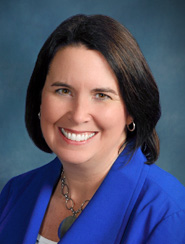
Sen. Stargel
Florida charter schools could give admissions preference to students whose previous schools struggled academically under legislation filed today in the state Senate.
The bill by Sen. Kelli Stargel, R-Lakeland, would add students who come from schools with a history of "D" or "F" grades to the list of groups allowed to receive preferential treatment in charter school admissions, which generally must be conducted by lottery.
As noted by the Gradebook, the bill would also bar charters from counseling out, or denying admissions to, students who struggle academically or have to repeat a grade. (more…)
Sen. Kelli Stargel
Key Florida lawmakers have revived an attempt to let students attend public schools across district boundaries.
The change is included in a bill filed Friday by Sens. Don Gaetz, R-Niceville and Kelli Stargel, R-Lakeland.
It would require school districts to allow parents from "any school district in the state" to enroll their children in "any public school that has not reached capacity."
Charter schools would also have to accept students across district lines.
There is a twist. SB 684, titled "Choice in Sports," would also tackle a perennial controversy over how Florida regulates high school athletics.
Among other things, it would stipulate that students are immediately eligible to participate in sports after they change schools, and create new fines for school employees who engage in athletic recruiting. (more…)
The fate of two pieces of legislation - one increasing access to dual enrollment classes for private school students, and one overhauling the rules governing high school sports and other extracurricular activities - looked uncertain going into the penultimate week of Florida's legislative session.
The dual enrollment bill had gotten traction in the Senate, where Sen. Kelli Stargel, R-Lakeland, was trying to address an unintended consequence of funding changes made two years ago that created a dilemma for some private schools whose high school students wanted to earn college credit. A similar bill had not been heard in the House.
The high school sports bill, meanwhile, was taken up Tuesday on the House floor and will likely come up for a vote today, but had faced an uncertain future in the Senate, where it had only cleared one of its three assigned committees.
Both measures received new life on Tuesday, when the Senate Appropriations panel added them to a massive education bill, with pages numbering in the triple digits, which tackles everything from K-12 school uniforms to the scope of the state's community college system.
Sen. Stargel
A bill that would overhaul Florida's system governing high school athletics for an "era of school choice" remains alive after passing its first state Senate panel Wednesday.
The proposal by Sen. Kelli Stargel, R-Lakeland, would place new limits on the operations and recruiting investigations of the Florida High School Athletic Association.
It would also require proportional representation of parents from schools of choice on its governing board, and stipulate that a student's choice of educational options cannot be a barrier to participation in extracurricular activities.
One of the main concerns - though others were raised by members of the Senate Education Committee in at times sharp rhetoric - was that under existing rules, student athletes can face recruiting allegations, and be barred from taking the field, if they move from one high school to another.
The recurring controversies around sports and extracurricular activities may seem trivial, but Stargel said, "those things make for a well-rounded child."
"I would say a lot of what the Florida High School Athletic Association does is good," she said. "There's a few areas where they just seem to not be understanding that we do have an era of school choice in the state of Florida. We do have many opportunities for our children to have many places they can go to school."
High school parents, coaches and administrators spoke in support of the FHSAA. They warned student athletes can be exploited by unscrupulous coaches who recruit student athletes to their teams. (more…)
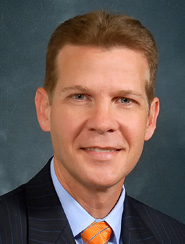
Florida Senate President Andy Gardiner
It was an emotional day in the Florida Senate, as lawmakers approved a suite of bills aimed at creating what Senate President Andy Gardiner described as a "pathway to economic independence" for children with special needs.
Part of the package, approved unanimously today, would expand the state's newest educational choice program.
SB 602 would allow 3- and 4-year-olds, children with muscular dystrophy, and more children with conditions on the autistic spectrum to qualify for Personal Learning Scholarship Accounts (or PLSAs).
The accounts are administered by scholarship funding organizations like Step Up For Students, which co-hosts this blog and employs the author of this post.
As with several other bills in the package, all members of the Senate signed on to the PLSA legislation as co-sponsors.
Other bills passed by the Senate would expand higher education options for special needs children, increase their employment opportunities, and allow families to create tax-free savings accounts to help people with disabilities cover living expenses. (more…)
For two years, Florida private schools have faced a dilemma affecting students who want a jump start on college. A change in the way the state funds dual enrollment has meant that for some of them, it's no longer free.
Sen. Stargel
This year, though, a fix may be in the works. The proposed legislation could also make college courses more accessible to home-school students.
In 2013, the Legislature shifted some of the costs of dual enrollment courses from colleges to school districts. The change wound up affecting many private schools, which started receiving charges of $72 per credit hour for students who enrolled in college courses. That meant private schools either had to come up with money to cover their costs, or take dual enrollment options away from their students.
Legislation by Sen. Kelli Stargel, R-Lakeland, approved last week by a Senate panel, would change the way private school students participate in dual enrollment.
The bill would create a new system, similar to the one that exists for home education students. Private-school students could enter articulation agreements with colleges, allowing them to take dual enrollment courses free of charge.
"I think it would be prudent to allow these kids the opportunity to attend our dual enrollment opportunities at our community colleges, and not charge them, the way that we don't charge other students," Stargel told the Senate Education Committee.
The bill, SB 874, would also require colleges to offer textbooks to home- and private- school students. Under the current law, they often have to supply their own. Similar legislation has been filed in the House.

