The number of Florida families choosing home education jumped nearly nine percent last school year.
The new numbers, based on registration data kept by districts and reported this summer by the state Department of Education, suggest that while the dramatic jump in homeschooling at the height of the pandemic appears to have slowed, the trend is still moving in one direction: up.
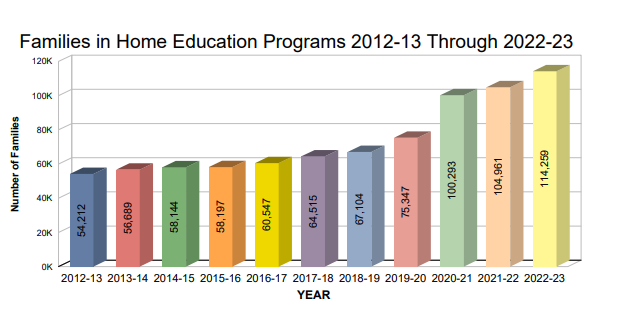 Reliable estimates of homeschooling participation are notoriously difficult to come by. These numbers are based on the number of families who registered with their districts as homeschoolers, as required by Florida law.
There is one quirk in the data. While the number of families choosing to homeschool jumped at a relatively high rate, the number of participating students leveled off, growing by just 1.4 percent. 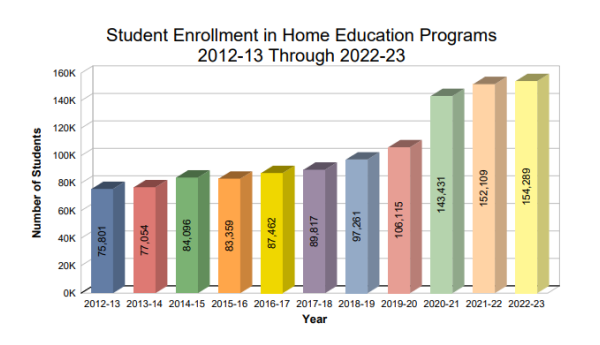
Reasonable people can debate whether the number of families choosing to homeschool or the number of students participating is the more relevant data point. If you have thoughts, please send them my way.
Some learning options that look or feel like homeschooling may not be reflected in these numbers. They do not include students who enroll full time in online public schools or students who enroll in private schools that support learning at home.
Next school year, students will have the option to enroll part time with their local school districts. And students receiving state educational choice scholarships will have the option to enroll in "personalized education programs" that allow them to mix and match different learning options without attending a single school full time.
It's a safe bet that in the coming years, new options will mimic some flexibilities of homeschooling, while remaining legally distinct. Many traditional homeschoolers prefer to keep it that way.
This blurring of the lines means homeschoolers' impact on the overall education landscape may be growing faster than homeschooling itself, as measured by official statistics.
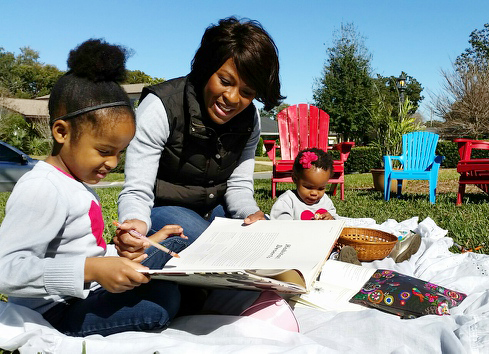
Tamsin Thomas homeschools her daughter Olivia, 5, while sister Ona, 1, sits close by. “I don’t want my daughter to be short-changed because of the color of her skin,” Thomas said of Olivia. “I feel like I’m the only one who has her best interests at heart.” (Photo courtesy of Tamsin Thomas)
Tamsin Thomas of Orlando, Fla. said when she was in high school, public school officials determined her younger brother, a bright-but-shy fifth grader, should be in special education classes. She was horrified. She feared her brother was being shifted, for no good reason, into less-challenging classes and onto a lesser track in life. She urged her mother to fight it.
Mom won. Now Thomas’s brother is set to graduate with a standard diploma, and planning to enlist in the Marines. But that experience and others convinced Thomas that when it comes to public schools, African-American parents are rolling the dice with their children’s futures.
So, she homeschools.
“I don’t want my daughter to be short-changed because of the color of her skin,” Thomas said of Olivia, 5. “I feel like I’m the only one who has her best interests at heart.”
Thomas isn’t alone.
Although the evidence is mostly anecdotal, a flurry of recent stories (like this, this and this) note a growing number of African-American parents turning to homeschooling.
Researchers estimate 200,000 of the 2.4 million homeschoolers nationwide are African-American. Their parents are largely motivated by the same reasons that propel other homeschool parents. But a significant number also want to shield their children from schools they believe will shortchange them, leading to outcomes that are beyond troubling.
In this respect, the rise in black homeschoolers isn’t a trend on the fringe, but another thread in the educational freedom story that has always been part of the black experience in America. As a new report from the Black Alliance for Educational Options put it, “Black people’s struggle to obtain an education in America is older than the Declaration of Independence.”
It wouldn’t be surprising if the homeschool chapter was especially telling in Florida.
The state with the second-highest number of black students in the nation (after Texas), and arguably the most robust array of choice options, had 84,096 home-schooled students in 2014-15, up 21 percent in five years. The state doesn’t track the students by race, but many homeschool parents, both white and black, say the increase in African-American homeschooling families is clear.
Thomas said when she began homeschooling Olivia several years ago, she was the only African-American parent in her homeschooling networks. But now there are several, and she expects to see more.
“It’s the way things are going in society,” Thomas said. “We say we think racism is behind us, but … “ (more…)
In the factory’s tiny lobby, a dozen middle-school-aged boys and a handful of parents stood shoulder to shoulder in front of the company president, a soft-spoken man with a pen in his shirt pocket. He held up one precision-crafted, metallic piece after another and explained how angles and radiuses, aluminum and titanium, came together through man and machine to create amazing things. This gizmo goes on a Black Hawk helicopter, he said. This one, on a Javelin missile. And this one?
“You all saw the Curiosity land on Mars?” he asked. Heads nodded. Well, he said, his company made some of the parts for the rockets that got it there.
Inside the boys’ heads, gears turned.
For some of them, this was their third trip to a manufacturing plant in the past month. For kids their age, that would be extraordinary in just about any school, public or private. But in their case, it’s even more unique: They’re home-schooled.
The Trinity Homeschool Academy in Tampa, Fla. emphasizes science, technology, engineering and math – the so-called STEM fields. Director Tonya Walters designed it that way. The mother of three created the all-grade-level network two years ago, aiming to fill an open niche in the home-school community and a gap between what kids don’t learn, in too many settings, and what high-tech, high-wage jobs need them to know.
Especially with the tough economy, “you realize all these college kids with liberal arts degrees can’t get jobs,” Walters said. “I thought, ‘How can I get my kids from point A to point B?’ ”
The academy now serves about 200 students and contracts with 15 teachers. Home school parents pick-and-choose classes in a system Walters calls “a la carte.”
In many ways, Trinity academy is in sync with the new definition of education. Practical, flexible, whatever works. The STEM emphasis defies home-school stereotypes, though the academy does proudly tout a Christian worldview and, in biology, offers some faith-based teachings that would make many scientists pause. At the same time, the academy shows how evolving options beyond traditional public schools are finding ways to bring kids up to speed on skills and knowledge many consider vital. (more…)

