Editor’s note: Andrew Campanella is president of National School Choice Week. This concludes our #schoolchoiceWISH series.

Campanella
As school choice supporters, we hope children who benefit from educational opportunity will “dream big.”
We tell students to aim for their loftiest goals and to never give up.
My #schoolchoiceWISH is that school choice organizations do the same – dream big – and turn 2014 into a Year of New Opportunity for children across America.
This isn’t mere rhetoric. We can do this.
Support for school choice in all of its forms is at an all-time high. This support is evidenced not just by public opinion polls, but also in the scores of school choice and education reform organizations that exist today. These groups are doing remarkable work at the state and national levels, and they're working together and collaborating more effectively than ever.
But for school choice to become an even more powerful movement, and for 2014 to become a Year of New Opportunity for families across America, these groups can forge even closer partnerships, either by planning joint events or partnering on projects designed to educate and empower parents and families.
To individual parents – "school choice" is not just about charter schools, or private schools, or traditional public or magnet schools, or online learning and homeschooling. It’s about having a choice of all of these options, being able to make a choice, and selecting the learning environments that are right for their individual children.
When school choice organizations work together, the collective messaging of these partnerships and this broad, familiar definition of school choice resonates with families.
It goes without saying that a charter school association and a private school choice group might not agree on every policy issue, or that a homeschooling organization and a magnet school consortium will not always find common ground. And yes, organizations do compete for scarce funding — that's an undeniable fact.
But National School Choice Week is one proof point that collaboration is possible, and that despite differences on specifics, school choice and education organizations can come together on the basics. Later this month, hundreds of organizations, thousands of schools, and millions of Americans will join together at 5,500 events across the country to celebrate all types of effective education options for children. (more…)
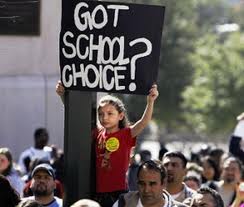
About 1,000 people are expected for the rally in Tally.
"Where are the parents who support school choice?"
"Where are the parents who support parental empowerment?"
"Where are the parents whose children benefit from education reform?"
These are typical questions from traditional parenting groups, groups that sometimes say they represent Florida parents in all educational matters. They have to ask the whereabouts of moms and dads of more than 1.5 million schoolchildren of choice, because such parents don’t tend to be in their membership files.
To the extent these choice parents are low-income and single moms who choose options such as the tax credit scholarship, they do indeed tend to be less visible in the political sphere.
Get ready, because that’s changing.
Early Wednesday morning, families from all over Florida, from Miami’s inner city neighborhoods to rural Pasco County, will board buses with their children and teachers and travel five to 10 hours to get to Tallahassee for School Choice Day. Organizers expect more than a thousand participants to gather and show lawmakers, traditional parenting groups, and everyone else the real face of parental school choice.
They won’t look like right-wing corporations. There’s a good bet they will be racially and economically diverse. In other words, they will probably look like you and me. (more…)
Editor’s note: Wendy Howard is executive director of the Florida Alliance for Choices in Education, which includes a broad range of school choice organizations. The views expressed here are her own and not that of FACE.
Four years after my daughter Jessica Howard began a petition drive to make it easier for students to access virtual education in Florida, she is still not eligible for the virtual provider of her choice. No wonder so many parents settle for learning options that may not necessarily be the best option. There is so much bureaucracy and public attack if a parent merely wants more choice.
As a parent advocate, I have met many parents who are desperate for just that.
One told me her child wrote a suicide note after severe bullying at her school, but fortunately everything turned out okay after they found another option. Another couldn’t transfer her child to a virtual school – despite severe allergies – because of the “seat time” restrictions that were in place at the time. Instead, she had to access a district’s “hospital homebound” program, which cost taxpayers an exorbitant amount of money.
In other cases, parents have children who are failing in the system, or are far ahead of the system, or are pursuing athletic or professional careers that require some reasonable flexibility with academic schedules. There are endless reasons why some families want to choose schools outside of their traditional zoned school, or prefer Option X to Option Y, or want to mix and match those options so their kids can thrive.
All of those parents and their stories have made me wonder: Why can’t we just let all parents decide? Why are we limiting their choices?
Why not all parents, all choices? (more…)
 In 2010, Doug Tuthill took a look around and realized he was living in a new era.
“Florida had this rapidly expanding portfolio of school choice options,” said Tuthill, the president of Step Up For Students, which administers the state’s tax credit scholarship program. “Yet there was little dialogue among the groups representing those choices. We weren’t talking to each other about what was working, what wasn’t, and why.”
Several important players in this bourgeoning movement recognized the need for more collaboration. Florida Virtual School and Step Up For Students, among others, wanted to see the school choice movement united, so they could learn from each other and talk through any differences.
Thus, FACE was born.
Florida Alliance for Choices in Education, or FACE, is comprised of more than 50 members, representing a diverse coalition of organizations dedicated to providing Florida school children with more educational options. Such organizations include National Coalition of Public School Options, Florida Charter School Alliance, Foundation for Florida’s Future, and StudentsFirst - all coming together with the belief that, as the FACE website says, “State policy should enable all parents to be fully engaged in their children’s education and to access those learning options that best meet their children’s needs.”
Step Up For Students (which co-hosts this blog) staffed the initial effort. Three individuals - Wendy Howard, a parent advocate from Tampa; Jim Horne, a former legislator and state education commissioner; and Julie Young, president and CEO of Florida Virtual School - spent a year facilitating outreach and diplomacy, eventually bringing all components of choice together in one organization.
Florida is the first state to do this. (more…)

