
Keith Jacobs II, affectionately called "Deuce," with his parents, Keith and Xonjenese Jacobs. Photos courtesy of the Jacobs family
When our son Keith — affectionately known as “Deuce” — was diagnosed with autism spectrum disorder at age 3, we were told he might never speak beyond echolalia (the automatic repetition of words or phrases). Until age 5, echolalia was all we heard.
But Deuce found his voice, and with it, a unique way of seeing the world.
He needed to find the right learning environment, with the assistance of a Florida education choice scholarship.
Deuce spent his early academic years in a district public school, supported by an Individualized Education Plan (IEP). Despite the accommodations, learning remained a challenge. We realized that for some, a student’s success requires more than paperwork. It requires community, compassion, and collaboration with the parents.
Imagine having words in your head but lacking the ability to communicate when you need it most. That was Deuce’s experience in public school. His schools gave him limited exposure to social norms and rigor in the classroom. Additionally, through his IEP, he always needed therapy services throughout the school day, which limited his ability to take electives and courses he enjoyed.
His mother and I instilled the importance of having a strong moral compass and working hard toward his social and academic goals. Although we appreciated his time in public school, we knew a change was needed to prepare him for post-secondary education. We applied and were approved for the Family Empowerment Scholarship for Students with Unique Abilities.
Knowing the potential tradeoffs of leaving public school and the IEP structure behind, we chose to enroll Deuce at Bishop McLaughlin Catholic High School in Spring Hill, about 35 miles north of Tampa. We believed the nurturing, faith-based environment would help him thrive. It was the right decision.
Catholic school provided Deuce with the support he needed to maximize his potential. Despite his autism diagnosis, he was never limited at Bishop. He was accepted into their AP Capstone Program. This was particularly challenging, but Bishop was accommodating. The school provided him with an Exceptional Student Education (ESE) case manager dedicated to his success, and he received a student support plan tailored to his diagnosis and learning style. The school didn’t lower expectations; instead, it empowered him to take rigorous coursework with the right guidance.
Any transition for a child with autism will take time to adjust. On the first day, I received a call: Deuce had walked out of class. This was due to his biology teacher using a voice amplifier. The sound overwhelmed Deuce’s senses, and he began “stimming”— rapidly blinking and tapping his hands. Instead of punishing him or ignoring the issue, the staff immediately reached out.
Together, we crafted a Student Success Plan tailored to Deuce’s needs, drawing from his public school IEP without being bound by it. His plan included preferential seating, frequent breaks, verbal and nonverbal cueing, encouragement, and clear direction repetition. For testing, he was given extended time, one-on-one settings, and help understanding instructions.
These adjustments made all the difference.
Throughout high school, Deuce maintained a grade-point average of over 4.0 while taking honors, AP, and dual enrollment courses. Additionally, he was inducted into the National Honor Society and Mu Alpha Theta Math Honor Society while also playing varsity baseball. Because of his success at Bishop, he will continue his educational journey at Savannah State University, where he will major in accounting and continue to play baseball.

Deuce Jacobs earned an academic scholarship to Savannah State University, where he plans to major in accounting and continue playing baseball.
Catholic schools in Florida increasingly are accommodating students with special needs. The state’s education choice scholarship programs have been instrumental in making Catholic education available to more families. Over the past decade, during a time when Catholic school enrollment has declined across much of the nation and diocesan schools have been forced to close, no state has seen more growth than Florida.
At the same time, the number of students attending a Catholic school on a special-needs scholarship has nearly quadrupled, from 3,004 in 2014-15 to 11,326 in 2024-25. Clearly, many families are choosing the advantages of a private school education without an IEP versus a public school with an IEP.
So, I’m puzzled why federal legislation being considered in Congress, the Educational Choice for Children Act (ECCA), includes a mandate that that all private schools provide accommodations to students with special education needs, including those with IEPs.
Although more and more students with special needs are accessing private schools, not every school can accommodate every student’s unique needs (which is also true of public schools). And, as I learned with Deuce, some schools can accommodate students more effectively if they aren’t bound by rigid legal mandates and have the flexibility to collaborate with parents who choose to entrust them with their children’s education.
If the IEP mandate passes, it would prohibit many schools from accepting funds through a new 50-state scholarship program, undermining the worthy goal of extending educational choice options to more families. The U.S. Conference of Catholic Bishops has called it a “poison pill” that would “debilitate Catholic school participation.”
Bishop McLaughlin’s willingness to partner with me as a parent not only allowed Deuce to succeed academically but also gave him the dignity and respect every child deserves. IEPs work for many. For others, like Deuce, it takes something more like collaboration to build a path forward together.
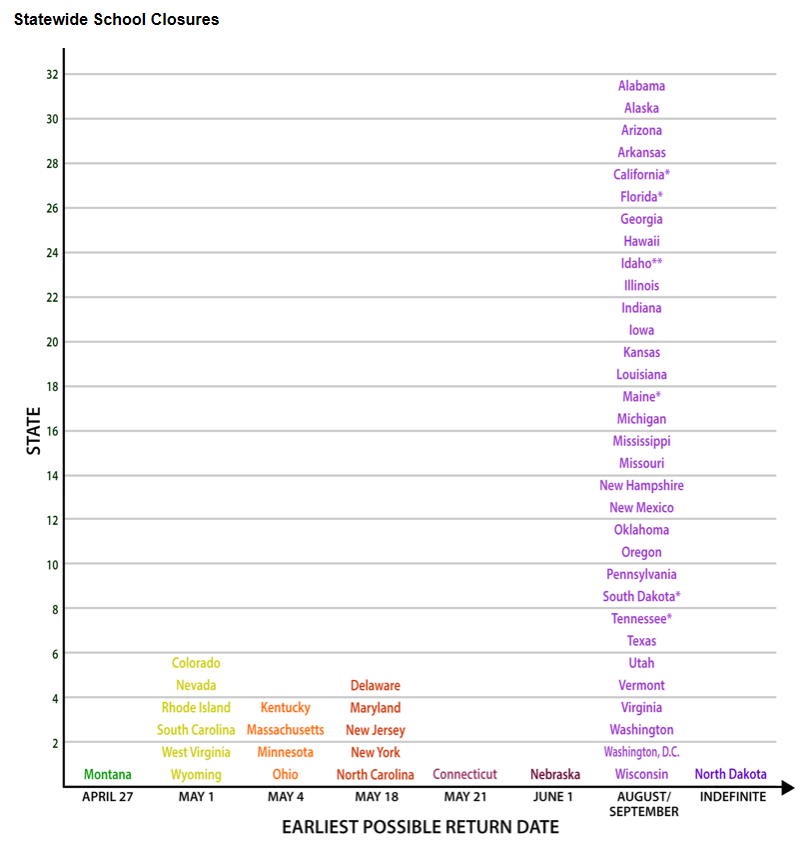
Schools in 31 states, including Florida, have announced that schools will remain closed for the remainder of the school year. Chart: Council of Chief State School Officers
Leaders at several Florida private schools greeted with relief Gov. Ron DeSantis’ decision to keep public school campuses closed and continue distance learning for the rest of the academic year due to possible effects of COVID-19.
The governor’s announcement came over the weekend amid pressure from advocates on both sides of the issue.
“We think it was the best decision under the circumstances,” said Chris Pastura, superintendent of schools for the Roman Catholic Diocese of St. Petersburg, which includes 47 schools and centers that serve 43,000 students in Pinellas, Hillsborough, Pasco, Hernando and Citrus counties. Many students receive state scholarships administered by Step Up For Students, which hosts this blog.
Pastura said reopening campuses would have been “an administrative nightmare” if even one student, parent or staff member had become infected with the virus.
“We would then have to look at closing more than one school,” he said, based on whether the infected person had siblings at another school or whether another one of the diocese’s schools was located close to the school where the case occurred.
DeSantis said in his announcement that his decision came after consulting with educators and parents.
“The last thing that we’re going to do is force everyone in school and have half the kids not show up with their parents,” he said. “And then teachers will not want to do it.”
Florida now joins 30 other states that have closed brick-and-mortar schools until August or September.
The governor’s decision came two days after President Donald Trump released federal guidelines that included a three-phase plan but no timelines, leaving specifics to each state’s governor. However, those guidelines recommended that school buildings remain closed during the first phase.
DeSantis had said on April 9 that he saw value in reopening school campuses in May, even if only for two weeks. That statement prompted public school educators across the state to begin making reopening plans, although some private school leaders said they would make their own decisions. Among options they considered were staggered schedules to allow for social distancing, a combination of distance learning and physical attendance, requiring masks and instituting enhanced disinfection procedures.
Now, private school leaders say, they will focus on making the best of the distance learning programs they launched in mid-March and have worked to improve.
“Teaching remotely has its challenges and requires accommodations, applied sometimes daily for some students to make it work,” said Kim Kuruzovich, executive director for LiFT Academy. “But we are keeping our students and staff safe while meeting virtually face to face.”
The school, about 25 miles west of Tampa, serves 140 students in K-12, 96 percent of whom attend on private school scholarships. Of those, 48 participate in the Gardiner Scholarship Program for students with unique abilities. Two receive a Florida Tax Credit Scholarship.
Kuruzovich said feedback from parents has been positive, and that school leaders have begun considering options for summer and the start of the 2020-21 school year.
“There is a desire by staff and parents to err on the side of caution and not rush to go back to what we had before without first seeing where we are with the coronavirus,” Kuruzovich said. “Most importantly, as with every school is to do what keeps all of us safe and moving forward academically.”
Stacy Angier, principal at Abundant Life Christian Academy, said she understands the reasons behind the decision but is disappointed for families. The school, which serves students in grades K-11 in hard-hit Broward County, was among the first in the state to pivot to virtual education and has worked hard to keep students engaged while online.
On Thursday, Abundant Life will host a virtual school pep rally for its 462 students, 234 of whom attend on a Florida Tax Credit Scholarship.
Meanwhile, plans for a virtual kindergarten graduation are underway, Angier said. The ceremony will take place via video, complete with individual photos of each child in cap and gown.
Parents in Citrus County received some good news going into the holiday weekend. Their community's only Catholic School, which they had rallying to save, will be able to remain open next school year.
Since they learned in early March that the Diocese of St. Petersburg was thinking about closing Pope John Paul II Catholic School, parents, pastors and alumni had been working with the school's administration to raise money, recruit more students and come up with a longer-term plan to keep the school viable.
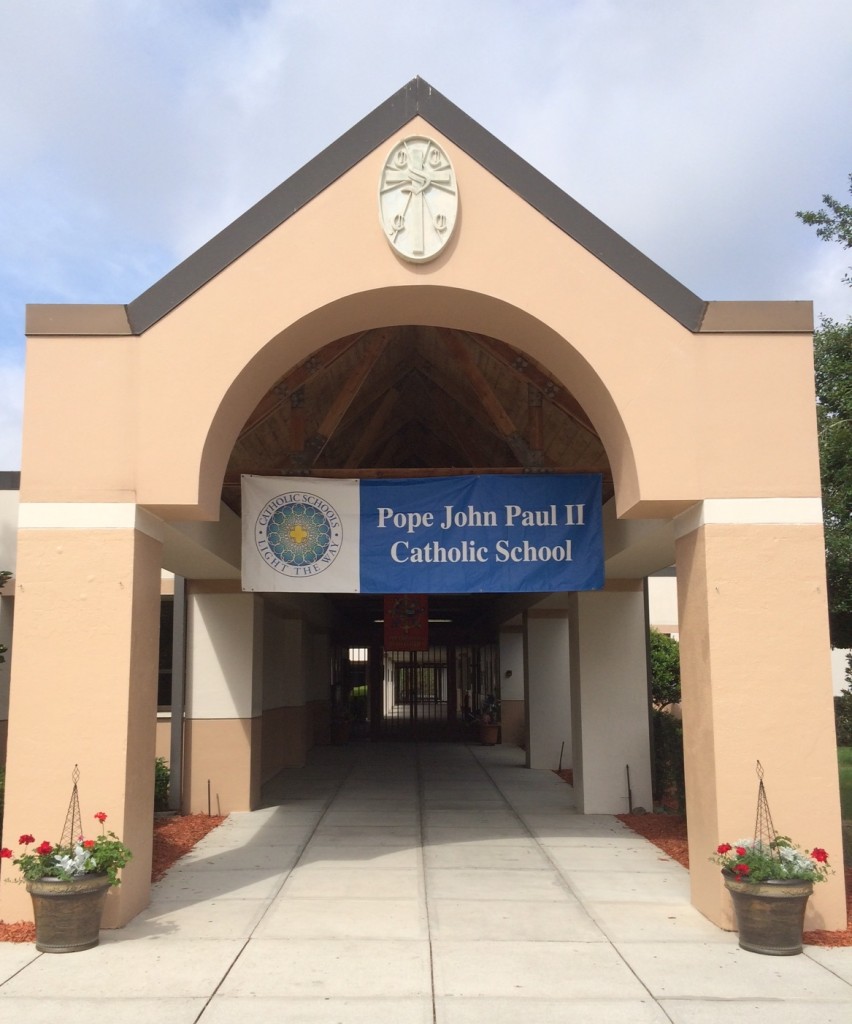 They met Monday with advisers to Bishop Robert Lynch to discuss their five-year plan to grow enrollment at the school and make it financially sustainable.
"We were very impressed with their work, and the bishop agreed with their proposal and wrote them a letter letting them go forward," said Frank Murphy, a spokesman for the diocese.
The diocese was concerned about stagnating enrollment at the school, located in Lecanto, about 80 miles north of Tampa in the northern reaches of its territory.
Faced with the impending closure, parents and pastors in the surrounding area spent the past two months working overtime to promote the school's pre-kindergarten program and scholarships that can help low-income parents afford tuition. Dozens of families came to the school.
"We have never had so many families come through and tour our facility," said Jennifer Petrella, a parent of kindergarten and fourth grade students who also helps lead the school's marketing efforts.
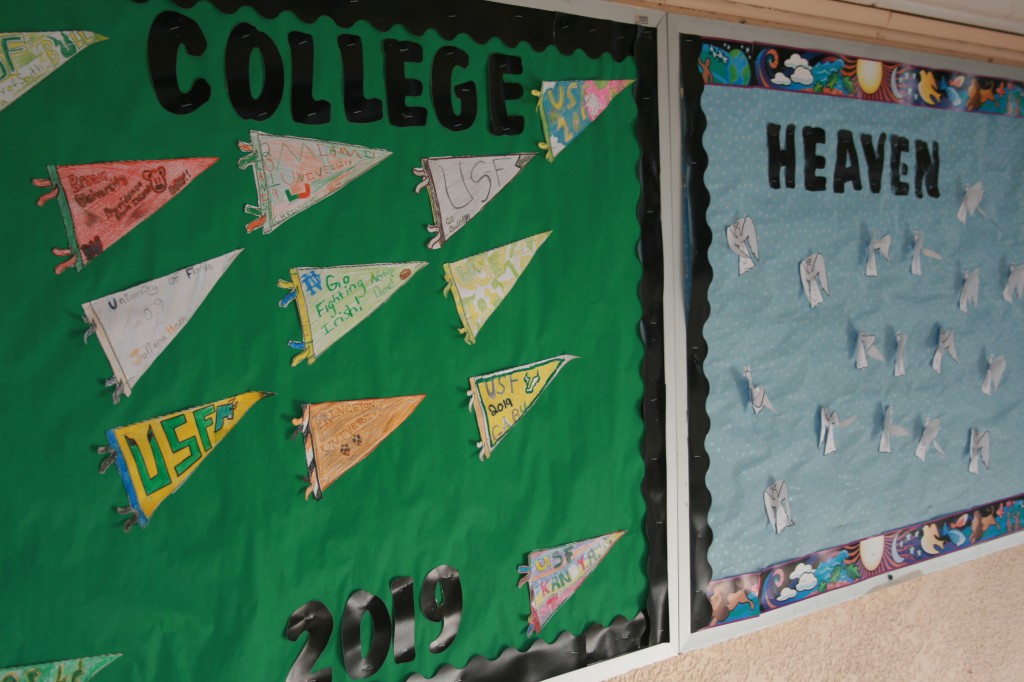
St. Joseph's goals for students are evident throughout the school.
Students know their priorities the moment they enter St. Joseph Catholic School. A sign by the front door reads, “Our Goals: College. Heaven.’’
Inside the West Tampa school’s cafeteria, boys and girls gather for Holy Karaoke, a morning program that encourages them to dance and sing, and focus on the lessons ahead.
Cartoon pumpkins belt out “Blue Moon’’ while bobbing across a giant movie screen. Sister Nivia Arias, in full habit, croons along at the pulpit before prompting her charges to recite daily affirmations.
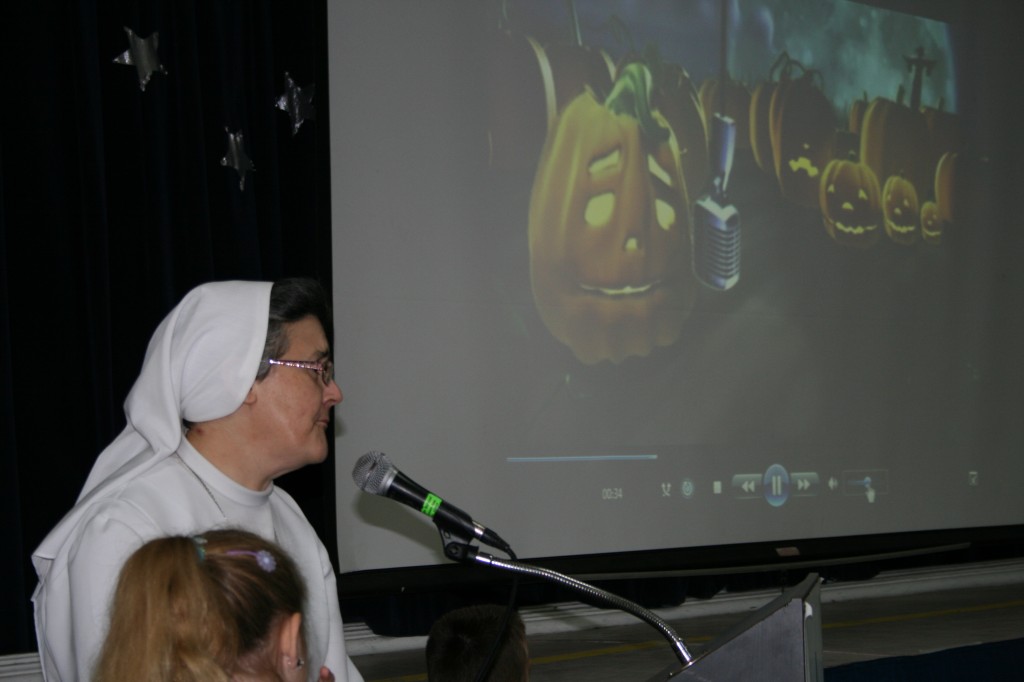
Sister Nivia Arias oversees St. Joseph Catholic School's Holy Karaoke morning show.
“We are active learners who do our best work every day,’’ little voices say in unison. “We do the right thing at the right time.”
The saying sums up the philosophy of this 116-year-old parochial school once run by Salesian nuns. It may also be prophetic.
Like other Catholic schools across the nation, St. Joseph struggles with limited resources while trying to attract students and teachers. But a new partnership with the Diocese of St. Petersburg and the University of Notre Dame might be the right thing at the right time.
St. Joseph and another local Catholic school, Sacred Heart in Pinellas Park, are among five schools in the nation taking part in the Notre Dame ACE Academies, a pilot program in conjunction with the university's Alliance for Catholic Education that aims to strengthen Catholic schools and the communities they serve.
The idea is to boost enrollment and help schools develop better leadership, curriculum, instruction, financial management and marketing. (more…)

