TALLAHASSEE, Fla.– Amanda Thompson said she will be the president of the United States.
Not wants to be or hopes to be but will be.Amanda Thompson said she will be the president of the United States.
Not wants to be or hopes to be but will be.
Just like she will be the attorney general of Florida, the governor of Florida, and the United States attorney general before reaching the Oval Office.
“That’s the plan,” she said. “I’m going to get there.”
Of course, there is some prep work to be done before she begins a career of service to her state and country.
First, Amanda, 17, is set to graduate this May from St. John Paul II Catholic High School (JPII), where she will be class valedictorian. She attends the parochial school in Tallahassee with the help of a Florida education choice scholarship managed by Step Up For Students.
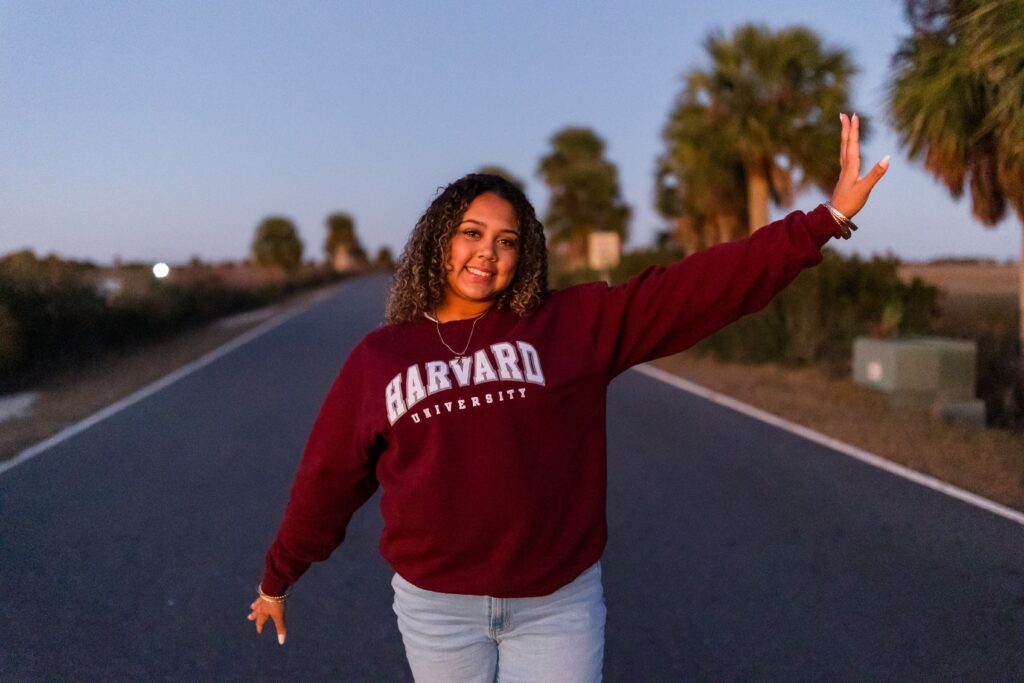
Then it’s off to Harvard University, where she plans to double-major in government and history and earn a degree from its prestigious law school. Along the way, Amanda will pitch for the Crimson softball team with designs on leading the program to its first appearance in the Women’s College World Series.
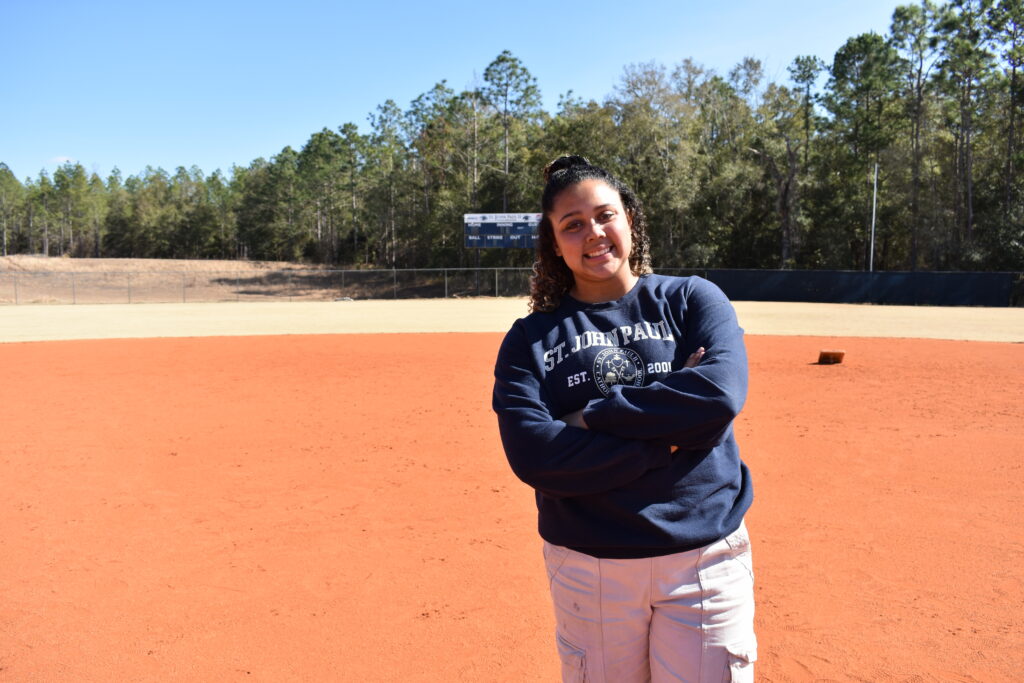
As that unfolds, Amanda is determined to play softball in the Olympics. She has attended tryouts for Team USA and is a member of the United States Virgin Islands national team.
Taken separately, any one of her goals is ambitious.
But combined?
“She has very, very high expectations,” said JPII Principal Luisa Zalzman. “She’s a go-getter, a high achiever. She has a drive that is very mature for her age.”
“She's done everything she's ever put her mind to,” said Amanda’s mother, Ashley Williard. “She said she wanted to be valedictorian, and I said, ‘OK, go be valedictorian.’ And she did it.”
Amanda is a bundle of energy and confidence. On the softball field, she has a running dialogue with everyone – teammates, opponents, coaches, umpires. In the classroom, she’s involved in every class discussion.
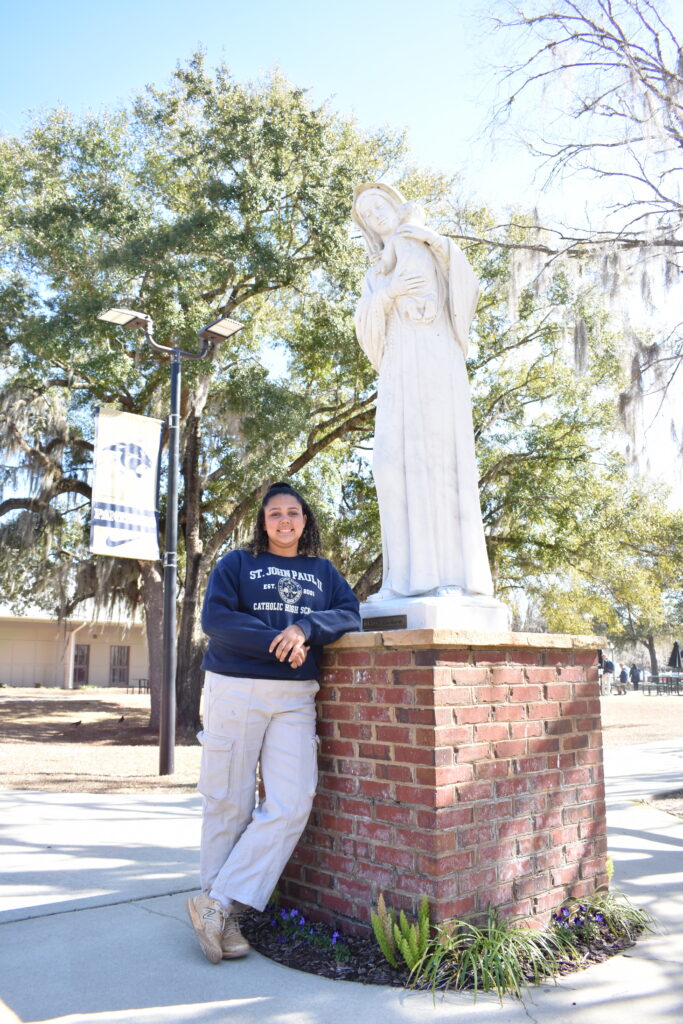
If you had approached her in August 2022 as she took the initial steps of her high school journey and told her she would graduate first in her class and be a member of Harvard Class of 2030, she would have been stunned.
“I would have said, ‘You got the wrong person.’ The difference between me then and me now is astronomical, and I think it’s because I attended this school,” she said. “It has to be.”
Amanda was a star as she rose through the ranks of the Tallahassee youth softball programs. Her parents, Ashley and James Thompson, envisioned their daughter earning an athletic scholarship to college. They were thinking of a high-end academic university like Duke or Notre Dame. That’s how Amanda, who attended her district schools until eighth grade, landed at JPII.
“We wanted a high school that was college-focused,” Ashley said. “Education is what we were looking for, and we could not have done it without Step Up For Students. No way could we afford to put her in that situation.”
There were “little things,” Amanda said, that shaped her academic future.
Her freshman English teacher encouraged her to write outside the margins during tests and essays.
“He said, ‘You don’t have to stay within this box. If you know more, write more on the paper.’ That stuck with me,” Amanda said.
Her freshman world history teacher announced to the class that Amanda scored the highest on the first test of the year.
“He congratulated me,” she said. “I thought that was insane.”
Midway through that semester, Amanda realized she had A’s in all her classes. That’s when she began to believe in herself as a student. Future valedictorian?
“Why not?” she said.
Amanda took AP World History as a sophomore and aced the AP test.
“That’s the class where I learned to learn,” she said.
Also, her love of history and government was born in that class, Amanda said. She can name all the countries of the world, tell you where they are located, and identify the flags.
“I’m working on my capitols,” she said. “It’s my hobby.”
Amanda took Spanish I and II in middle school and passed each, but not with grades that would stand out on a high school transcript. Sara Bayliss, JPII’s college advisor, suggested that Amanda retake those courses.
“She said the grades weren't good enough, that I could do better,” Amanda said.
Amanda retook both classes. She asked Principal Zalzman, a native of Venezuela, for tutoring help. The result was a pair of grades that fit proudly on the transcript Amanda sent to Duke. Duke was her dream school for education and softball.
And then Harvard called.
At midnight on Sept. 1 of her junior year – the first day college coaches can contact 11th graders – Amanda received a phone call from the Harvard softball coach.
“I didn’t even know they had a softball program,” Amanda said.
Intrigued, Amanda accepted a recruiting visit to the university located just outside of Boston. That trip marked the end of her Duke dreams.
“I want to make a difference in this world, and I think Harvard is the perfect school for me,” she said.
Terrence Brown, JPII’s softball coach, has watched Amanda emerge as an Ivy League student and a Division I softball player good enough to attend Team USA tryouts and earn a spot on the national team of a small territory with Olympic ambitions.
“She’s goal-oriented, and she doesn’t let anything get in the way of achieving those goals,” he said. “She’s worked very hard to get to where she’s going.”
Ashley and James are proud parents, but Ashley said they won’t take too much credit for Amanda’s success.
“We have nothing but pride,” Ashley said. “She is self-driven, self-motivated. We try to provide motivation. She’s missed proms and dances because of softball travel and schoolwork, and that was all her decision.
“There are a lot of sacrifices made to go along with this. She’s not afraid of hard work. She says she’s going to do something, and she goes out and does it.”
By Lauren May and Ron Matus
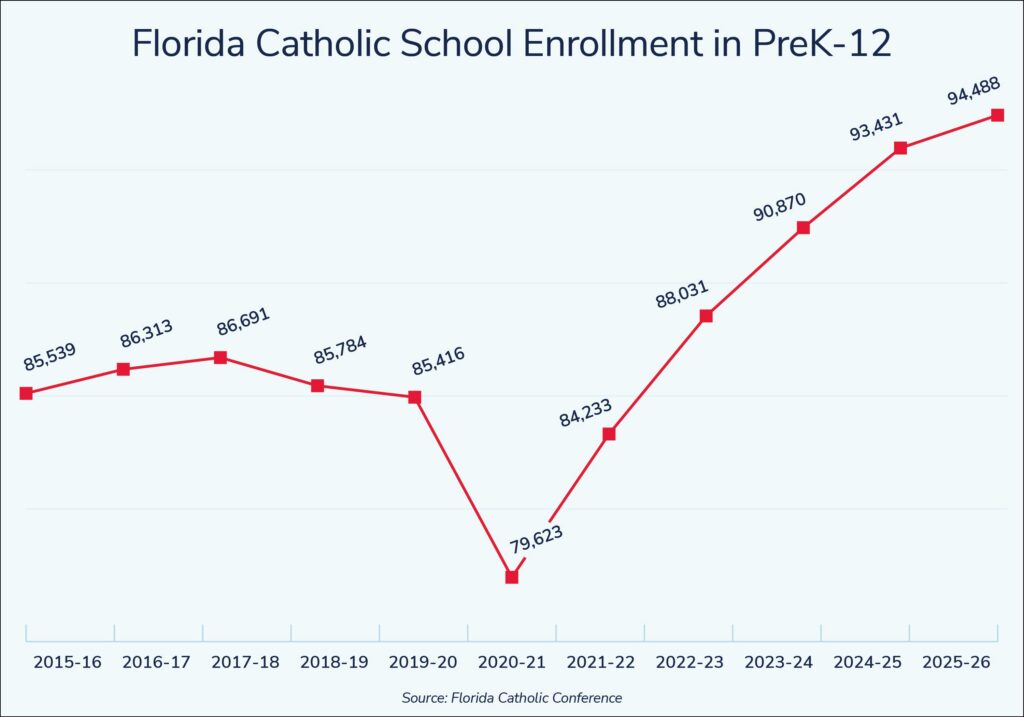
Catholic school enrollment in Florida is up again this year, rising 1.1% to 94,488 students, according to the latest numbers from the Florida Catholic Conference.
The continued growth is likely to bolster Florida’s reputation as the national standout in Catholic schooling. Through last year, Florida Catholic school enrollment was up 12.1% over the past decade. Nationally, it was down 13.2%.
To spotlight the trend lines, we published a special report in 2023, “Why Catholic Schools in Florida Are Growing: 5 Things to Know,” followed by update briefs in 2024 and 2025.
In that spirit, here are five things to know about the 2025-26 numbers:
The trend continues. This year marks five years of consecutive growth. Since 2020-21, when enrollment dipped in the wake of the pandemic, Catholic school enrollment in Florida is up 18.7%.
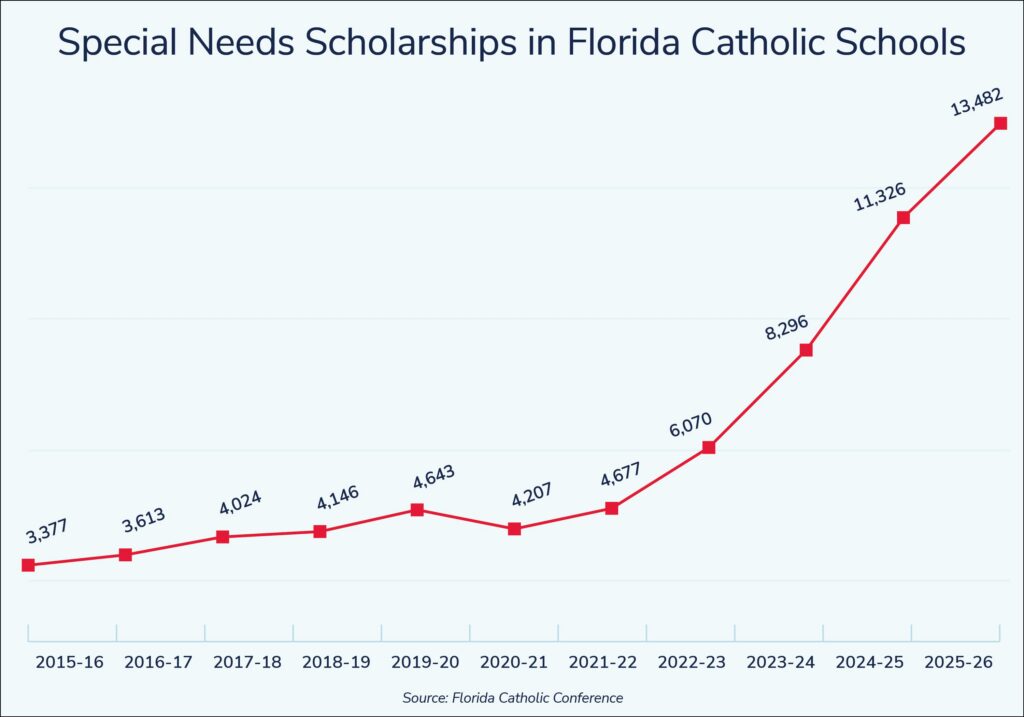
Special needs surge. Students with special needs are a leading factor. This year, Catholic schools in Florida are serving 13,482 students who use the state’s Family Empowerment Scholarship for Students with Unique Abilities. That’s up 19% from last year and triple the number from five years ago. FESUA students now encompass one in seven of all Catholic school students in Florida.
Non-Catholic students. Catholic schools have a long history of serving a diverse array of students. This year, 20% of students in Florida Catholic schools are non-Catholic, up from 14% a decade ago.
Choice scholarships are critical. In 2022-23, the year before choice in Florida became “universal,” 47.2% of all Catholic school students in Florida used choice scholarships. This year, 92.1% use them.
Context for the trend line. This year’s enrollment increase is smaller than any of the past five years. Time will tell whether that’s an anomaly. But it’s worth noting that except for a la carte learning, K-12 enrollment in Florida is slowing all over:
It’s likely that demographic shifts, including falling birth rates and declining immigration, are significant factors here. With private schools, it’s also possible that barriers such as zoning and building codes are preventing supply from better meeting demand. Last year, a Step Up For Students survey of parents who were awarded choice scholarships but didn’t use them found one in three said there were no seats available at the schools they wanted.
One final note: This post, not to mention our reports on Catholic education in Florida, wouldn’t be possible without the Florida Catholic Conference. FCC Director of Accreditation Mary Camp has been carefully tracking the enrollment and scholarship data for years. We are grateful to partner with the FCC and particularly indebted to Mary.
About the authors
Lauren May is Vice President and Head of the Federal Scholarship Tax Credit Program at Step Up for Students and a former Senior Director of Advocacy at Step Up For Students. As a proud graduate
of the University of Florida, she received her bachelor’s degree in special education
and her master's degree in early childhood education. She then completed another
master's degree in educational leadership from Saint Leo University. A former
Catholic school teacher, early childhood director, and principal, she was honored with
University of Florida’s “Outstanding Young Alumni” award in 2018. As a believer
that parents are the first and best educators of their children, Lauren loves working
with families across the state and beyond to ensure they can find and make
use of the best educational options for their children.
Ron Matus is Director, Research & Special Projects, at Step Up For Students. He
joined Step Up in 2012 after more than 20 years as an award-winning journalist,
including eight years as the state education reporter for the Tampa Bay Times, the
state’s biggest and most influential newspaper.
AVE MARIA, Fla. – Toby and Nicole Mickelson were thinking about moving from Minnesota even before they heard about school choice in Florida. The weather, the politics, and the taxes were all getting to be too much, plus Nicole’s parents had recently become snowbirds with a winter home in southwest Florida.
Still, it wasn’t clear which warmer, less expensive, more conservative state they might move to.
But then a friend in Florida posted praise on Facebook for the state’s private school choice scholarships, which the Florida Legislature and Gov. Ron DeSantis had made available to every single student, beginning in the 2023-24 school year and are administered by Step Up For Students.
Toby and Nicole were stunned.
“I said, ‘Can you believe this even exists?’ Nicole said, “He said, ‘Are you kidding me?’ “
“Once we found out about the Step Up money, it (Florida) was a shoo-in.”
This was in the summer of 2024.
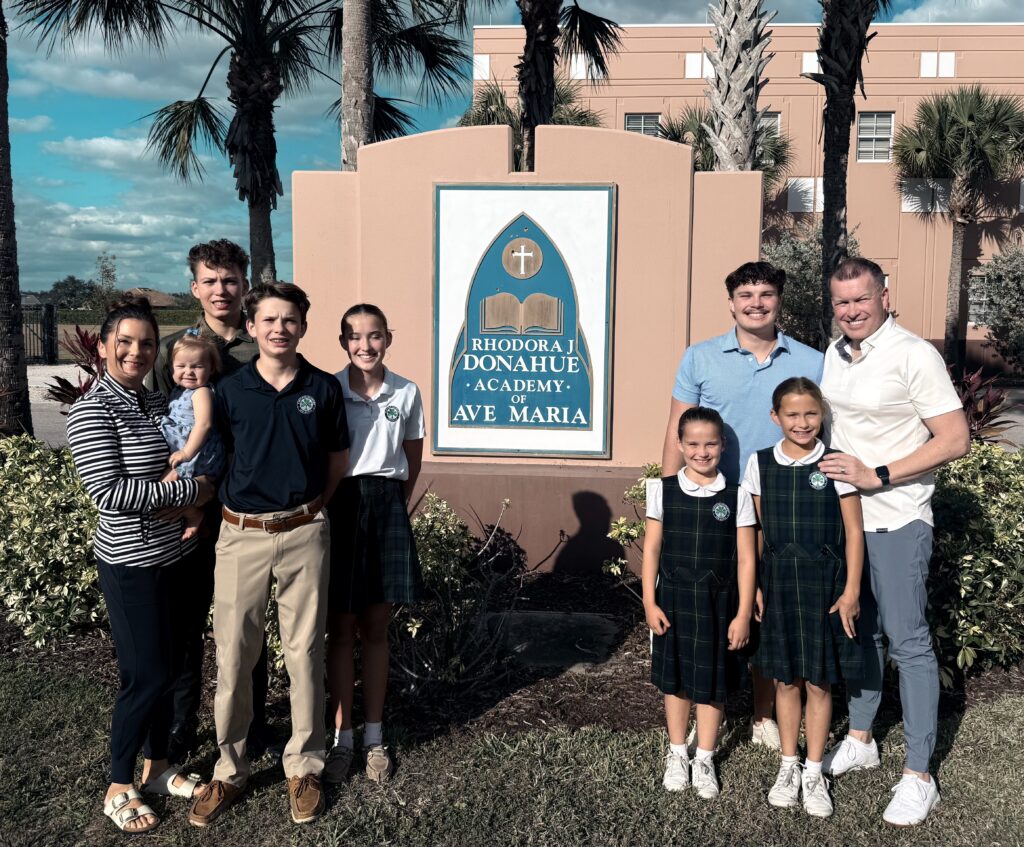
In early 2025, the Mickelsons applied to get their kids into Rhodora J. Donahue Academy, a classical Catholic school in Ave Maria, a predominantly Catholic community about 30 miles from Naples. In April 2025, their kids were accepted.
Incredibly, the family found the perfect house in Ave Maria and sold their home near Minneapolis almost simultaneously. By July, they were Floridians, with a month to spare before school started.
“We pinch ourselves every day,” Nicole said. “We’re so grateful to be here.”
The Mickelsons aren’t alone.
The Sunshine State has become a magnet for a whole new breed of transplants. We don’t have good numbers to quantify the trend, yet, but it’s easy to find families who moved here wholly or in part because 1) Florida offers generous school choice scholarships to every family, and 2) The education landscape is increasingly diverse because of all that choice, with more options for more families all the time.
At one school for students with special needs in Jacksonville, the families of 24 students — 10% of the entire student body — moved to Florida to access the school and the scholarships. At Donahue, according to the Diocese of Venice, at least two dozen students fit that description. Meanwhile, at a school for students with autism in the Tampa Bay area, a half dozen families moved from other countries or Puerto Rico.
The Mickelsons said families in Minnesota who hear about Florida’s choice scholarships initially “don’t believe it,” Nicole said. “They think it’s too good to be true.”
But, as the Mickelsons learned, they’re real.
Toby is an occupational safety manager for a commercial kitchen company and a member of the Air Force Reserves. Nicole is the vice president of sales for her family’s long-distance trucking business.
In Minnesota, they sent their kids to classical Catholic schools. For a big family, that wasn’t a breeze financially. Tuition per child averaged nearly $10,000 a year. “You can’t sustain that,” Nicole said.
Commuting was a challenge, too. One school was 20-30 minutes each way; the other, 30-40 minutes. “We lived in our cars,” Toby said.
The Mickelsons had some familiarity with Florida.
Four years ago, Nicole’s parents bought a home in Fort Myers, where they live for half a year. And three years ago, the Mickelsons visited Ave Maria University while they were checking out colleges with their oldest child. The university is also in the community of Ave Maria.
It was then that they learned about Donahue Academy, which is also a classical school.
Classical schools “teach a lot of classic books, like Dante’s ‘Inferno,’ not New Age-y things,” Toby said. For Donahue to also be a classical school was “icing on the cake.”
At the time the Mickelsons applied, Donahue had 440 students and a long waiting list. The Mickelsons weren’t sure they had a shot. But thankfully, the school was also in the midst of a huge expansion that would allow it to serve 615 students.
Donahue could be the poster child for another Florida-centered education trend, the revival of Catholic schools. Unlike Catholic schools in much of the country, Catholic schools in Florida are growing again. No region of Florida is showing more growth than the Diocese of Venice, which includes the cities of Fort Myers, Naples, Sarasota, and Bradenton.
“My husband said, ‘Let’s apply, let’s do the paperwork. If they get in, that’s our sign to move,'" Nicole said.
After praying and fasting, they got a thumbs up.
The Mickelsons have seven children. The oldest is in college. The next-oldest is homeschooled. Four attend Donahue, in grades 9, 7, 5, and 2, respectively. The youngest is a year old.
Nicole said school choice wasn’t the only reason for the move to Florida, but she put it at the top of the list, followed by politics, taxes, weather, and her parents living nearby. She said Donahue probably wouldn’t have been affordable without the choice scholarships.
In Ave Maria, the Mickelsons no longer worry about the long commutes, either. They live a few blocks from the school, so the kids bike there. “It’s like a dream,” Nicole said.
The plan is for the kids to graduate from Donahue, then attend Ave Maria University.
Nicole and Toby are both able to work remotely. And now that everything in Florida is working out so well, word is getting back to their friends in the Gopher State.
One family recently pulled their kids out of Catholic school because they could no longer afford it. For now, they’re homeschooling. But thanks to school choice, Florida looks mighty enticing.
Said Nicole, “I have a lot of Minnesota friends who want to move to Florida now.”
JACKSONVILLE, Fla. – The diagnosis was Entamoeba histolytica, which is an infection caused by ingesting an amoeba that produces fatigue, abdominal pain, weight loss, and a few more symptoms you don’t want to have when you are more than 9,000 miles from home.
That’s where Christopher Trinidad happened to be during a visit to his parents’ homeland in the Philippines the summer before the eighth grade.
Born and raised in Jacksonville, Christopher’s immune system was not accustomed to some of the pathogens found in the local food. He had not built up a resistance like residents have. Lying in a hospital bed in the city of Bacolod, while the antibiotics did their thing, Christopher had this thought: “This has to be my science fair project.”
And so it was.
After returning home, Christopher ordered microorganisms online. “Safer organisms,” he said, than the one that waylaid him a few weeks earlier. He experimented with various items found in the kitchen pantry – ginger and garlic – mixed them with water and other ingredients and developed a solution that killed the organisms.
“What if,” Christopher thought, “we use these solutions on the actual thing? This can help so many people.”
His project finished first at a regional science fair.
“Impressive, right? Wait until you hear what he did his freshman year,” said Carla Chin, director of marketing and communications at Bishop Kenny High School in Jacksonville.
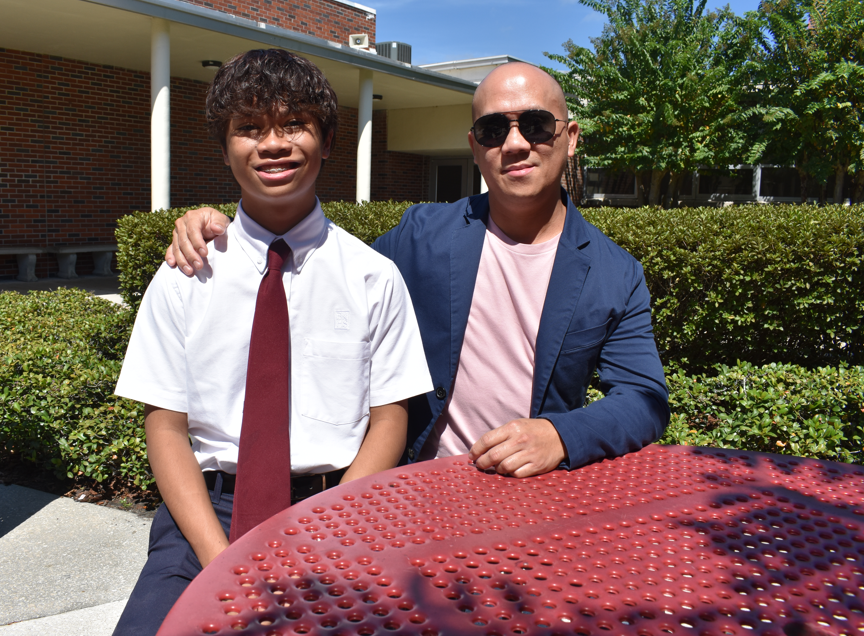
Christopher, a sophomore, attends the parochial Catholic school on a Florida education choice scholarship managed by Step Up For Students.
He sat in a chair inside Chin’s office. His father, Greg, sat in another and proudly listened as his son, with a mixture of pride and modesty, described the project that earned first place at a regional science fair and then a bronze medal at the Genius Olympiad and a $15,000 scholarship to the Rochester Institute of Technology at a global competition held in Rochester, New York.
Using an electroencephalogram (EEG), which measures electrical activity in the brain, artificial intelligence, virtual reality, and violin music, Christopher was able to predict the moods and emotions of stroke victims who are unable to speak, thus creating a line of communication with doctors.
“By using brain waves, doctors can know what their patients are feeling, which would lead to better decision-making,” he said.
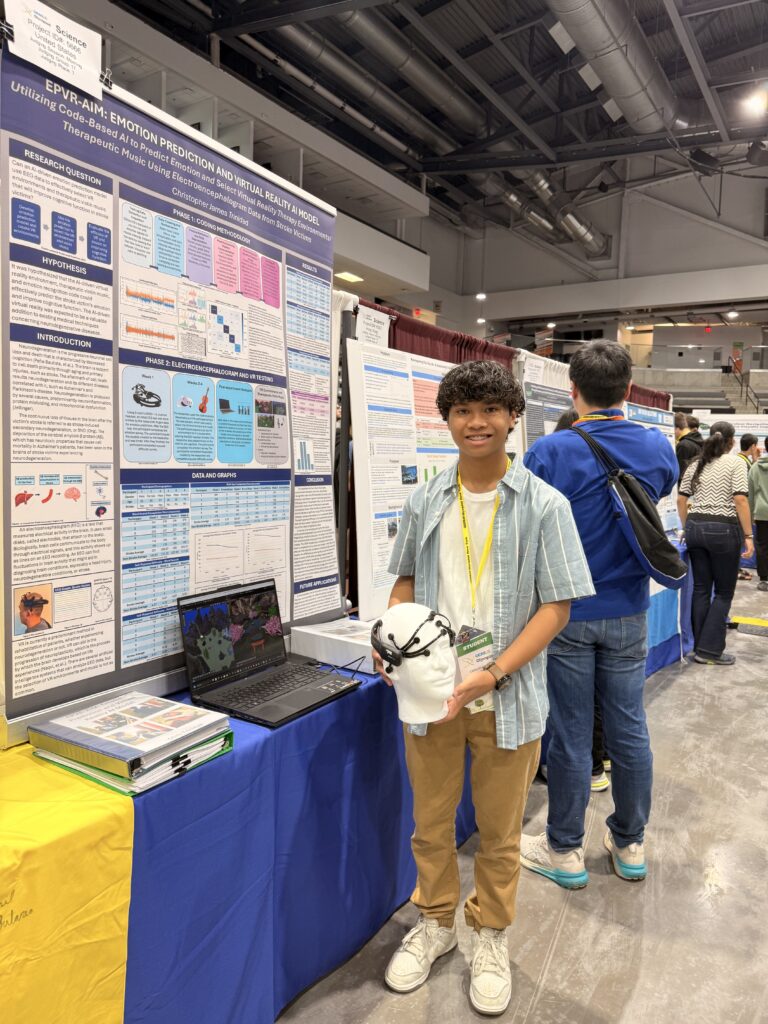
Michael Broach is the Vice Principal at Bishop Kenny and the Director of Mission Integration, as well as the AP Capstone Department chair. He was responsible for approving Christopher’s science project.
“That was one of the most sophisticated projects, I think, that I've seen in my years of being here,” Broach said. “And just the way his mind works is well above his peers. Well above what you would expect of somebody of his age.”
Christopher is 15.
He wants to be a neurosurgeon.
“I’ve always been fascinated with the brain since I was little,” Christopher said. “It controls everything in our body. It’s really interesting, and going into surgery, fixing people's brains is really complex, and that's what I love about it.”
His parents – Greg and Shiela – are both nurses, so Christopher was raised around medical science. Their house is filled with textbooks related to their careers. Christopher has read them all.
The valedictorian of his middle school, Christopher has a 4.3 weighted GPA at Bishop Kenny. He chose to attend the Catholic high school because it aligns with his faith and has a high academic standard.
“It challenges me,” he said. “I know there are other people here I can talk to, and it gives me a greater experience.”
He’s not the only student at Bishop Kenny who knows what an electroencephalogram is and how it works.
While he spends a considerable amount of time working on his science fair projects (keep reading to learn about what his plans are for this year’s project), he’s very active at school. Christopher is a member of the Science Club, Medical Career Club, St. Vincent de Paul Society, campus ministry, and the Brain Brawl. He plays the piano at the monthly mass. He’s also first violin for the Jacksonville Symphony Youth Orchestra.
Listening to his son talk, Greg had one feeling. “Blessed,” he said. “He has a humble heart. We try to remind him always what’s hard.”
Greg understands hard.
Raised in a small town an hour’s plane ride from Manila, Greg’s childhood was humble at best. He went through elementary school with only two pairs of shoes. He caught rides to school on trucks headed to the sugarcane fields on days when his mom couldn’t afford bus fare.
“I didn’t have the opportunity to join the Boy Scouts,” Greg said. “My mom didn’t have the money.”
Greg understood the power of an education and where it could lead him. He became a teacher until, at age 26, he immigrated to the United States in search of the American Dream.
He worked odd jobs and became a certified nursing assistant. From there, he attended nursing school in St. Augustine. He now works as a traveling nurse in the cardiac catheterization labs in hospitals around North Florida. He became a traveling nurse for the pay because he and Sheila support three family members in the Philippines.
That’s why Christopher traveled to the Philippines the summer before eighth grade, to see where his parents’ stories began.
“I wanted him to see and feel the difference of being here in this world compared to a third-world country,” Greg said.
The lesson wasn’t lost on his son.
“I just feel really lucky that I'm here in America and I have more opportunities than some kids have in the Philippines, and I’m not going to let this go to waste,” Christopher said.
Greg said he is grateful for the Florida education choice scholarship that helps pay Christopher’s tuition at Kenny.
“In the Philippines,” he said, “if you don’t have money, you don’t go to school.
“He has this opportunity of having this scholarship, and I'm telling him, you're way more blessed than what other people have in other states. We're so thankful that all these opportunities are coming for our son.”
Christopher’s next opportunity is this year’s science fair, where he will take last year’s project a step further.
“I'm planning to build a rehabilitative exoskeleton so it can help people with movement disabilities,” he said. “I can also use an EEG in that, so they can think about what they're going to do with their exoskeleton, which basically helps them move. It would correlate to their actual thoughts. So, if they wanted to walk, they would be able to think it, then the exoskeleton would help them walk.”
It’s been a month since classes started, and Matthew Ottenwess is settled into his freshman year at Tampa Catholic High School.
He’s made friends and likes his teachers.
His high score on the school’s entrance exam gained him admission to three honors classes and one AP course. He plays linebacker on the junior varsity football team.
This was the educational landing his mother, Maggie, was looking for when she learned the family would move from New Mexico to Florida after her husband Chris, a Chief Master Sergeant in the United States Air Force, received a transfer to MacDill Air Force Base in Tampa.
The Ottenwesses have a Florida education choice scholarship to thank for that.
“It’s a game-changer,” Maggie said.

Maggie, Chris and Matthew visit Yellowstone National Park. (Photos courtesy of Maggie Ottenwess)
While the family was still stationed at Kirtland Air Force Base in Alburquerque, Maggie was able to apply for a Family Empowerment Scholarship for Educational Options (FES-EO), managed by Step Up For Students.
“The scholarship made the (moving) process easier, gave us more choice, allowed us to take a breath and not have to worry about additional stresses, both monetary and interpersonal,” Maggie said. “It eased the PCS (Permanent Change of Station) experience. There are countless other things that change – doctors, dentists, specialists, church, youth group, scouts. This took one of the larger chunks off the list.
“Box checked.”
Matthew had been homeschooled during the past five years. Chris and Maggie decided he would return to a brick-and-mortar school setting for high school. They also wanted that setting to be at a faith-based school, preferably a Catholic school.
They understood that would burden the family’s finances, but it was a sacrifice they would accept.
Chris received his Permanent Change of Station order on Dec. 23, 2024. Soon, Maggie was told of Florida’s private school scholarship program from other moms within the military community.
“I couldn’t believe what I was hearing,” Maggie said. “It was too good to be true.”

Maggie set her alarm for 7 a.m. local time on the first Saturday in February. Families could apply for FES-EO scholarships that day at 9 a.m. EST. Since Albuquerque is two hours behind, Maggie wanted to apply as soon as the session opened.
“In the military, on-time is late,” she joked.
Maggie found the “Scholarships for Military Families” page on the Step Up website and entered her family’s information. The process went smoothly until Maggie came to the screen that required her to enter her Florida address. Since the move wouldn’t happen until June, and since the family would live on the Air Force Base, they had yet to be assigned housing, so no Florida address.
“I was in panic mode,” she said.
Her fear was quickly defused during a live chat with customer service.
“You’re not the first,” Maggie was told. “We get this a lot.”
She just needed to upload Chris’s Permanent Change of Station order in the proof of residency screen on the application.
Once Maggie learned that Matthew was awarded a scholarship, she started researching private faith-based schools in the Tampa area and settled on Tampa Catholic because of its challenging history and science curriculums. He was accepted Feb. 28.
“Our Christian faith is important to our family,” Maggie said. “It is the foundation that makes all the complications, moves, hardships, financial struggles, stress, and the like possible. We incorporated religion into Matt's homeschool curriculum and wanted to keep that moving forward. We were open to both Christian and specifically Catholic options. We believed a faith-centered school would continue to support his character and moral compass.”
The FES-EO scholarship covers more than half of the yearly tuition at Tampa Catholic. Maggie said they can afford to cover the rest without her getting a job, something that is not easy for military spouses. Local businesses are not quick to hire someone who could be moving in two or three years.
This allows Maggie to continue her work as an advocate for younger enlisted Airmen, military families and dependents. She works on various committees, task forces, and councils that deal with medical, special needs, and religious issues.
“So, the scholarship is not only helping my son get a quality education, it's helping the mission of the military by me having the breadth and space and time to do those things,” Maggie said. “The scholarship is allowing a difference to happen.”
Chris, who is the Command Chief of the 6th Air Refueling Wing at MacDill, has been in the Air Force for 28 years. He and Maggie have been married for 18 years. They’ve lived on five bases in four different states.
Matthew, who was born when his parents were stationed in New Jersey, his mom’s home state, has lived in Mississippi, Illinois, New Mexico and now Florida.
When asked about the latest move, he said, “I was super excited, a little nervous for all the changes, but definitely excited to get a whole different experience of school.”
The experience was somewhat of a jolt at first. He said it took him a few weeks to become comfortable with the return to the classroom setting. He had attended Catholic school before being homeschooled.
He said he likes living in Tampa, and being on the football team allowed him to make friends quickly, since fall practice began before the first day of classes.
“It's really good,” he said. “(Tampa Catholic) has a really good curriculum. I like the teachers, and it's fun to hang out with my friends all day.”

Recent Clearwater Central Catholic High School graduates (from left) Jan Mistak, Ian Galloway, Nancy Dolson, and Paige Daily each earned National Merit Scholarships.
CLEARWATER, Fla.– They are honor students and athletes.
Volunteers in the community and student ambassadors at school.
One is a champion sailor who has competed in the national and international regattas in places like Canada, Argentina, and Poland.
One is a state champion cheerleader. There is an Eagle Scout who won a district championship in the high jump. There is a three-sport athlete who was voted homecoming king.
They have grade point averages north of 4.0 and PSAT and SAT scores that are the envy of nearly every high school student who has taken the tests.
They are four students who graduated this spring from Clearwater Central Catholic High School, united by the same unwavering drive to excel academically.
And that drive led them to this: a National Merit Scholarship.
Paige Daily, Nancy Dolson, Ian Galloway, and Jan Mistak are among the 6,870 winners nationwide out of the 50,000 students from the Class of 2025 who qualified. The scholarship covers nearly all college costs. All four attended CCC with the help of a private school scholarship managed by Step Up For Students.
“Having college paid for is huge, and the recognition is nice,” Paige said. “You work hard (academically), and it’s nice for people to appreciate that.”
Paige will attend Florida State University and major in finance.
Nancy, CCC’s valedictorian, was accepted to the University of Florida’s honors program and will major in construction management.
Ian is headed to Florida State, where he will major in biomedical engineering.
Jan (pronounced Yon) will major in physics and continue his sailing career at the Massachusetts Institute of Technology (MIT).
Since 2021, CCC has identified high-academic-achieving freshmen and, using the Ray Dass college-readiness program, guided them through the steps necessary to achieve a National Merit Scholarship. Ray Dass includes preparation for the PSATs and SATs with live, online tutoring.
CCC has had at least one National Merit Scholarship winner every year since then. It can add to that total next spring, since five members of the Class of 2026 are National Merit Qualifiers.
Meet the 2025 winners:
Paige Daily
 Paige and her teammates on the cheerleading team raised a state championship banner after claiming the Class 1A title in Competitive Cheer in January. Banners are a family thing. Her dad, Chris, and his brothers won state soccer titles for CCC.
“It was cool to see her put a banner up in the gym with me and her uncles,” Chris said.
Paige was born and raised in Atlanta, Georgia. She and her parents moved back to Pinellas County when she was in the eighth grade. She found herself surrounded by strangers during the start of her freshman year at CCC, but quickly set about changing that.
Paige played lacrosse as a freshman and joined the cheerleading team as a sophomore. She was a member of Peer Ministry; Water 4 Mercy, which raises funds to help bring sustainable water to rural villages in sub-Saharan Africa; and Morning Star Amigos, where she spent time with students at Morning Star Catholic School, which educates children with unique abilities in Pinellas Park.
“We appreciate them and recognize them,” Paige said.
She was also involved in the Fashion Upcycle Club, which collects and donates formal dresses to students in Pinellas County who can’t afford a dress to wear to their prom.
“When I came here, I really pushed myself to try a lot of new things, things I would never have done before, because I would be too afraid of failing, and I would rather just stay in my bubble than push myself,” Paige said. “But it just helped me be a lot more confident and want to try new things and experience new things, and that's kind of what high school is all about.”
Nancy Dolson
There’s nothing like a sibling rivalry to drive ambition, especially for the youngest in the family. Nancy’s older brother Richard was an Eagle Scout. Nancy became an Eagle Scout. Richard attends the University of Florida. Nancy was accepted into UF’s honors program and will attend the university on a National Merit Scholarship.
“Every time I do something, I try to surpass him a little bit,” Nancy said.
 Nancy was one of the first girls to join the Boy Scouts when it became coed in 2019. She became the first female in her Boy Scout district to achieve Eagle Scout when she refurbished the outside entrance to the St. Vincent De Paul Community Kitchen in Clearwater. She built four earth boxes, repaired existing planters, and pressure-washed the area.
“It was pretty gloomy,” said Nancy, who helps serve breakfast there on Sunday mornings.
Nancy was captain of the cross-country team as a senior. She was the president of the Student Ambassador club and the student chaplain for Peer Ministry. She helped start CCC’s Math Club and was a member of the Model United Nations Club.
Nancy has served as a summer counselor at Boy Scouts camps across the country. She even participated in her Ray Dass classes while at camp in New Mexico.
“Nancy is a doer,” said her mom, Barbara. “She does great things every day that make me proud of her. I’m so thrilled to call her my daughter.”
Nancy will major in construction management but hasn’t decided on a career path.
“I have a lot of goals that aren't career-based,” she said. “I'm still trying to work out the career stuff.”
One of her goals is to hike the Appalachian Trail.
“That's a big one for me,” she said. “Probably after I graduate.”
Ian Galloway
Ian is the second National Merit Scholarship winner in the family. His sister, Taylor, who graduated from CCC in 2022, also earned one. Taylor recently completed her junior year at Florida and has applied to medical school.
“She’s on her way. She's crossing off goals, and she's doing very well,” Ian’s mom, Amanda Galloway said, “and I do think that she was a motivating factor for Ian to go after this scholarship.”
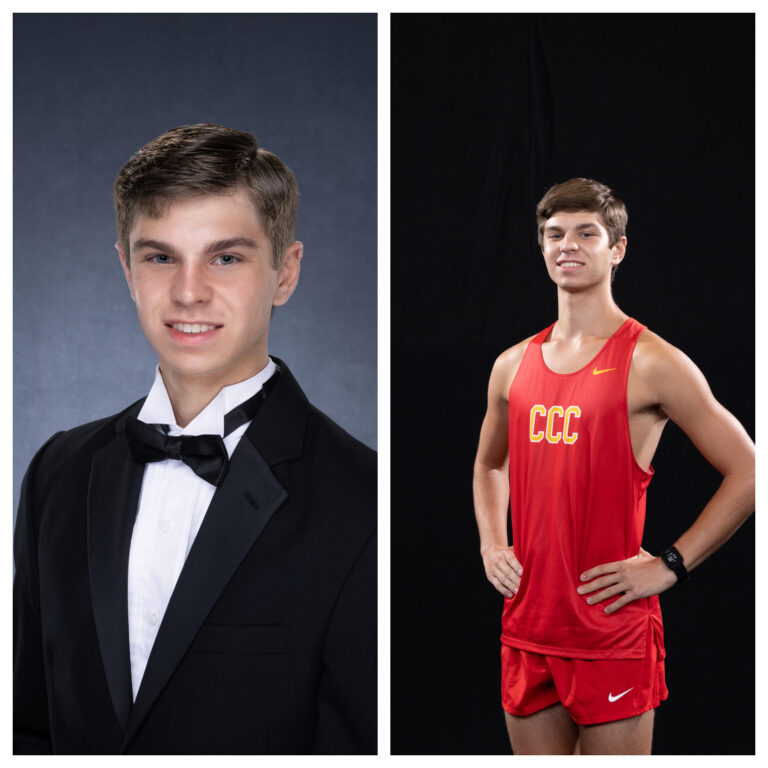 Ian’s father, Michael, is a pediatric oncologist, and Amanda is a radiation therapist.
“I come from a family that’s really, really interested in health sciences,” Ian said.
He will major in biomedical engineering with an eye on a career of “helping people from a different approach,” he said.
Ian was a member of the Model United Nations Club and Peer Ministry. He was a student ambassador and helped start the Marauders Meadow Club, a club designed to grow plants around campus.
He played basketball and soccer and ran cross country and track. He was the homecoming king as a senior. He wore a bald cap and performed a takeoff on the character “Eleven” from the Netflix series “Stranger Things” for the senior class movie during homecoming week.
“I was kind of a comic relief character,” Ian said. “I got to see myself look goofy on the big screen.”
“He was very good,” Nancy Dolson said.
The seniors won.
“He’s smart. He’s athletic. He fits into a lot of different places,” Amanda said. “He's kind of an oddball, but in a lot of good ways, so I'm excited to see where life takes him.”
Jan Mistak
Jan began sailing when he was 7 and started racing sailboats when he was 11. He’s raced in theYouth World Championship in Poland and Argentina. This summer, he will participate in the Youth World Championship in San Pedro, California.
“My dream was to combine competitive sailing with top-tier education focused on technology and science. I am thrilled to have made that dream a reality by being accepted to MIT and their varsity sailing team” he said.
 Sailing in Poland represented a homecoming of sorts for Jan. His parents, Agnes and Gus, originally from Poland, have worked in real estate since early 2000.
“Hard work brought us to where we are today, and we wanted to model that for our children,” Agnes said.
When the children were young, they would go on family walks that took them past CCC. Gus and Agnes hoped that one day it would be possible for the kids to attend this school. They wanted the faith-based education and the high academics that CCC provides.
Maggie completed her freshman year at CCC, while Julia will be an eighth-grader at St. Paul Catholic School in St. Petersburg.
The honor of achieving the National Merit Finalist status definitely set a high standard for his sisters to follow.
“It's great to see that the hard work paid off for Jan, and he's an inspiration for his sisters,” Agnes said.
In addition to sailing internationally, Jan was busy during his four years at CCC.
At CCC he was a member of Water 4 Mercy, Catholic Relief Services, the Entrepreneurs Club, and Peer Ministry. He served as his homeroom representative for the student government, was a student ambassador, and competed in the newly created Math Competition club. He participated in various school-wide fundraisers.
Jan, like the others, earned a National Merit Scholarship by studying – he logged on to the Ray Dass classes wherever he was, even during his sailing travels. Yet, like the others, it wasn’t all just studying, studying, studying.
All four had a variety of interests and talents that they used to their fullest.
“Obviously, academics are important,” Chris Daily said. “But there's a lot more to it, which is great. It's the whole person that CCC looks at, which is really neat.”

Sebastian (left) and Alejandro have combined to win more than 60 awards for directing and graphics while working for the Christopher Columbus (High) News Network.
Originally, all Raymond Rodriguez-Torres was expecting was a public service announcement honoring his late daughter.
He – and his daughter’s memory – received more. Much more.
Rodriguez-Torres hoped the multi-media club at Christopher Columbus High School in Miami, his alma mater, could produce a PSA about Live Like Bella, the nonprofit that battles childhood cancer in honor of his daughter Bella, who died in 2013 when she was 10.
Omar Delgado, the teacher who oversees the club at Christopher Columbus, thought Bella’s story warranted more.
“I said, ‘This is a documentary, and I have the perfect guy to do it,’” Delgado said.
That would be Sebastian Broche, who recently graduated from the private Catholic high school after attending on Florida’s Family Empowerment Scholarship for Equal Opportunities (FES-EO) managed by Step Up For Students.
Sebastian led a team of 18 Columbus students that included his brother Alejandro and produced a moving 30-minute documentary. The project earned Sebastian a Suncoast Student Production Award (SSPA) from the National Academy of Television Arts & Sciences for best director and an SSPA for Alejandro for best graphics.
It was also named the best documentary in the nation by Student Television Network.
It is expected to be released on Amazon Prime Video.
“What they put together is beyond what we could have ever been able to conceive, which was telling Bella’s story in the appropriate way. I think it was extremely touching,” Rodriguez-Torres said. “I’m so proud of these kids. It’s difficult for me to put it into words.”
“Live Like Bella” tells Bella’s story from when she was first diagnosed with Stage Four Alveolar Rhabdomyosarcoma, through her six-year fight and ends with her legacy, which is a nonprofit that has raised more than $37 million and provided more than $6.5 million in financial support for families in 49 states and 37 countries since its inception in 2013.
There are interviews with Bella’s family and doctors, videos and pictures of Bella, a clip of LeBron James and Dwayne Wade of the Miami Heat, who wrote #LiveLikeBella on their sneakers during the 2013 NBA Eastern Conference Finals, and pictures of Bella that turned into sketches through the magic of editing. The documentary received a standing ovation from the overflow crowd at the Miracle Theater in Coral Cables after its premiere in March.
“It’s pretty powerful,” Sebastian said. “And that was the goal.”
***
Sebastian and Alejandro, who has attention deficit disorder (ADD) and attends Columbus on a Family Empowerment Scholarship for Students with Unique Abilities (FES-UA), are Miami natives but lived most of their lives in Costa Rica. The boys returned to Florida during their middle school years. By then, their parents had divorced and their dad, Alejandro Sr., had moved to Miami. He wanted Sebastian to attend Columbus. Their mom, Aimée Uriarte, agreed and moved with the boys to Miami.
The FES-EO made attending the private Catholic high school affordable.

Aimée flanked by her talented sons during the "Live Like Bella" premier.
Two years later, Aimée Uriarte wanted the same high-level academic opportunity for the youngest of her two sons, knowing that’s what Alejandro needed to develop his talents and self-confidence. As a single mother, Aimée was able to achieve that with the FES-UA scholarship.
“I think every family deserves the scholarships, regardless of income or their child’s conditions,” said Aimée Uriarte, the boys’ mother. “I think the whole country should emulate Florida.”
Sebastian admitted that the all-male student body, the strict dress code, and the challenging classes at Columbus took some getting used to.
“God works in mysterious ways,” he said. “The fact that I ended up here is probably one of my biggest blessings. It was definitely the school for me. I feel it has given me so many opportunities. It was something that I didn't know I needed at the time, but now looking back, I can’t see myself going anywhere else.
“They make you a man and a man of principles, especially.”
Sebastian will attend Santa Fe College in Gainesville in the fall with the goal of transferring across town to the University of Florida, where he plans on majoring in journalism. His goal is to own a digital media company.
That’s a different career than what he expected when he entered Columbus as a freshman. Back then, Sebastian was interested in art and architecture. But a friend suggested he join Christopher Columbus News Network (CCNN), the student-run broadcast news program. Sebastian did and soon realized his talents included directing and producing programs and videos.
“I found out I was better at broadcasting than drawing,” he said.
Alejandro, 16, followed his brother to Columbus and joined CCNN, as well.
“I think they were both just trying to find their way and they were able to tap into a side of themselves they didn’t know they had,” Delgado said. “As a teacher that's what you want to see. You want to see kids reach their full potential, and I really think that Sebastian and Ale are doing that.”
Alejandro’s plan is to attend Florida State University and pursue a career in film.
“Getting to see the level of national recognitions and not only academic, but also the human quality of teachers and mentors that Sebas and Ale have had access to at Columbus, is something I never imagined in my wildest dreams. Never” Aimée said. “I’m simply in awe and beyond proud of the men my sons are becoming.”
The brothers have combined to win more than 60 awards for directing and graphics. Sebastian earned a $4,500 per semester scholarship from the National Academy of Television Arts & Sciences, received a $7,500 grant from Media for Minorities, and received the Mike Wallace Memorial Scholarship, worth $10,000, funded by CBS News.
***
Raymond Rodriguez-Torres and his wife, Shannah, were approached by several groups, including Netflix, about a documentary on Bella after the clips aired of NBA superstars paying tribute to their daughter. But the couple was uncomfortable with strangers coming to the house and taking videos of Bella’s bedroom.
Rodriguez-Torres is a 1994 graduate of Columbus and was a part of CCNN during its early years. The network of Columbus alumni in South Florida is very tight. It threw its support behind Bella’s fight against cancer and later behind the nonprofit. Word spread through the alumni circle and Rodriguez-Torres found himself meeting with school officials interested in working on his original plan of a PSA. Eventually, he met with Delgado, and Delgado sold him on his vision of a documentary produced by CCNN.
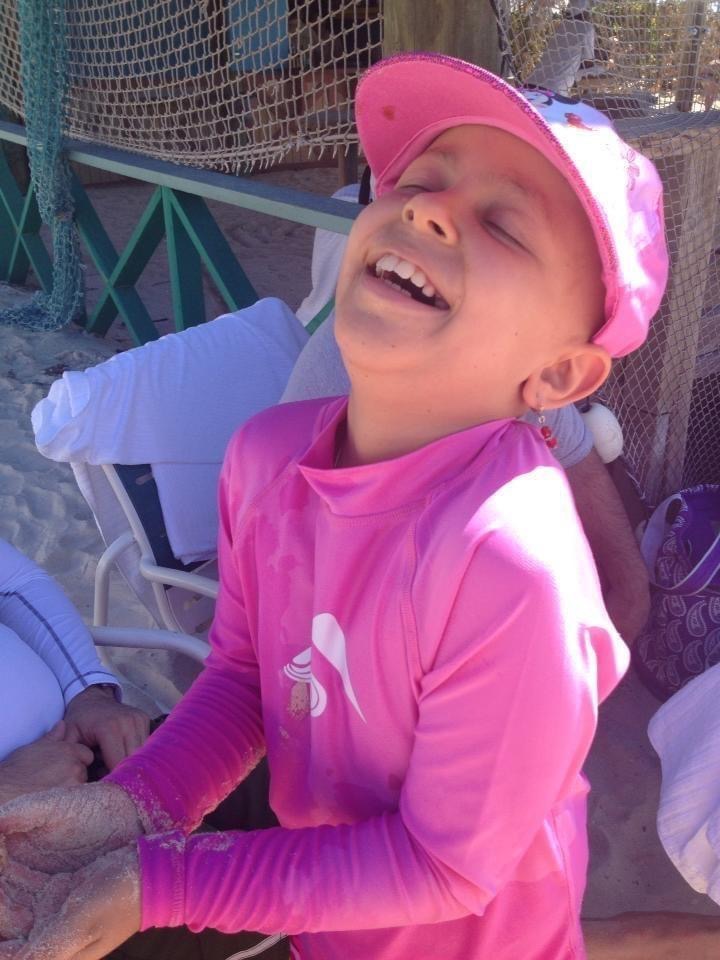
The Live Like Bella foundation has raised more than more than $37 million to fight childhood cancer.
“I knew we had one shot at this,” Rodriguez-Torres said. “Ultimately, I said, ‘This is the way God and Bella wanted it. They want a bunch of high school kids doing something nobody expects.’ Little did I know what was coming.”
Delgado did. Sebastian was the producer and editor. He made the storyboards and came up with the questions to be asked during the interviews. Alejandro worked on graphics and animation.
“He’s a really creative kid,” Sebastian said of his brother. “He’s a lot more creative than I am. Give him a camera and give him an idea, and that kid will blow your mind.”
Sebastian learned of Bella’s powerful story during a meeting with Shannah and Raymond Rodriguez-Torres. Sebastian, who already produced two documentaries for CCNN, knew it would be his biggest challenge. But he said he wasn’t intimidated.
“I knew how strong of a story it was,” Sebastian said, “and during the whole meeting I was thinking, ‘OK, here’s how I want to tell it.’ ”
Nearly six months later, the documentary was ready. Nearly everyone who saw the finished product was amazed that it was produced by a high school senior directing a team of fellow classmates.
Nearly everyone, because Delgado was not amazed.
“Sebastian impresses me every single day,” Delgado said. “To see who he has become in the last four years is something that I am eternally proud and grateful for.
“But to tell you I was surprised, I wish I could because I missed that feeling of being surprised by Sebastian. I don't have it anymore because it’s something I expect from him, because he's such an amazing human being and he just keeps on producing.”
San Jose Catholic School in Jacksonville is one of more than 200 Catholic schools in Florida dedicated to fostering Catholic identity and academic excellence.
Editor’s note: To hear a podcast with Step Up For Students’ president Doug Tuthill and Michael Barrett, click here.
It’s crunch time for Michael Barrett.
 Charged with advocating for the passage of bills that help Florida’s Catholic school students, Barrett has been working long hours during Florida’s 2021 legislative session, which began March 2. His reading material these days is heavy on proposed bills and legislative analysis.
And, quite appropriate for the education representative for the Florida Conference of Catholic Bishops, a book about prayer.
A product of Catholic schools, Barrett represents Catholic education at the state level and coordinates with the U.S. Conference of Catholic Bishops at the federal level. He also represents the Conference with the Florida Association of Academic Nonpublic Schools and maintains relationships with school choice organizations and special needs groups.
After a stint as a teacher with Teach for America, law school and some time in private law practice, he believes he’s in the perfect role.
“My faith always has been important to me, and to have this opportunity was a great way to use my legal and educational background to work in the public policy arena and work for the Church,” he said.
These days, it’s Barrett’s job to do everything he can to make sure bills introduced in the Florida Legislature and championed by his organization don’t fall through the cracks. The former high school basketball point guard and Notre Dame law school graduate, who came to his post about six months ago, has a lot to pay attention to in his rookie year on the job.
With nearly 30,000 of Florida’s roughly 80,000 Catholic students receiving some type of state scholarship, education choice plays a significant role in Florida’s Catholic schools. Which is another reason why the pressure is on for Barrett.
He’s watching a pair of bills that would impact the state’s dual enrollment program, SB 52 and its companion, HB 281, which would fix an 8-year-old glitch in the program that was created when a change in the law shifted the cost of dual enrollment to school districts. Because school districts are state funded, the state picked up the cost. But private schools, which weren’t allowed to pass the cost on to their students, had no alternative but to limit their dual enrollment offerings.
Under Barrett’s watchful eye, the bills have cleared all their committee stops and are headed to the House and Senate floors for approval before the two chambers can begin negotiations on a final bill.
The funding is still in flux, but Barret isn’t sweating it.
“I believe the money will be there in the end,” he said.
Barrett also is watching HB 7045, which would streamline state scholarship programs. Aside from adding simplicity, the bill would help Catholic schools and other private schools by removing a requirement that those applying for the Family Empowerment Scholarship Program must attend a district school the year before receiving the scholarships.
The bill would do the same in 2022 for those who participate in the McKay Scholarship program for students with special needs, which would be managed under the Family Empowerment Scholarship umbrella.
“We have about 1,000 who are not on McKay, but who have some sort of individualized education plan,” he said. “So, more students could gain access to those programs.”
Though the Catholic Church has a specific set of beliefs, Barrett sees Catholic education as a big tent and ideal for anyone seeking “a great education” regardless of religious affiliation because of the overall sense of community Catholic schools offer.
“People understand that it is a Catholic school, but that doesn’t mean you have to be Catholic to enroll there,” he said, adding that Pope Paul VI, who was head of the Catholic Church from 1963 until his death in 1978 and fostered improved ecumenical relations, believed the Church’s mission is to “propose the gospel, not impose the gospel.”
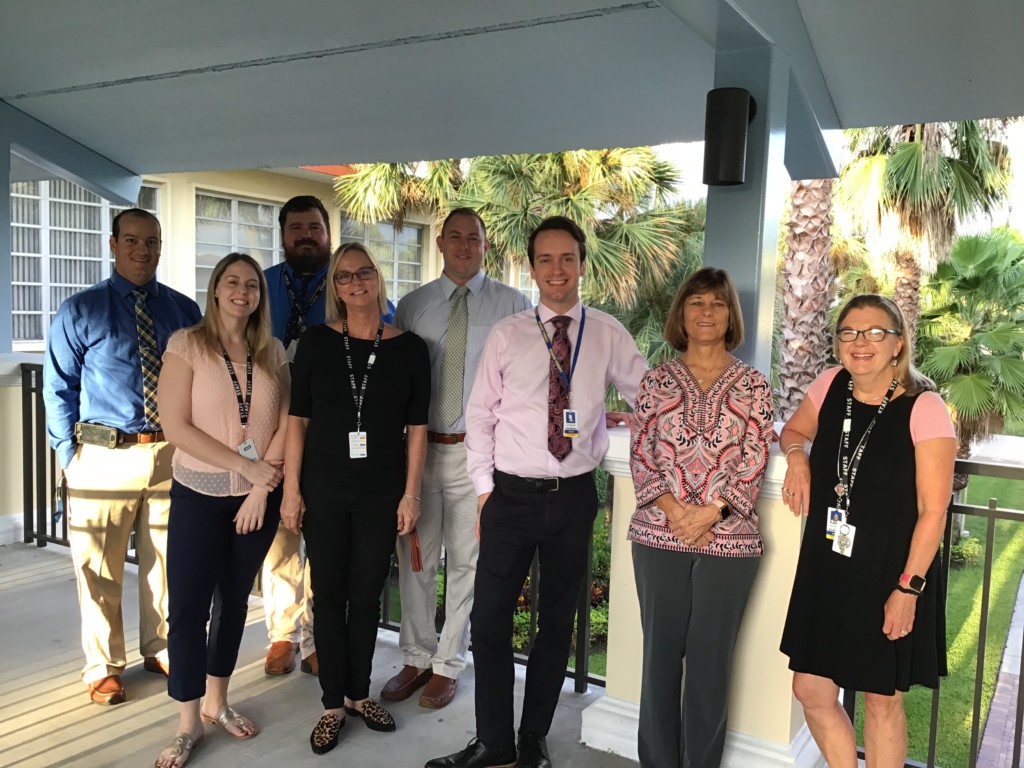
Alumni from Cardinal Newman High School, returning as faculty. Many Catholic school students return to teach at their alma mater - drawn back by the bond of community and religion.
Anxious thoughts flooded Joe Molina’s mind.
He was navigating his first day of teaching Spanish at Cardinal Newman High School, a Catholic school in West Palm Beach.
Cardinal Newman was no ordinary school. Molina was a student at the school nine years earlier. That spring day, he was overwhelmed and reached out to his mentor and former teacher, Susanne Escalera, for help. Now a fellow colleague, she told him to take several deep breaths and relax. He then could face the classroom.
Those kind words reminded Molina where he had found himself: back at home.
Molina’s story is not uncommon. Many Catholic school students return to teach at the very schools they attended. They are drawn back, in part, by the bond of community and religion. Molina forged relationships at Cardinal Newman that have lasted nearly a decade.
As a student, Molina overcame his hurdles in calculus with the help of a teacher, Christine Higgins, who is now the principal. And when he tore his ACL and dislocated his knee cap in high school football, his coach, Don Dicus, stood by his side, reminding him that no matter how hard it gets, it was essential to go forward.
Now in addition to teaching Spanish, Molina is the football coach at Cardinal Newman, hoping to teach the same values he learned in high school to the next generation of students. (more…)
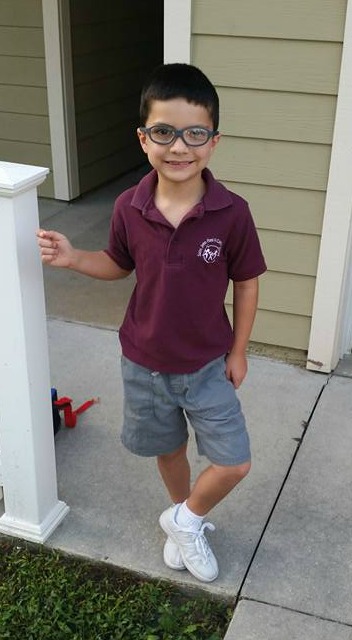
Thanks to school choice programs, Catholic schools in Florida are growing again, allowing them to continue to offer high-quality education to students like Camron Merritt. Camron, 7, was struggling in his prior school but is now learning and making friends. Says his mom, "This school saved my son's life."
This year, for the fifth year in a row, Catholic schools in Florida did not do what Catholic schools across America are doing. They didn’t close and shrink. They grew.
Behind the trend lines are students like Camron Merritt.
A year ago, Camron, a 7-year-old with emotional scars and learning disabilities, was going from bad to worse in his prior school. Rolling under desks. Mouthing off to his teachers. Getting picked on by other students. A lack of support and communication from school officials further frustrated Camron’s mother, Melissa Merritt. She knew she had to make a change.
She found Saint John Paul II Catholic School, a PreK-8 that recently reversed its own fortunes. She also found that Camron, as a child once in foster care, was eligible for a school choice scholarship that gave her the financial means to enroll him. Eight months later, she said, he’s a different child.
Camron is sitting in class. He’s listening and learning. He’s making friends. The second week of school, he was invited to a birthday party – for the first time ever.
“This school saved my son’s life,” Merrit said. “This scholarship saved my son’s life.”
Fueled by a quartet of pace-setting educational choice programs, Catholic schools in Florida continue to do what thousands of shut-down Catholic schools elsewhere can’t: Provide high-quality options to disadvantaged students.
For Saint John Paul II, the scholarships “made the difference between the school being able to survive, and the parents and kids (in the area) having choices,” said principal John Larkin.
The latest numbers show Florida Catholic school enrollment rose slightly this year, from 84,452 to 85,539 in PreK-12, according to survey data collected by the Florida Catholic Conference last fall. To repeat: That’s five years of growth in a row. The encouraging trend lines hold true even if Pre-K students are out of the mix, with K-12 upticks in four of the last five years.
In Florida, parents of four-year olds can use Pre-K vouchers to send their children to private schools. Parents with special needs-children can use McKay Scholarships or Gardiner Scholarships to cover their tuition. Low-income parents and parents of current or former foster children can also access tax credit scholarships, which are administered by nonprofits such as Step Up For Students, which hosts this blog.
The percentage of Florida Catholic school students using these scholarships has risen steadily, from 4 percent in 2007-08 to 24 percent this year.
As a result, Catholic schools in Florida have, in recent years, enrolled a growing number of children from families that would otherwise struggle to afford a private-school education, and avoided the sad fate of their national counterparts. (more…)

