Cantor
House Majority Leader Eric Cantor, R-Va., will be in Florida Friday to talk about school choice.
He's scheduled to tour the Academy Prep private school in Tampa, and hold a roundtable discussion with students and parents. Students at the highly regarded school attend with the help of Florida's tax credit scholarship program for low-income students, which is administered by Step Up For Students (which co-hosts this blog.)
Cantor has put a spotlight on school choice over the past year, with visits to charter schools in Denver and Philadelphia, a Catholic school New Orleans that accepts vouchers, and an appearance at the Brookings Institution last month.
You can read more about Academy Prep here.
Editor's note: This post originally appeared on the Fordham Institute's Choice Words blog. It's one of many pieces written in response to Fordham's release of a "school choice toolkit" for lawmakers that called for more regulatory accountability measures for "voucher schools."

Glenn
Policy-making usually involves trade-offs, finding the right balance between competing objectives and even principles. This is especially true in education, where so much is at stake, both for vulnerable children and for the health of society.
One of the principles that should guide educational policy is that "parents have a prior right to choose the kind of education that shall be given to their children" (article 26, 3, Universal Declaration of Human Rights, adopted in San Francisco in 1948). Officially, at least, this right is acknowledged by almost every nation, and in many of their constitutions; it has been settled law in the United States since the Supreme Court’s 1925 ruling in Pierce v. Society of Sisters (268 U.S. 510).
Americans agree, as Terry Moe showed in Schools, Vouchers, and the American Public (Brookings Institution, 2000). This is especially true of parents for whom public school provision is of inadequate quality. “Among public [school] parents, vouchers are supported by 73 percent of those with family incomes below $20,000 a year, compared to 57 percent of those with incomes above $60,000. . . . 75 percent of black parents and 71 percent of Hispanic parents, compared to 63 percent of white parents. . . . 72 percent of parents in the bottom tier of districts favor vouchers, while 59 percent of those in the top tier do” (212).
Moe also found, however, that “enthusiasm for regulation is remarkably uniform and cuts across groups and classes – including private [school] parents, who appear quite willing to see the autonomy of their own schools compromised in the interests of public accountability” (299). This expectation of government oversight is also well-established in international law and practice, and specified in the Pierce decision.
On the other hand, if the regulatory hand of government is too heavy, the right of choice becomes meaningless: what’s to choose among schools forced to be alike? (more…)
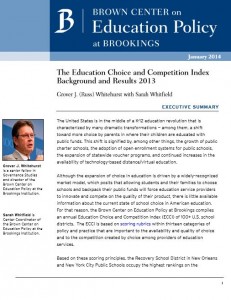 Four Florida school districts again rank in the Top 25 big districts nationally when it comes to providing meaningful school choice, according to the latest annual report from the Brown Center on Education Policy at the Brookings Institution.
The Duval County and Miami-Dade County school districts tied at No. 13, the report says, while the Pinellas County School District comes in at No. 19. All three districts earned C+ grades. The Brevard County School District was one of eight Florida districts to earn a C, coming in at No. 22.
The rankings are based on 13 categories, including the breadth and quality of learning options, including charter schools, magnet schools and virtual courses, and the accessibility of private schools through vouchers and tax credit scholarships. The think tank also looked at how well districts close or restructure undersubscribed schools; if they provide comparative data to parents; and whether they provide transportation to choice schools. (See the scoring guide here.)
There wasn’t much fluctuation from last year’s rankings, when Miami-Dade came in No. 10. The Recovery School District in New Orleans was again No. 1 (with an A), followed by New York City (with an A-). Denver climbed from No. 24 to No. 5 after moving to a common application for all public schools, including charters.
In all, 14 Florida districts are on the list. Thirty-four districts nationwide received F grades, including Osceola in Central Florida. (See scoring for each district here.) (more…)
It shouldn’t be a secret that some Florida school districts perform better than others, despite more challenging demographics. Yet for years, it’s been a fact hidden in plain sight. Now, though, a leading think tank is giving the Legislature and the Florida Board of Education a compelling reason to take a closer look.
 A new study from the Brookings Institution, released this morning, relays what FCAT data has been trying to tell us. Some Florida districts are chugging ahead despite a heavier load of high-poverty kids, while some with lighter loads lag. Some are making sustained gains relative to the pack, while others progress in fits and starts. The differences are puzzling, fascinating and, if you happen to live in an underperforming district, maddening. Yet they’ve been given scant attention by researchers, reporters, policy makers and advocacy groups.
Stepping into the vacuum, Brookings’ Brown Center on Education Policy analyzed a decade’s worth of test data for fourth- and fifth-graders in Florida and North Carolina. It controlled for race, income and other variables. And it came away with two findings: 1) School districts account for only a small percentage of the total variation in student achievement – 1 to 2 percent. (Teachers account for about 7 percent). But 2) the differences between districts are still so great that by the end of the school year, a kid in a higher-performing district can be nine weeks ahead - a quarter of a school year ahead - of a like student in a lower-performing district. Over time, the accumulated deficits would obviously be staggering.
“We suggest that a variable that can potentially increase productivity by 25% is important,” the researchers wrote. “These are differences that are large enough to warrant policy attention.”
It's not just Florida and North Carolina that should be crunching more numbers. As the report notes, there are roughly 14,000 school districts nationwide. In this age of accountability and choice, parents routinely compare schools, and all kinds of think tanks compare states. But districts? Not so much.
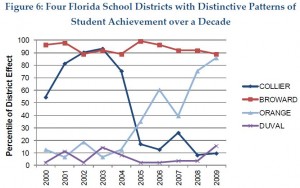
The Brookings researchers pointed to districts that showed distinctive patterns relative to other districts – they were either consistently high performing, consistently low performing, dramatically rising or dramatically tanking. In Florida, the districts that fit that bill were Broward, Duval, Orange and Collier, respectively. These districts weren’t necessarily the ones that made the most pronounced pattern in each category. And the researchers offered a number of cautionary caveats, including, again, that they only looked at data for two grades, and that comparisons were made “relative to their demographic odds” – not to a set standard like FCAT pass rates.
But still, the trend lines punctuate the point: District performance deserves a spotlight. (more…)
Editor's note: This guest post from StudentsFirst is authored by Vice President of Fiscal Strategy Rebecca Sibilia and fiscal policy analyst Sean Gill.
We appreciate Doug Tuthill’s recent redefinED post challenging StudentsFirst to consider supporting voucher or tax-credit scholarship programs that aren’t just limited to what he describes as the “failing schools” model. We agree with his assertion that school choice policies, including private school options, are about empowering parents to select the best school for their child.
It is true that we believe voucher programs should prioritize low-income students in low-performing schools. However, we want to make clear that this position is not based simply on a “politically safe compromise.” Indeed, our entire State Policy Report Card judges not what is politically popular, but rather the laws and policies we believe, through evidence, best practices, and common sense, will deliver the best results for kids.
We think it is important that states focus on more than policies that just provide access to schools; states must prioritize expanding access to high-quality choices for families that traditionally lack them. A Brookings study found that students from low-income households are much more likely to attend low-performing schools than middle or high-income students. This is important because the same study further confirms that low-income kids can actually achieve at high levels when they attend high-performing schools. Unfortunately, as Florida Education Commissioner Tony Bennett has mentioned, low-income families often lack the resources to enroll in potentially higher-performing private schools or to relocate to a school district that offers a better public education.
Policymakers must always consider tradeoffs and unintended consequences when considering how to budget limited resources. Consider if a state adopted a universal voucher program. This would provide the most theoretical choice, but it could also easily have the unintended effect of simply subsidizing the students already enrolled at private schools and those in families who may otherwise be able to afford private school tuition. This would result in few new students being able to attend a high quality school option, and wouldn’t expand access to those who need it the most. Presumably, avoiding this problem is one of the reasons why the Florida Tax Credit Scholarship program is currently limited to low-income children.
Using this logic, we believe that when state resources are limited or the existing supply of desirable private schools is limited, it also makes sense to prioritize vouchers or scholarships for those low-income children attending a low-performing school or living in low-performing school districts. There are practical, administrative considerations that also make targeted programs more effective. For instance, when looking at the state of Tennessee, where Gov. Haslam has proposed a voucher program, we’ve determined that the four districts with the lowest performing schools also have both higher concentrations of low-income families and private schools in their communities.
We find that most voucher and scholarships programs are capped by enrollment or appropriation levels. Given that low-income students can be found in most counties throughout a state, these caps then create an unintended consequence of spreading out scholarship recipients among multiple communities, which would not provide enough demand to create new private school options. (more…)
 Florida: Tony Bennett is selected the state's new education commissioner (redefinED). He tells reporters afterwards that he champions school choice first and foremost because of the social justice component (redefinED). A new group headed by T. Willard Fair, co-founder of the state's first charter school, aims to create a pipeline of black executives and entrepreneurs to help lead private and charter schools (redefinED). The Miami-Dade school district ranks No. 10 in the country for school choice, according to a new report from Brookings (redefinED). A Catholic school in Tampa is at the heart of a University of Notre Dame project to revitalize Catholic schools, particularly for Hispanic students. (redefinED).
Louisiana: Voucher parents are worried in the wake of the legal ruling that puts the program in limbo (advertiser.com). Gov. Bobby Jindal makes a pitch for vouchers at a Brookings Institution event in Washington D.C. (Huffington Post).
Washington: More than 150 teachers, parents and administrators attend a charter school conference in the wake of the successful passage of a charter school ballot initiative (Tacoma News Tribune). (Full disclosure: The conference was sponsored by the Washington Charter School Research Center, which was founded by Jim and Fawn Spady. Fawn Spady chairs the board of directors at the American Center for School Choice, which co-hosts this blog.)
Michigan: The education adviser to Gov. Rick Snyder presents the governor's sweeping public school choice proposal to business and education leaders (Grand Rapids Business Journal). (more…)

Robinson
Standardized test costs. They total about $1.7 billion a year nationwide, according to a new report from Brookings that includes state-by-state figures. Not much, concludes researcher Matt Chingos, who adds “perhaps we’re spending less than we should.” Coverage from Education Week and Huffington Post. Former Florida education commissioner Gerard Robinson tells the latter about test anxiety: “I won't pretend that tests don't matter and there's no anxiety -- but I also tell people there's anxiety with sex. There's anxiety with sex, but there isn't any talk about getting rid of that.”
And still more Jeb summit coverage. Politic365 on the “Florida Formula.” EdFly Blog on the crucial center. Rick Hess on "The Common Core Kool-Aid."
More protests from Hillsborough parents. They want better training for employees who work with special-needs children, StateImpact Florida reports. More from Tampa Bay Times.
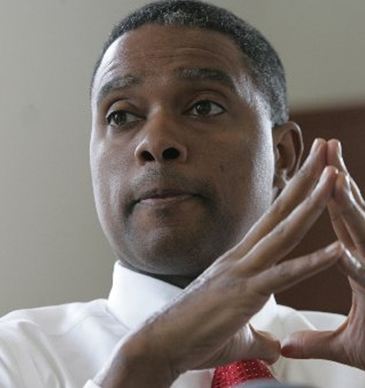 Gerard Robinson. The former Florida education commissioner, who stepped down three months ago, will be among the panelists next week responding to a new Brookings report on standardized testing and the Common Core. More here.
DOE responds to Tampa Bay Times contracting story. I can't remember the last time DOE did a point-by-point, line-by-line rebuttal to a story. Press release here.
Career academies. Get a nice write-up in the Gainesville Business Report.
Testing. New Duval Superintendent Nikolai Vitti removes some internal standardized tests from the district schedule, prompting praise from teachers union president Terrie Brady, reports the Florida Times Union.
FCAT. Will any private schools that accept tax credit scholarships give it? Asks Gradebook.
Contract talks. Continue next week in Palm Beach County after nearly falling apart last week, reports the Palm Beach Post’s Extra Credit blog.
Schools put kids in reach of convicts. Tampa Bay Times columnist Sue Carlton.
Black students who won private school vouchers through a lottery in New York City were much more likely to later enroll in college than other low-income students who applied but did not win, according to a study released this morning.
The study of a privately funded New York voucher program for elementary school students showed no significant impacts for students overall, including Hispanic students. But the story was different for black students: 34 percent who attended private schools with vouchers were enrolled full-time in college three years after graduation from high school, compared to 26 percent for the non-voucher group – a rate 31 percent higher. For black students enrolled in college either full- or part-time, the voucher boost was 24 percent. The researchers called those differences large and statistically significant.
The study is the first to use a “randomized trial” – considered the gold standard for researchers - to determine effects on private school vouchers on college enrollment. It was conducted by Matthew M. Chingos, research director of the Brown Center on Education Policy at the Brookings Institution, and Paul E. Peterson, who directs the Program on Education Policy and Governance at Harvard.
The students participated in the New York School Choice Scholarships Foundation Program, which, in 1997, offered three-year, private school scholarships worth up to $1,400 annually for up to 1,000 low-income kids. Recipients could attend any private school in the city. At the time, the total per pupil cost in the city’s Catholic schools was $2,400.
The researchers offered words of caution about interpreting the results, given statistical estimates they described as “fairly noisy.” But they also said further discussion was warranted given the apparent differences in outcomes for black and Hispanic students. (more…)
The Brookings Institution's ranking of school choice met with mixed results today, and properly so. But one conclusion that may escape attention should have profound implications for choice and school governance in the years to come: One of every two households engages in some form of school choice, and more would do so if given the chance.
The report is limited to an examination of quality and competition in the nation's 25 largest school districts, but this hides the sweep of the enterprise. The Brown Center on Education Policy didn't just look at public school choice within each individual system. It surveyed private options in each district's boundaries, factoring in publicly funded alternatives such as vouchers or tax credit scholarships and paying attention to how performance is assessed. And it considered whether and how districts have embraced virtual education.
Thus, author and center director Russ Whitehurst writes:
... more than 50 percent of parents of school-aged children have engaged in some form of school choice, albeit primarily in the form of residential choice and private school tuition: two socially inequitable means of determining where a child attends school. There is little doubt based on the long waiting lists for popular public schools of choice that many more parents wish to exercise choice than are currently able to do so, and schools of choice consistently generate more positive evaluations from parents than assigned schools.
Each district was given a letter grade determined by factors as varied as the enrollment at "alternatively available schools" -- which included charter and voucher enrollments -- and student assignment systems where "preferences are maximized." But, honest intentions notwithstanding, the methodology may be misleading. For instance, seven Florida counties make the list, with Duval County (Jacksonville) getting the highest overall ranking within the state. With apologies to Rick Hess, Duval has done little to actively enhance school choice.
While the Duval County school board has begun to authorize more charter schools in the Jacksonville area in just the last year, Duval is near last among Florida districts on the Brookings index in density of charter schools, according to 2010-11 data from the Florida Department of Education. Just 2.7 percent of the public school population in Duval is enrolled in charter schools. By comparison, Miami-Dade County's charter school enrollment is at 10.2 percent of the county's total public school population, but is ranked just 20th of 25 districts overall at Brookings.
The State of Florida has done more to create the conditions for choice that Dade has embraced, just as it has created and enhanced the means-tested tax credit scholarships to private schools that have penetrated nearly 5 percent of the eligible population in Duval County. The growth of, and prospect for more, publicly funded private school options led Duval County school board chairman W.C. Gentry to tell a radio interviewer one year ago, "Fundamentally, [school choice] is very bothersome. The notion that we would effectively dismantle a system of public education and give students and parents choice and go do whatever they choose to do is anathema to the basic underpinnings of our society."
This is no attempt to discredit a report that was intended to celebrate "a fundamental rationale ... in creating a vibrant marketplace for better schools." In identifying an expanded definition of public education and a demand for more and better school options, Whitehurst brings sunlight to the differences between school systems in how they meet the needs of parents, and those differences often disappoint. Still, if the intent of the index is to create public awareness, a deeper dive is necessary.

