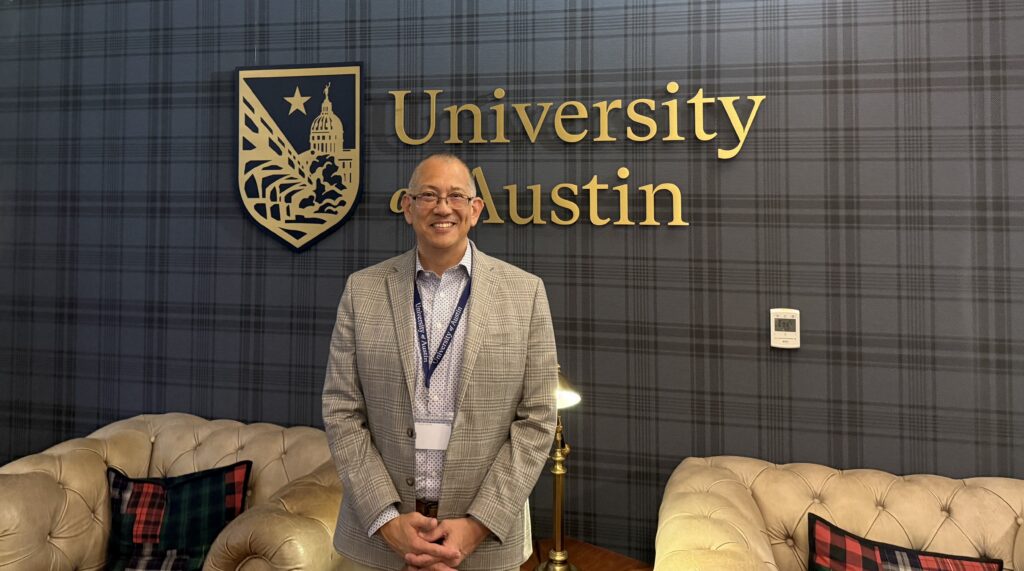
Students at the University of Austin are getting an overview of the nation’s rapidly expanding education choice movement, including its storied history in Florida.
The survey course includes guest lectures delivered by top national researchers and thought leaders, including Ron Matus, director of research and special projects at Step Up For Students. The nonprofit organization is Florida’s and the nation’s largest education choice scholarship funding organization. Matus, who spent 25 years as a journalist and eight years as the state education reporter at the Tampa Bay Times, has authored many white papers on education innovation in Florida for Step Up.
The topic of Matus’s lecture was “Freedom, Pluralism and School Choice: Competing Rationales and Contemporary Practice” and included a special emphasis on education innovation in the Sunshine State.
Matus shared the evolution of public education in Florida from its first model of neighborhood zoned district schools to the rise of charter schools, homeschooling, private school scholarships, educational savings accounts, a la carte learning, and even public schools now offering individual courses paid for with education savings accounts. He also described the many learning options now available, from traditional private schools to farm and forest schools to microschools and programs customized by families.
Matus also recommended reading that exposed students to various arguments in favor of education choice, including economist Milton Friedman’s 1955 groundbreaking essay “The Role of Government in Education,” which emphasized free markets and competition, and John E. Coons, a professor emeritus at the University of California, Berkeley, School of Law, who focused on dignity and fairness to all families regardless of income.
Erin Davis Valdez, executive director of the university’s Center for Education and Public Service, developed the course, which followed two K-12 practicums with rotations that began in the fall of 2025 at participating private and charter schools.
She describes the program as being in “the incubator phase,” and hopes to expand it into an academic minor.
“What we’re trying to do every term is offer a course for students interested in education policy as a career or in teaching as a career or something adjacent to it, like entrepreneurship,” she said. “But for now, students can take these as elective classes, and it builds their interest in the field.”
Valdez, who was homeschooled as a young child in Lakeland, Florida, a year before it became legal, said she chose the guest lecturers by looking for the best researchers and thought leaders in the movement. In addition to Matus, the list includes Eric Wearne, an associate professor in the Education Economics Center at Kennesaw State University and director of the Hybrid Schools Project. Wearne, who once described most traditional teacher prep programs as “thinly veiled arms of the HR department of the school district,” spoke on “Design Policy for New School Models.”
Others included Patrick Wolf, Distinguished Professor and 21st Century Chair in School Choice at the University of Arkansas, who spoke about the history of school choice policy, Jay P. Greene, senior fellow at the Defense of Freedom Institute, who spoke on the national responsibility of American universities; Katherine Bathgate, CEO and founder of SchoolForward, who spoke about economic foundations and emerging policy issues I education freedom; Mary K Wells, managing partner at Bellwether, who spoke on the last 30 years of education reform efforts; and Anita Scott, director of public policy for the Texas Home School Coalition, who spoke on connecting policy and practice in the homeschooling community.
Matthew Ladner, a senior adviser for education policy implementation at The Heritage Foundation’s Center for Education Policy and former executive editor of the NextSteps blog, is scheduled to lecture on June 1 about new directions in education choice and the question of accountability. The class will conclude June 8 with a lecture by Robert Pondiscio, a senior fellow at the American Enterprise Institute, whose topic is “The Last Days of Public School.”

Great Hearts Academies, the leading provider of classical education in the country, is dedicated to serving families in the moral and intellectual formation of their children.
Editor’s note: This article from Rick Hess, resident scholar and director of education policy studies at the American Enterprise Institute, appeared recently on edweek.org. You can listen to a podcast with reimaginED executive editor Matt Ladner and Great Hearts Online executive director Kurtis Inforf here.
Great Hearts Academy launched in 2001 with 130 students. Today, it operates 33 classical K-12 schools serving more than 25,000 students in Arizona and Texas.
At a time when there’s a lot of interest in classic liberal arts school models, and with Great Hearts seeking to expand its offerings via pre-K and online offerings, it seemed like a good time to chat about their work with CEO Jay Heiler, who’s been on the board of Great Hearts since its founding and spent more than a decade as chair of the Arizona Charter Schools Association.
Here’s what he had to say.
Rick: So, Jay, what is a Great Hearts Academy? What makes it distinctive?
Jay: Great Hearts academies are grounded in an ethos of education as formation of the virtuous human person, not only in knowledge and intellect but also of the heart and character. We long and educate for a more philosophical, humane, and just society, but we consider this work as apart from the controversies of the day or the continuous political and polemical theater.
Our school model features a rich liberal arts curriculum and a culture that fosters friendship, marked by a common love of the true, the good, and the beautiful.
Rick: Can you talk a bit about what it takes to make that kind of curricular model work?
Jay: Great Hearts academy life is simple to understand in terms of what it includes and what it excludes. It includes the Great Books, the best of what has been thought and written for millennia, Socratic pedagogy grounded in conversation, and a culture of friendship.
It excludes screen time and pop culture, on the supposition that students are now immersed in an overabundance of those things outside of the school day.
Rick: Some critics have argued that Great Hearts’ value-based, classical model isn’t a good fit for all students. What’s your response to such critiques?
Jay: Great Hearts is an emphatically anti-elitist organization because its central assertion is that the best education for some is the best education for all, and our purpose is to make it accessible to all, so that all might have the chance to lead a great life and do things that matter to them and our society.
Classical education begins and succeeds by grounding itself in timeless things that do not change. It disabuses young minds from the common tendency to see one’s own time as safely evolved beyond the perils and failures of earlier times. It refutes the cult of novelty. It opens the mind by engaging with centuries of human thought and conversation, disaster and triumph, error and recovery, insight, and inspiration.
For these reasons, we believe every child would benefit from a Great Hearts classical education, and we go to work every day to reach as many families as possible.
Rick: How did Great Hearts get started?
Jay: In the early years of charter schools, the prevailing vision was “let a thousand flowers bloom.” Our original insight was that this is not how education would be reformed, accounting for goodwill or the market. So, we wanted to take the best possible education and replicate and then scale it. We began 21 years ago with 130 students in a leased church classroom building, improved for occupancy via some borrowed funds, with grades 7 through 9.
Rick: What’s your network look like today?
Jay: Since our founding, Great Hearts has grown to become the leading provider of classical education in the U.S., with more than 25,000 K-12 students in public, nonsectarian charter schools and now a new preschool offering as well: Young Hearts.
We have accomplished this as a nonprofit organization. We currently operate in Phoenix, San Antonio, Dallas, and Fort Worth. Amid the travails of the pandemic, we also launched Great Hearts Nova, our innovation-centric division which includes fully online charter academies in Arizona and Texas and microschools.
To continue reading, click here.
 Editor’s note: This commentary from Robert Pondiscio, a senior fellow at the American Enterprise Institute, originally appeared on the Institute’s web site.
It is a truth so obvious that it scarcely needs to be said: successful businesses have satisfied customers while unsatisfied customers take their business elsewhere. It’s true of restaurants, garages, and all manner of retail outlets and consumer services.
Forgive the mercantile comparison, but schools are no different. Parents who are happy with their child’s school, teachers, curriculum, and culture have no reason to leave, especially given how disruptive changing schools can be to family routines and scheduling. You don’t even consider it unless you’re deeply upset, or your kids are miserable.
Given this unremarkable observation, it’s hard to account for the outsize response — and outright anger — that greeted a recent paper from Heritage Foundation scholars Jay Greene and James Paul, who functionally made the same anodyne point: Unhappy parents are more likely to support school choice.
And right now, parents are deeply unhappy about critical race theory, gender ideology, and other strident manifestations of “culture war” in their kids’ schools. These parents are an obvious target for school choice advocacy as the answer to their problem.
Quelle horreur!
While the paper carries the provocative title, “Time for the School Choice Movement to Embrace the Culture War,” the only sin Greene and Paul committed is to favor dispassionate analysis over bland big-tent pieties which aren’t true and haven’t been for years.
“School choice offers a sensible resolution to cultural debates,” they wrote. “School choice gives parents what they want, regardless of which side they are on — more control over their children’s education. And, it acknowledges that parents have pluralistic views about which values to instill in their children.”
This is so obvious that one wonders how choice advocates would propose to motivate parents to demand choice instead. A free toaster with every new enrollment? Five hundred dollars back when you trade in your old school?
Schools are the institutions we build to transmit to children the values, habits, stories, and ideas we value: In a word, our culture. To think there should be no debate about what that comprises is to misunderstand entirely what a school is and the purpose it serves in civil society.
If Greene and Paul erred, it was in using the imprecise and provocative phrase “culture war” to characterize the inevitable disagreements over these issues among people in a politically, socially, and intellectually diverse nation —a nation, not incidentally, that is more than large and advanced enough to support a broad range of school options and flavors for the more than 50 million children we need to educate and usher toward rewarding and responsible adult life.
So why the immune response to the obvious ideas offered by the authors? There’s no real mystery.
As a recent paper by Ian Kingsbury in the Journal of School Choice noted, ed reform organizations and personnel tilt overwhelmingly to the progressive left. To many, the idea that some parents might be less than enamored with the “woke agenda” is prima facie evidence of racism and white supremacist impulses that cannot be countenanced under any circumstance.
There’s no reason even to be curious about such parents’ discomfort in their public schools and whether they might see that agenda as culture warring. Through this lens, it’s school choice as the new white flight, period.
It’s also a hangover effect of ed reform’s era of technocracy and paternalism. A generation of advocates and activists have no conception of reform as anything other than a social justice initiative and not a lot of use for choice apart from that agenda. The suggestion by Greene and Paul that the culture war represents an opportunity to advance choice is not just counterintuitive but anathema to this way of thinking.
My sense is that the scorpions in the ed policy and advocacy bottle have all lost the thread. Even choice advocates who view choice as an intrinsic good tend to underestimate the extraordinarily radical proposition they are championing: asking Americans to overthrow the cultural habit of sending their children to local public schools that has persisted, largely unquestioned, for generations.
That’s a tremendously heavy lift and one that is unthinkable for most parents until or unless displeasure with their child’s school makes staying put untenable. The endgame of the school choice movement is changing the model of how Americans educate their children. Sitting in judgment of parents’ reason for wanting to avail themselves of choice distracts from that mission. It’s an act of self-sabotage.
Still, the critics may have a point. It was probably a bad idea for the authors to suggest that it’s time for the school choice movement to “embrace the culture war.” They should have added three words for clarity and emphasis: “Get over it.”
 In the American film classic “The Blues Brothers,” a pair of musical misfits accept a mission from God to save the orphanage where they grew up. Desperate to raise money, they impersonate a country and western band only to have the crowd boo and throw bottles against the chicken wire surrounding the stage.
The stage lights are cut off, causing one of the band members to speculate that they’ve blown a fuse. A more perceptive band member notes: “I don’t think so, man. Those lights are off on purpose.”
Public school parents have a lot to be upset about these days. Often, the things they’re upset about contradict each other. For instance, some parents want mask mandates, others want to create a giant pile of masks and dispose of them with fire.
Some parents want school vaccine mandates, others threaten to pull their children out of school over the issue. The controversy of social studies and history curriculum will continue to prove unresolvable as preferences wildly vary.
The fundamental problem in all of this is attempting to have a one-size-fits-all school system in the first place. A more pluralistic system remains the best available solution. Lawmakers, however, may be able to take other productive actions in addition.
Max Eden, a research fellow at the American Enterprise Institute, published a paper recently recommending that state lawmakers move school district elections to uniform election dates. Eden notes that district elections often have very low voter turnout rates. Higher turnout rates would create a more authentic district democracy and elect governing boards with a stronger claim to community support and democratic legitimacy.
Eden also calls for partisan as opposed to non-partisan school board elections. While the word “partisan” evokes negative feelings, and partisan labels can imperfectly communicate candidate policy preferences, knowing a little about the policy preferences of a candidate beats knowing absolutely nothing about their preferences, which is where matters typically stand now.
While some of our friends in the reactionary K-12 policy preference community regularly attempt to wrap themselves in the democracy flag, it rings insincere in a country littered with single-digit district election turnout rates.
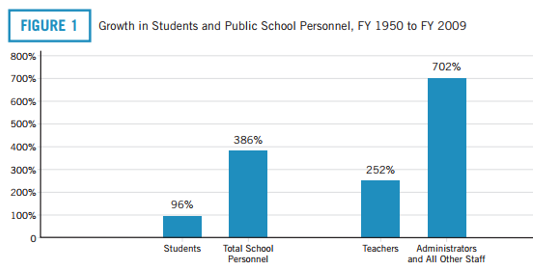
School district democracy as it stands is rigged. In the fancy terms of public choice economics, school district democracy is highly susceptible to regulatory capture. Unionized employee interests and contractors have an intense interest in school board elections, while the vast majority of the general public could not name a single member of the current or any past school board in the school district in which they reside.
The true primary purpose of the public school system, if we pay attention to what is done rather than what is said, shifted long ago into maximizing adult employment.
 Could district democracy be made more legitimate? It’s not a substitute for empowering families to control the education of their child directly. Even in a well-functioning democracy, some disputes will remain unresolvable, creating the need for pluralism and tolerance. But no one other than the current beneficiaries would even attempt to justify a rigged democracy, so it would be worth a try.
It won’t be easy. School district democracy didn’t blow a fuse; those turnout rates are low on purpose.
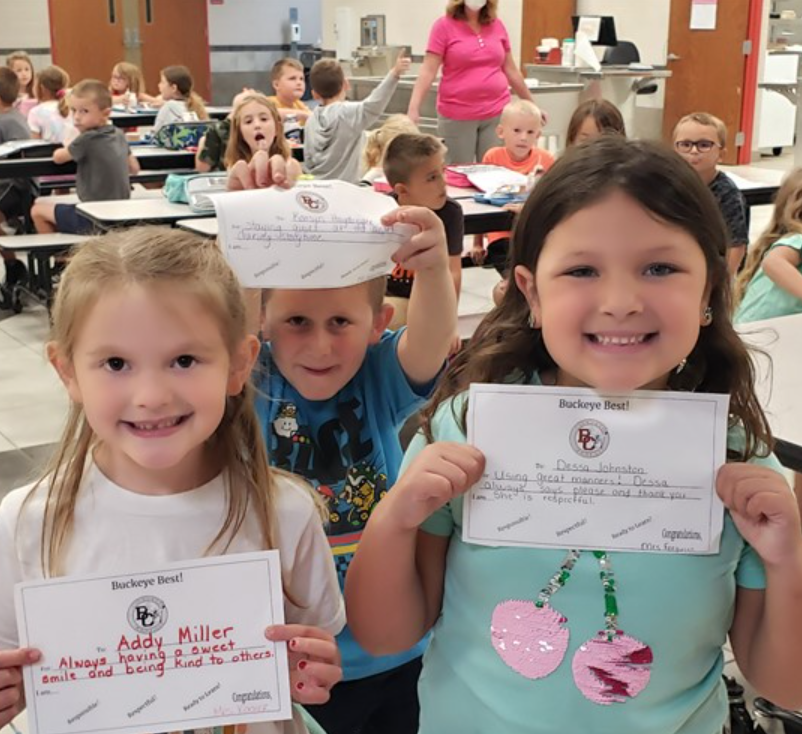
Buckeye Central Schools, a school district in Crawford County, Ohio, that serves more than 600 students in prekindergarten through twelfth grade, is among districts in that state that participate on open enrollment.
Jay Greene and James D. Paul gathered data for a new study for the American Enterprise Institute released Sept. 22 demonstrating that Democrats in state legislative chambers have only rarely made the difference in passing original private choice legislation nationwide.
The authors make the case that choice supporters have erred in seeking constrained and overly regulated programs in search of Democratic support which failed to meaningfully materialize. While they note that the choice movement needs all the support it can get, they fear Republican votes are being taken for granted. Ultimately, Greene and Paul call for private choice bills with universal eligibility and moderate levels of regulation.
My preferences also run toward universal programs with moderate levels of regulation. I think the Greene-Paul case deserves consideration, debate and reflection.
Whether or not one agrees with Greene and Paul’s conclusions, I believe there is an alternate case to make: Constrained and overly regulated private choice programs have only a limited ability to achieve policy goals that liberals, libertarians and conservatives tend to share.
Americans want public schools to teach necessary academic knowledge and to prepare students to exercise the responsibilities of citizenship as adults. Americans also want public schools to serve as engines of social mobility. They’ve been getting too little of any of that for decades. The unions want to max out the number of district employees to expand their membership, money, influence and power. There has been plenty of that going on for decades and too little to show for it.
K-12 choice is a tool which can give the public more of what they want from the education system. It also is respectful of pluralism. Once you get past the broad academic and civic goals, agreement about education quickly falls apart in the abstract. Individual children vary wildly in their interests and needs and thus can benefit from access to a diverse and specialized set of schools.
Ohio Republicans have passed multiple choice programs since 1995 and focused their efforts on the areas of greatest academic need: Cleveland students, students in failing schools, students with special needs, charter schools with geographic limits. Each of these were entirely worthy efforts.
This year, however, they embraced a number of more inclusive measures, in part, I believe, because the Fordham Institute found and documented the fact that students in every major urban district in Ohio find themselves surrounded, or nearly surrounded, by suburban districts that will not accept open enrollment transfers.
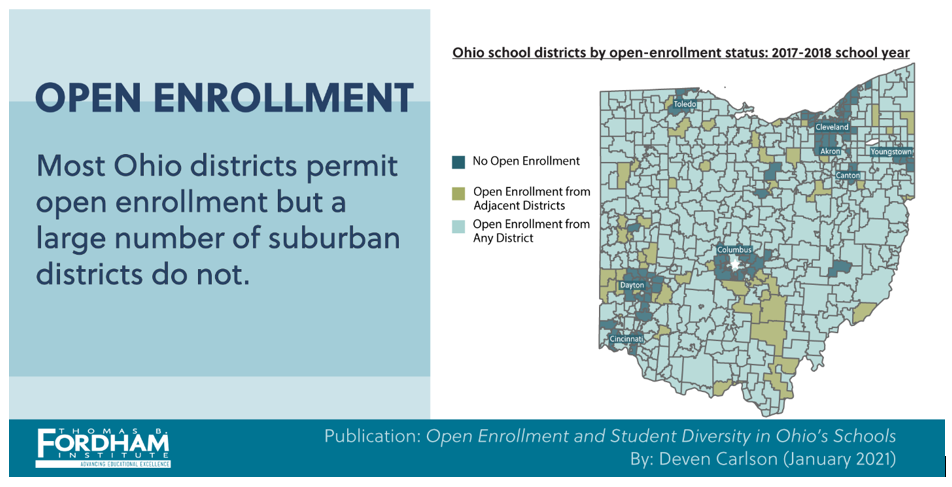
Whether you are a conservative, a liberal, a libertarian or a vegetarian, this map should disgust you as an American.
It apparently disgusted Ohio lawmakers, who took away geographic limits on charter schools, passed a new universal choice program, and improved existing choice programs. If suburban districts want to continue to deny open enrollment opportunities, they will have to do it with fewer students in the future.
K-12 choice deserves bipartisan support, and as Greene and Paul demonstrate, has received too little of it. We should include suburban and rural students in choice programs. They pay their taxes, they have unmet needs.
Our egalitarian desire to give advantage to the poor should be reflected in funding levels rather than in eligibility. No one would ever dream of denying a student access to a university because his or her parents paid too much in taxes. Levels of financial aid routinely vary, however. We should be worried about the sustainability of Republican support if our programs do not include their communities. Those communities pay for the programs; they should have the opportunity to participate.
We should most of all seek inclusive and diverse programs because (ironically) those are the programs that can best serve the interests of the poor. If you want to serve the interests of poor and urban students, yes, give them charter schools. Yes, give them education savings accounts, vouchers and/or education tax credits. It ultimately is untenable to ask suburban and rural voters to pay for such programs and then have them find themselves excluded from participation.
You also, however, want to create incentives necessary to give them access to suburban public schools. Limited, targeted programs won’t be equal to such a task.
The school choice programs that have passed to date usually did not need bipartisan support. A much stronger, impactful, inclusive movement can, however, achieve this and much more.
 If you wanted to determine, tomorrow, if your child was on track in reading or math, where would you turn? What if you wanted to know how your child was doing in a particular math concept, like the Pythagorean theorem?
There are some companies that exist for such purposes, like DreamBox Learning, which provides math curriculum, lessons, and formative and summative assessment. But as a regular practice – parents getting outside audits of their child’s understanding of certain subjects and topics, and getting external assessments untethered from the district school system – it is far from the norm.
As I wrote recently in a paper for the American Enterprise Institute, parents should have the resources to obtain regular audits of their child’s learning, and such audits should become commonplace. In the era of COVID-19 learning, this will become more critical than ever.
The National Center for Education Statistics pegs total average per-pupil spending at $14,439 per child in public schools across the country. To get a child from kindergarten to high school graduation costs taxpayers more than $187,000 on average over those 13 years. This is an incredibly costly expense with a high potential for information asymmetry, which can occur when one party has better information about a product or service than another party.
In nearly every other aspect of our lives, such costly investments typically have an associated appraisal market to assure the buyer of the quality of their investment. Yet, no similar market exists for K-12 education. From home appraisals to horse appraisals, external audits of the value of a product provide important information to the end user. We should apply that concept to K-12 education by separating learning assessment from learning delivery.
In normal (non-COVID times), parents largely are recipients of data on public school performance on state assessments, received at the end of the year, providing little information on their child for any necessary education course corrections. They also have access to state- or district-level school report cards, which provide information on the school, not the student.
There also are data from measures such as the National Assessment for Educational Progress (NAEP) that provide state-to-state and some district-level assessments. But while those are useful to education researchers, they are less informative for parents.
For many parents, the most useful information on their child’s progress comes from parent-teacher conferences. Yet these tend to be held infrequently throughout the year. Grades on student homework provide additional information but can be subjective or even inflated.
Teachers may provide information on student progress through portfolios or performance assessments, and schools provide formative and interim assessments. For example, in many schools, parents receive quarterly reports and then report cards at the end of the semester. Some schools also use private assessments, including tests like the PSAT and external assessments for gifted students or English as a Second Language (ESL) exams for non-native English speakers.
And more and more schools are using tools like Schoolology that allow for real-time reporting on student grades. But these evaluations aren't universal and may not always focus on student understanding of discreet concepts.
So, while parents are not entirely in the dark when it comes to how much their children know, they largely do not have day-to-day, actionable information about student progress. Creating an appraisal market for K-12 education could provide immediate, granular information on student performance for parents that is actionable and timely. To do so, states should provide funding for diagnostic and evaluative testing to parents separately from the per-pupil dollars spent on their child in district and charter schools.
When Arizona designed and implemented its groundbreaking education savings account (ESA) program in 2011, they were on to something. Allowing ESA funds to be used for assessments and diagnostic tests, along with the accounts’ other uses (e.g., private school tuition, online learning, special education services and therapies, etc.), was a helpful solution.
As micro-credentials grow in popularity, freeing-up funding in the form of ESAs will enable more students to get specific certifications of learning and knowledge acquisition. ESA-style accounts also enable parents to pay directly for diagnostic tests at testing sites unrelated to the school in which their child is learning.
Making ESAs a reality for every child would enable families to easily acquire real-time, external audits of their child’s learning. And it would likely foster a growth in the supply of such diagnostic tools in the market.
To date, five states – Arizona, Florida, Mississippi, Tennessee, and North Carolina – have education savings account options in operation, enabling parents to pay for external audits of their child’s learning if they choose. Other states should follow suit. Short of that, states should at least allow parents to leverage a small portion of their child’s state per-pupil funding to pay for assessments and other diagnostic tools.
Information on their child’s progress is a powerful tool. When combined with education choice options, it can be the key to finding options that are the right fit for them, setting them up for success long term.
In the vision laid out by their strongest supporters, education savings accounts have the potential to revolutionize public education, giving parents direct control of funding and allowing them to assemble customized educational programs for their children, buying services from private schools, public schools, home-school curriculum providers, and more. Plain-vanilla school choice could start to seem passé. Parents could save money left over at the end of the school year for future expenses, including college, giving them a greater incentive to shop around and economize.
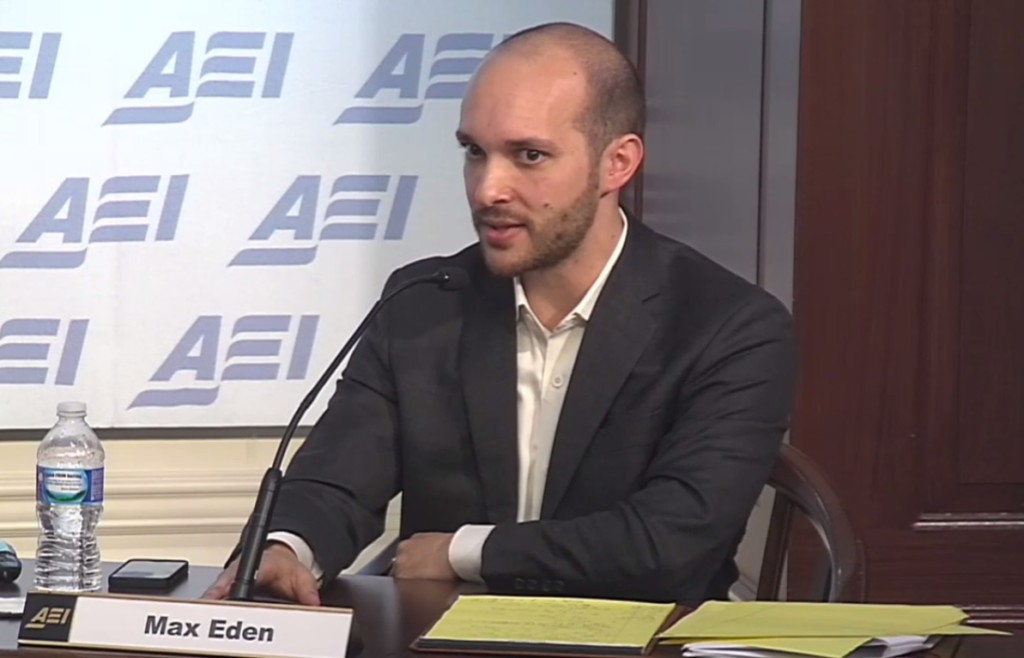
Eden
That's the theory. On Wednesday, during an American Enterprise Institute event that billed ESAs as "the new frontier in school choice," Max Eden of the Manhattan Institute said he wanted to throw some "cold water" on it. The programs might work for some students — like those with special needs — who tend to qualify for larger weighted per-pupil funding, and for whom the benefits of a fully customized education are obvious. But when it comes to their potential to totally transform the broader education system, Eden said he was skeptical.
"There's a sense throughout [the nine papers presented at AEI's event] that this will explode in numbers and in scope, and I'm very skeptical of that," he said. ESAs may be more likely to create "a marginal system that will provide marginal support to relatively marginalized students."
In the end, he said, "The prime benefit of ESAs may help make the world even safer for charters." If more legislatures pushed for them, that might broaden the window of political possibility for educational choice. And ESAs could provide new options for children, like those with special needs, whom charter schools often struggle to serve well. "I don't know that I see [ESAs] being an explosive and revolutionary thing," Eden said.
Matthew Ladner, a senior policy adviser to the Foundation for Excellence in Education who's been a leading proponent of ESAs as a concept, said Eden made some valid points. (more…)
A recent report by the American Enterprise Institute, which we highlighted here, argued burdensome charter school applications were creating needless barriers for new schools.
Critics, including some charter school authorizers, pushed back, saying the report went too far, and that its recommendations would weaken charter school oversight.
Since then, Mike McShane, one of the lead authors of the report, has answered his critics.
Districts and other charter school authorizers might want to know about proposed charter schools' marketing plans, to get a sense of whether it will attract enough students to become financially viable, he writes. But will a charter school's answer to that question really help regulators predict its success?
Much better resourced organizations can’t get market analysis right. Don’t believe me? Well head to your local 7-11 and try to pick up a Crystal Pepsi, a Pepsi Blue, a Sprite Remix, a Dr. Pepper Red Fusion, a Citra, a Vault, a Surge, a 7-Up Gold, or a Coca-Cola Blak. And that is just the market for carbonated soda. If you think a charter board can do better with something as complicated as demand for schooling options, I’ve got some oceanfront land in Missouri to sell you.
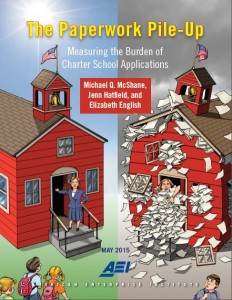
Charter schools were first conceived as a bargain. Teachers (or, in the case of some of Florida's oldest and most successful charters, parents) would receive the freedom to start new schools and experiment with different educational models. In exchange, they would face greater accountability for their academic results.
That bargain is threatened by a "paperwork pileup," a new report by the American Enterprise Institute argues. Charter schools are startup enterprises. The more hoops they have to jump through during the application process, the fewer promising new schools will be launched. Every page added to a charter school application puts those teachers or parents at a greater disadvantage.
In practice, however, the charter bargain has become fairly one-sided. Charter school authorizers often include hundreds of tasks in the application to open a charter school, creating an onerous and lengthy process that risks freezing out potential school operators. To be sure, many application tasks are well within authorizers’ rights to require, but others are unnecessary and unduly burdensome for applicants. This is a real problem for the groups of teachers that Shanker envisioned, who might lack the time or resources to tackle these outsized applications and create new educational options for students.
In short, the report focuses on what has become a timely topic in Florida: How do you set a high bar for prospective charter schools, without creating needless barriers?
(more…)
 A new survey suggests excessive regulation of school choice programs could cause some private schools not to enroll students who use vouchers or tax credit scholarships.
The report released this morning by the American Enterprise Institute is the result of what its authors call "the largest and most in-depth survey of its kind."
The think tank hired a team of University of Arkansas researchers, who polled leaders of hundreds of private schools in Indiana and Louisiana, which have voucher programs, and Florida, which is home to a tax credit scholarship program administered by nonprofits like Step Up For Students, which co-hosts this blog.
Of the three states, leaders in Florida's private schools appear to be least troubled by state regulations, and most likely to participate in its scholarship program.
"It is imperative that policymakers develop the best mechanisms possible to facilitate successful programs," the authors write in their conclusion. "Policies meant to burden private schools, starve them, or regulate them into the public school mold are inconsistent with school choice theory and could ultimately hurt the students these policies are designed to help."
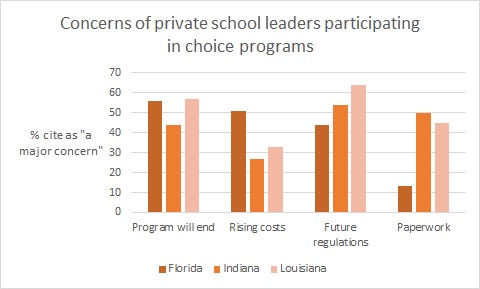
Charts use data from the report, but were produced by redefinED.
More than half the schools accepting Florida's scholarships cited the possibility of the program ending one day as a "major concern." Half were also greatly worried about whether the size of scholarship payments would continue growing to keep up with their increasing costs. The surveys were done last spring, amid a contentious debate over regulation and expansion of the program, but before it was challenged in court.
On the other hand, more than nine in ten schools accepting vouchers in the other two states were at least somewhat concerned about paperwork requirements and the prospect of future regulations. Florida's schools shared those concerns, but not at the same magnitude.

