Florida Gov. Ron DeSantis signed an executive order recently to transition the state away from the current academic standards, which begs the question: What will replace them? I have a suggestion on that front, but first, some basics.
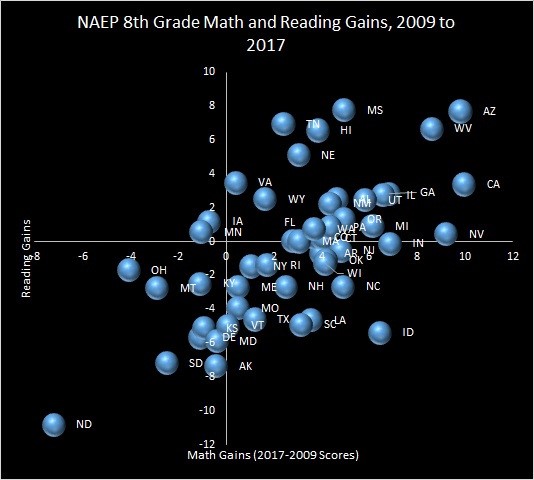
Federal law requires states to have a set of academic standards and to test students against those standards in grades 3-8 and again in high school as a condition of federal funding. About a decade ago, a number of states adopted “Common Core” academic standards and tests, which eventually became quite controversial. As an education reform strategy, both center-right analysts like Erik Hanushek and center-left analysts like Tom Loveless found little prospect for broad improvement in outcomes due to adoption of the standards.
In fact, if we examine eighth-grade trends in scores since 2009, just before many states adopted the standards, to the most recent numbers, the results are decidedly less than meh, although multiple factors always are at play in influencing scores at any given time. While “meh” results square with the Hanushek/Loveless research findings, this does not preclude the possibility of states doing themselves some harm in transitioning to new standards.
Practices eliciting a great deal of controversy for ambiguous benefits don’t tend to endure. The theory of change behind the standards movement seems straightforward: States create (hopefully) an integrated set of academic standards, test students against those standards, make the results transparent to families, and perhaps reward/sanction schools based on them. If in fact it were this straightforward, we would expect to see broad improvement in a variety of academic indicators since the adoption of the strategy in the mid-1990s. But the theory-of-change bucket seems leaky. Meanwhile, much of the public has grown deeply fed up with a culture of test prep in public schools.
Supporters of academic transparency – I include myself in this category – ought to use this opportunity to consider carefully what it is we want from our system of standards and tests, how to minimize unintended consequences, and how to increase the utility of the system to students. Federal law requires states to have them, so why not adopt the best standards that any state has developed?
Massachusetts was a pioneer in the standards movement, creating standards almost a decade before the federal requirement. Massachusetts also adopted several other K-12 reforms simultaneously, so we should exercise caution in concluding that standards and testing led to the state’s improvement. Nevertheless, those standards were widely admired by scholars. Even prominent supporters of the Common Core project judged them superior to the Common Core standards.
Massachusetts has long held the highest scores in all subjects on the National Assessment of Educational Progress. We can’t be certain what they did right, but they seemed to have done something right, and it might be the standards. The reality is that there would be a large amount of overlap in a three-circle Venn diagram between the old Florida standards, the more recent Florida standards, and the old Massachusetts standards. Massachusetts may, however, have succeeded in positively influencing curriculum with its standards, which have been described as “content rich.” Color me skeptical as to whether there is either a Florida, Arizona or even (blasphemy!) Texas way to teach long division, but Massachusetts seemed to do better than others with its old standards, and in fact better than itself after adopting Common Core.
There is no issue of federal nudging or compulsion, real or imagined, at this point. Florida is entirely free to adopt whatever standards it wishes. You won’t find many areas of agreement between me and Diane Ravitch, but I think this qualifies as one: You must have standards, and Massachusetts has developed what appear to be the most useful set. Why settle for less?
My advice, not that you asked for it, is to call up the Bay State and see if anyone there can send over a copy.

Wendy Howard: Higher standards will mean our next generation is better prepared for college or the workforce. That’s good for kids, parents, taxpayers and our country.
Editor’s note: Wendy Howard is executive director of Florida Alliance for Choices in Education, a group that includes a wide range of school choice organizations, including Step Up For Students, which co-hosts this blog. A shorter version of this post ran this week as a letter to the editor in the Tampa Bay Times. Given Wendy’s conservative political bent, her staunch support for school choice and the concerns about Common Core, we thought it worthwhile to share a fuller version.
With attacks on the Common Core State Standards for education coming from both sides of the aisle, what are parents to think?
I’ve heard Common Core is Obama’s agenda to indoctrinate our children. I’ve heard it’s an unconstitutional federal takeover. I’ve even heard it’s a scheme to perform experiments nationwide on our next generation. After doing some research, I learned none of those concerns hold water. The bickering continues, however, while our children suffer the consequences.
The fact is, our kids need higher standards for education. Let’s look at a couple of disconcerting facts from the perspective of a parent with two children attending a public charter school.
Forty percent of Florida’s class of 2013 who took the ACT college entrance exam were graded “not college ready” in any subject, which is higher than the national average of 31 percent. As a parent, this has huge financial implications. If my children are part of these statistics, I will have to pay for remedial classes in college, something I simply cannot afford. As a taxpayer, I expect my child’s diploma to mean she actually succeeded in high school and can move right into college courses. As a nation, millions of kids and their parents are impacted each year when that turns out not to be the case.
Higher standards will mean our next generation is better prepared for college or the workforce. That’s good for kids, parents, taxpayers and our country.
Here’s another troubling statistic: Thirty percent of high school graduates can’t pass the U.S. military entrance exam, which is only focused on basic reading and math skills. At what point does the lack of high standards become a national security issue? If the learning gap between the U.S. and other countries continues to rise, which country becomes the next super power? What does our country look like in 20, 40, 60 years? I guess that depends on whether we look at the achievement gap between the U.S. and other countries as a crisis – or another issue we kick down the road. (more…)

